
Beyond the Headlines: Why the UAE’s Endorsement of India Signals a New Order in West Asia
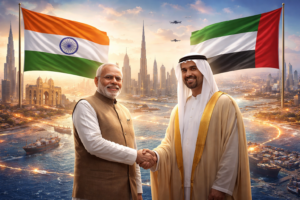
In a significant geopolitical development, the UAE Ambassador to India has affirmed that New Delhi’s diplomatic voice carries substantial weight in West Asia, asserting that Tehran “cannot afford to ignore” India’s position amid escalating regional tensions following strikes on Iran. The endorsement transcends mere diplomatic courtesy, reflecting India’s evolution from a passive oil importer and labor exporter to a strategic stakeholder with unique credibility among all regional players. Ambassador Alshaali’s implicit critique of the international community’s inaction, coupled with his emphasis on evaluating actions over statements, underscores a growing vacuum in traditional security guarantees that India—with its economic heft, balancing act between Israel and Iran, and human-centric approach prioritizing stability for millions of expatriates—is increasingly positioned to fill, signaling a new multipolar order where Global South voices like India’s are indispensable for de-escalation and peace.
Beyond the Headlines: Why the UAE’s Endorsement of India Signals a New Order in West Asia
The news clip is brief, but its implications are seismic. On March 10, 2026, Abdulnasser Jamal Alshaali, the Ambassador of the United Arab Emirates to India, delivered a message that transcended routine diplomatic courtesy. He didn’t just thank India for its concern regarding the ongoing tensions with Iran; he explicitly stated that Tehran “cannot afford to ignore” New Delhi’s position. He asserted that India’s voice “carries considerable influence” in a region often defined by the heavy footsteps of the United States, Russia, and China.
To the casual observer, this might seem like a simple gesture of goodwill. But to those who track the tectonic shifts in global geopolitics, it is a profound validation of a new world order—one where the Global South is not just finding its voice, but is learning to project its power. This is the story of how a centuries-old trade relationship evolved into a strategic necessity, and why the UAE is publicly betting on India as the premier peace broker in a volatile West Asia.
The Context: A Region on the Edge
To understand the weight of the Ambassador’s words, one must first look at the landscape of West Asia in March 2026. The region is, once again, holding its breath. The “Tehran Strikes” mentioned in the report are not an isolated incident but the latest flashpoint in a long, shadowy war.
For months, tensions have been simmering. A series of unexplained explosions at critical infrastructure facilities, the sabotage of shipping lanes in the Strait of Hormuz, and the escalating rhetoric between Iran and a coalition of Western and Gulf states have pushed the region to the brink. The strikes referenced by Ambassador Alshaali represent a significant escalation—a kinetic military action that has shattered the fragile calm.
For the UAE, this is personal. The Emirates has spent the better part of a decade transforming itself from an oil-dependent nation into a global hub for commerce, tourism, and logistics. It is a glittering skyscraper of globalization built on the foundation of stability. Every missile fired, every ship detained, and every war drum beaten is a direct threat to its national project. The UAE’s foreign policy is, therefore, obsessed with one thing: de-escalation and economic security.
Why India’s Voice Matters: Beyond Symbolism
When Ambassador Alshaali says India’s voice “carries weight,” he is not being polite. He is being pragmatic. In the traditional power dynamics of West Asia, India was often a consumer of security—a large importer of oil and a remittance-dependent nation whose primary concern was the safety of its 9 million citizens living and working in the Gulf.
That narrative has changed. Today, India matters for three distinct reasons:
- The Economic Heavyweight:India is now the world’s fifth-largest economy and is on track to become the third-largest. It is the UAE’s second-largest trading partner, and the two nations are linked by the Comprehensive Economic Partnership Agreement (CEPA), which aims to push bilateral trade to over $100 billion. More importantly, India is the lifeblood of the UAE’s economy. The millions of Indian professionals—from the engineers building Dubai’s skyline to the financiers in the DIFC—are not just workers; they are stakeholders. Any conflict that destabilizes the Gulf directly impacts India’s energy security and its economic growth, making New Delhi a deeply interested party.
- The Strategic Pivot (I2U2 and Beyond):India has moved from being a bystander to a player. The formation of the I2U2 grouping (India, Israel, UAE, USA) is a testament to this new, multi-lateral approach. This quadrilateral has quietly been working on everything from food security to space collaboration. It positions India as a crucial link between the technological prowess of the West and the developmental needs of the Gulf. Furthermore, the India-Middle East-Europe Economic Corridor (IMEC), announced at the G20 Summit, is a direct competitor to China’s Belt and Road Initiative. It envisions a rail and shipping link connecting India to Europe via the UAE, Saudi Arabia, Jordan, and Israel. For this dream to become reality, the region must be at peace. India now has a direct, tangible stake in the stability of the corridor.
- The “Trusted Voice” Paradox:This is perhaps the most significant factor. In a region rife with historical mistrust, India occupies a unique space. It has maintained a delicate balancing act for decades. It is one of the few countries that enjoys strategic partnerships with Israel, while simultaneously maintaining warm relations with Iran and the Arab world.
- It buys oil from Tehran and has worked with Iran to develop the Chabahar Port, a gateway to Central Asia bypassing Pakistan.
- It buys advanced weaponry and technology from Israel and is a vocal supporter of the Jewish state.
- It has a “Special Relationship” with the UAE and Saudi Arabia, anchored by defense cooperation and intelligence sharing.
This “de-hyphenation” of its foreign policy means that when New Delhi speaks, all sides listen, because they know India is not an extension of Washington’s foreign policy. It has its own interests, and its primary interest is peace.
The Ambassador’s Critique: “Actions Speak Louder”
Alshaali’s comments were not just a compliment to India; they were a thinly veiled critique of the international community’s failure, and a specific jab at the status quo. His statement that the UAE “evaluates actions rather than statements” is a direct message to the West and the United Nations Security Council (UNSC).
He is pointing out the hypocrisy of diplomatic condemnation without tangible consequences. For years, the Gulf states have felt caught in the crossfire of the US-Iran rivalry. They have watched as the US has sought to re-engage with Iran diplomatically, while simultaneously struggling to provide the security guarantees its Gulf allies demand.
By calling on the UNSC to “condemn the attacks,” the UAE is publicly acknowledging that the current mechanisms for maintaining global peace are failing. The UNSC, paralyzed by veto powers and geopolitical rivalries (most notably between the US, Russia, and China over Ukraine and other issues), has been unable to act decisively.
In this vacuum, regional powers are forced to look for new guarantors of stability. India, with its growing military presence in the region (including its anti-piracy missions and naval deployments in the Persian Gulf) and its neutral-but-vested stance, becomes an attractive alternative or, at the very least, a vital complementary force.
Modi’s Call for De-escalation: A Blueprint for the Global South
The report highlights Prime Minister Narendra Modi’s call for “immediate de-escalation.” This is not just a standard diplomatic talking point. It reflects a core tenet of Indian strategic culture—the belief that dialogue and diplomacy must always trump conflict.
For Prime Minister Modi, who has personally invested in deepening ties with every leader in the region (from the Crown Princes of the Gulf to the Presidents of Israel and Iran), the current crisis is a personal and political setback. He has positioned India as a Vishwa Bandhu (Friend of the World), a nation that bridges divides rather than creating them.
The Indian approach offers something different from the Western “ally/enemy” paradigm. India proposes:
- Economic Interdependence: Making war too expensive to consider.
- Human-Centric Security: Prioritizing the safety of expatriate workers and the flow of trade.
- Respect for Sovereignty: A consistent call for adherence to international law, without taking sides in sectarian conflicts.
When Modi speaks, he speaks for a massive population in the Global South that suffers the most when oil prices spike and supply chains are disrupted. His voice, as the UAE Ambassador notes, carries weight because it is backed by the demographic and economic reality of 1.4 billion people.
The Human Element: The Invisible Stakeholders
Beyond the geopolitics of missiles and memorandums, there is a human story that often gets lost. The “stability” the Ambassador speaks of is not just a political condition; it is the air that millions of families breathe.
Consider the Indian nurse in a hospital in Sharjah, whose ability to send money home to Kerala depends on the UAE Dirham remaining strong and her job remaining secure. Consider the Emirati businessman who has invested millions in a logistics venture designed to move goods from Mumbai to Milan via the new economic corridor. Consider the Iranian student studying in Dubai, caught between the nationalism of his homeland and the opportunities of his host country.
When the Ambassador says Tehran cannot ignore India, it is because India represents the hopes of these people. An Indian-brokered de-escalation is not about grand strategy; it is about ensuring that the planes keep flying, the ships keep sailing, and the salaries keep coming.
Conclusion: A New Kind of Power
The UAE Ambassador’s statement is a milestone. It is a formal recognition that the unipolar moment is over, and the bipolar Cold War structure is not returning. The future is multi-polar, and in that future, influence is not just measured by aircraft carriers, but by economic heft, diaspora connections, and diplomatic credibility.
India is being called upon to move from the periphery to the center of West Asian security. It is being asked to use its “weight” not to crush one side or the other, but to hold the scales steady. As the strikes on Tehran threaten to spiral into a wider war, all eyes are now on New Delhi.
The question is no longer if India has a role in West Asia, but whether it can translate its considerable influence into a durable peace. The UAE has made its bet. The world is now watching to see if India can cash that check.
You must be logged in to post a comment.