
Beyond the Headlines: Why the India-Germany Pivot is a Strategic Game-Changer
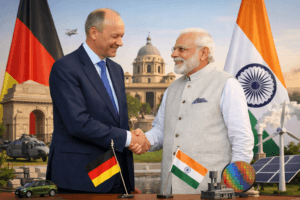
The recent visit of German Chancellor Friedrich Merz to India, resulting in 19 key agreements, marks a strategic pivot in bilateral relations, driven by shared imperatives to diversify supply chains and enhance strategic autonomy amid global shifts. The cornerstone is a defence industrial cooperation pact, shifting the relationship from buyer-seller to co-innovation and co-production, while collaborative frameworks in semiconductors and critical minerals aim to build resilient, China-alternative tech supply chains. Germany’s additional €1.24 billion commitment to green projects, including a concrete green ammonia offtake agreement, accelerates India’s energy transition with both investment and market guarantees. Underpinned by a new Indo-Pacific dialogue and eased mobility measures, this enhanced partnership transcends transactional trade, representing a deeper alignment between two major democracies to jointly foster a multipolar world order based on technological sovereignty, sustainable infrastructure, and democratic resilience.
Beyond the Headlines: Why the India-Germany Pivot is a Strategic Game-Changer
The recent two-day visit of German Chancellor Friedrich Merz to India, culminating in 19 key agreements, is far more than a routine diplomatic exchange. It represents a profound and calculated alignment between two major democracies at a time of global tectonic shifts. While the sectors covered—defence, technology, energy—are headline-grabbing, the real story lies in the strategic intent driving this partnership. This is not merely about trade; it’s about building a resilient, multi-polar framework for a new world order.
The Strategic Backdrop: A Convergence of Necessities
To understand the weight of these agreements, one must look at the converging pressures on both nations. Germany, in the wake of the “Zeitenwende” (turning point) announced after Russia’s invasion of Ukraine, is urgently diversifying its economic and security partnerships away from over-dependence on any single region. India, steadfastly pursuing its “Atmanirbhar Bharat” (Self-Reliant India) vision, seeks cutting-edge technology, sustainable investment, and reliable defence partners to secure its rise amidst an increasingly assertive China and regional instability.
This visit marks a decisive move from dialogue to deliverables, transforming a historically cautious relationship into a proactive strategic alliance.
Decoding the Key Pillars of Cooperation
- Defence& Security: The Cornerstone of Trust
The Joint Declaration of Intent on Defence Industrial Cooperation is arguably the most significant outcome. For decades, India’s defence imports from Germany have been substantial, but largely transactional. This agreement shifts the paradigm to “co-innovation and co-production,” as highlighted by Prime Minister Modi.
- What it means: Germany, a leader in high-end engineering (submarines, propulsion systems, defence electronics), is now willing to share technology and manufacturing with India. This directly supports India’s domestic defence manufacturing goals and reduces its import burden.
- The Bigger Picture: It signals Germany’s comfort with India’s strategic autonomy and its role as a security provider in the Indo-Pacific. The establishment of a dedicated bilateral dialogue on the Indo-Pacific further cements this, aligning both nations’ vision for a free, open, and rules-based region. The new Track 1.5 Foreign Policy and Security Dialogue will foster deeper understanding between policymakers, think tanks, and scholars, building a long-term strategic consensus.
- Technology & Critical Minerals: Securing the Future Supply Chain
The agreements on semiconductors, critical minerals, and telecommunications are a direct response to global supply chain vulnerabilities exposed by recent geopolitical events.
- Semiconductor Ecosystem Partnership: While the details are nascent, this pairs India’s ambitious chip manufacturing incentive scheme (ISMC) with German expertise in industrial automation, chemical engineering (for specialty gases), and advanced R&D. This could help India move beyond chip design and assembly into more complex areas of the value chain.
- Critical Minerals Collaboration: As the world races to secure lithium, cobalt, and rare earths essential for EVs and renewables, this partnership is crucial. Germany gains a potential partner in responsible sourcing and processing, while India accesses German technology for mineral extraction and recycling, enhancing its own domestic capabilities.
- Telecommunications: In the shadow of global debates over 5G/6G network security, this collaboration likely focuses on developing open, interoperable, and trusted network solutions, reducing dependence on single vendors.
- The Green Engine: Energy Transition & Sustainable Investment
The 1.24 billion euro top-up to the Green and Sustainable Development Partnership (GSDP), bringing the total commitment to over 11 billion euros, is a massive vote of confidence in India’s green transition.
- From Pledges to Projects: The offtake agreement between AM Green and Germany’s Uniper for green ammonia is a concrete market-making deal. It guarantees a buyer for India’s future green hydrogen derivatives, de-risking investment in production facilities.
- Focus on Implementation: The MoU between Indian and German energy regulatory bodies and the new National Centre of Excellence for Skilling in Renewable Energy in Hyderabad show a focus on the unglamorous but vital “plumbing” of the energy transition: standards, certification, and a skilled workforce.
- Battery Storage Working Group: This addresses the Achilles’ heel of renewables—intermittency. Collaborative R&D here can lower costs and accelerate India’s grid integration of solar and wind power.
- The Human Bridge: Mobility, Education, and Ease of Living
The visa-free transit for Indian passport holders through Germany, though seemingly minor, is a psychologically impactful gesture that eases travel and strengthens people-to-people ties. The Higher Education Roadmap and skilling initiatives aim to create a continuous pipeline of talent, ensuring that strategic partnerships are underpinned by human capital and mutual understanding.
The Unspoken Driver: The China Calculus
While diplomatically unstated, managing relations with and dependencies on China is a subtext for both countries. For Germany, China remains a major market but also a systemic rival. For India, China is a direct security challenger. Their cooperation in diversifying supply chains (critical minerals, semiconductors), building alternative infrastructure (green energy), and enhancing security dialogue offers both nations strategic optionality and reduced vulnerability.
Challenges and the Road Ahead
The momentum is clear, but success hinges on execution. Bureaucratic hurdles, differences in procurement processes (especially in defence), and intellectual property sharing frameworks will need careful navigation. The newly established CEO Forum will be critical in translating government intent into commercially viable, large-scale projects.
Conclusion: A Partnership of Scale and Purpose
The India-Germany agreements of 2026 move the relationship from one of “potential” to one of “project implementation.” This is a partnership based on complementary strengths: Germany’s technological depth and India’s scale, innovation talent, and strategic geography.
In a world fragmenting into competing blocs, the deepening bond between the world’s largest democracy and Europe’s economic powerhouse is a significant development. It represents a coalition not against any one country, but for the principles of democratic resilience, technological sovereignty, and sustainable development. The visit wasn’t just about inking deals; it was about two civilizational states drafting a shared blueprint for navigating an uncertain century. The real work begins now, but the foundation has never been stronger.
You must be logged in to post a comment.