
Beyond the Headlines: Why Siemens Energy and Polycab Are Poised for Outperformance This Week
Amidst the geopolitical uncertainty stemming from the escalating Iran-Israel conflict, Motilal Oswal Financial Services has identified Siemens Energy and Polycab as its top stock picks for the week, recommending them not as short-term trades but as leveraged plays on profound, multi-year infrastructural shifts. Siemens Energy (target ₹3,600) is positioned to capitalize on the global grid modernization and energy transition, with a massive 38% order backlog growth and strategic capacity expansion insulating it from weekly volatility. Simultaneously, Polycab (target ₹9,600) remains a direct beneficiary of India’s robust domestic demand, leveraging its deep distribution network and pricing power to navigate commodity cycles while steadily gaining market share in cables and wires. Together, these recommendations form a barbell strategy that balances global energy resilience with domestic consumption, urging investors to look beyond short-term market noise and focus on the long-term, non-discretionary capital expenditure cycles driving these companies.
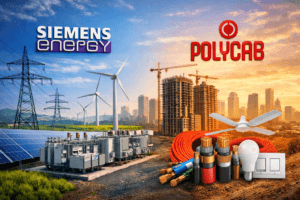
Beyond the Headlines: Why Siemens Energy and Polycab Are Poised for Outperformance This Week
As global markets open on March 2, 2026, investors are bracing for a week laden with geopolitical tension. The escalating conflict between Israel and Iran, with strikes reverberating as far as the Gulf states, has injected a fresh wave of volatility into crude oil prices and risk-off sentiment. In such times, the cacophony of market noise can drown out the sound of solid, long-term fundamentals.
Yet, it is precisely during these periods of uncertainty that the most compelling investment opportunities are forged. While the headlines scream of missiles over Dubai and Doha, a different kind of power surge is quietly building—one rooted in multi-decade infrastructural shifts.
Motilal Oswal Financial Services has released its top stock recommendations for the week, spotlighting Siemens Energy and Polycab India. At first glance, these might seem like two disparate entities—one a global energy technology giant, the other a dominant Indian wires and cables manufacturer. However, a deeper dive reveals a shared narrative: they are both leveraged plays on profound, non-discretionary capital expenditure cycles that transcend short-term geopolitical flare-ups.
This isn’t just a rehash of a broker’s note. This is an exploration of why these recommendations carry weight, the specific catalysts driving their growth, and what investors should really be watching this week.
The Macro Crosscurrents: Navigating Geopolitics and Secular Trends
Before dissecting the stocks, it’s crucial to acknowledge the elephant in the room: the Iran-Israel conflict. The immediate market reaction is often a flight to safety and a spike in oil prices. For Indian markets, which are net importers of energy, this is a traditional headwind. It can pressure margins, influence central bank policy, and create short-term earnings uncertainty.
However, astute investors know that not all sectors are affected equally. The recommendations of Siemens Energy and Polycab are, in a way, a bet on the resilience of domestic and “green” infrastructure.
- Energy Independence vs. Energy Security: While oil price hikes hurt the overall economy, they simultaneously accelerate the global push for energy independence and renewable sources. Every spike in fossil fuel prices makes the economic case for solar, wind, and grid modernization stronger. This is the primary tailwind for Siemens Energy.
- Domestic Demand Resilience: Polycab’s fortunes are tied more intimately to the Indian consumption story—real estate, industrial capex, and government-led infrastructure spending—than to global oil prices. While input costs (like copper and aluminium) are commodities influenced globally, the underlying demand for wires and cables in India remains remarkably robust, driven by urbanization and a structural housing upcycle.
Thus, while the geopolitical situation demands vigilance, it does not invalidate the powerful bottom-up stories of these two companies. It merely requires a longer-term lens.
Siemens Energy (CMP: ₹2,897, TP: ₹3,600): The Linchpin of the Energy Transition
Motilal Oswal’s revised target price of ₹3,600 implies a 24% upside from the current market price (CMP). This confidence isn’t misplaced; it is built on a foundation of visible, tangible trends that are often obscured by the complexity of global energy markets.
- The Great Grid Revival
For decades, the world’s power grids have been underinvested and overburdened. Today, they are the critical bottleneck in the energy transition. You cannot connect a solar farm in Rajasthan or an offshore wind farm in the North Sea to the consumer without a robust transmission network.
Siemens Energy is at the absolute epicenter of this “Grid Capex Cycle.” The company is not just a participant; it is a market leader in high-voltage direct current (HVDC) technology, which is essential for transmitting renewable energy over long distances with minimal loss. The 38% year-on-year (YoY) growth in their order backlog isn’t just a number; it’s a testament to a multi-year visibility that most industrial companies can only dream of.
The Human Insight: Think of the grid as the world’s largest machine. For the last 20 years, we’ve been running it without proper maintenance while adding more load (data centers, electric vehicles, heat pumps). Now, we are in a forced, global “catch-up” maintenance and upgrade phase. Siemens Energy is selling picks and shovels in this gold rush.
- The Transformer Capacity Constraint
The report highlights a planned capacity expansion to 60,000 MVA (Mega Volt-Ampere). To the layperson, this might seem like a minor operational detail. In reality, it is a massive strategic signal. Transformers are the unsung heroes of the grid, and the world is currently facing a severe transformer shortage. Lead times have stretched from months to years.
By aggressively expanding capacity, Siemens Energy is not just preparing for demand; it is positioning itself to capture market share from competitors who are unable to scale. This expansion, coupled with strong export opportunities, particularly from markets in the Middle East and Europe that are scrambling to secure supply chains, provides a powerful double-engine for growth.
- The “Hidden” Profitability Drivers
While a 26% revenue growth is impressive, the real story is in the profitability. The 200 basis point expansion in EBITDA margin to 24.1% suggests operating leverage is kicking in. The note mentions “lower other expenses,” which in the context of an industrial giant often points to better project execution, stabilized supply chains, and operational efficiencies.
Furthermore, the 57% PAT (Profit After Tax) growth, fueled by higher other income and a lower tax rate, highlights the power of financial leverage in a high-growth phase. For investors, this means that as the order book converts to revenue, the bottom line is expanding at a much faster clip—a hallmark of a high-quality compounder.
The Verdict for the Week: With a strong order book acting as a buffer, Siemens Energy is less susceptible to weekly market whims. Any dip caused by geopolitical jitters this week could be viewed by long-term investors as a buying opportunity. The revised target of ₹3,600, based on 55x March 2028 EPS, reflects a premium valuation, but it is a premium earned by visibility and criticality.
Polycab India (CMP: ₹8,469, TP: ₹9,600): The Wires of a Nation’s Growth
Polycab, often dubbed “the investor’s favorite compounder,” presents a different but equally compelling thesis. At a 13% implied upside, the target might seem modest compared to Siemens Energy. However, for a large-cap stock of Polycab’s stature, this represents a steady, reliable climb—the kind that builds wealth over time.
- The “Project Spring” Multiplier
Motilal Oswal mentions “Project Spring,” an internal initiative aimed at growing at 1.5 times the industry rate. This is crucial. In a sector that can often become commoditized, Polycab has managed to consistently gain market share. How?
- Distribution Depth: Polycab’s products are not just available in metros; they are omnipresent in Tier-2, Tier-3 cities, and beyond. This deep distribution network creates a formidable moat.
- The Brand Pull: In a market where electricals can be a trust-based purchase (safety from fire and short circuits is paramount), Polycab has successfully built a brand that signifies quality. The “Polycab Hai” jingle isn’t just an earworm; it’s a trust signal for electricians and homeowners alike.
- Navigating Commodity Volatility
The recent quarter saw temporary margin pressure due to commodity inflation and high channel inventory. This is the reality of a business dealing with copper and aluminium. However, the note correctly points out that this has reversed.
The Human Insight: Watching Polycab navigate raw material cycles is like watching a skilled sailor tack against the wind. They don’t fight the wind (commodity prices); they use it. With inventory normalizing and full cost-pass through implemented, they have restored their pricing power. This ability to pass on costs to consumers without losing demand is the ultimate proof of a strong brand and market leadership.
- The FMEG (Fast-Moving Electrical Goods) Gamble
While cables and wires are the cash cow, the future growth vector is FMEG—fans, lights, switches, and appliances. This segment is fiercely competitive, with organized players like Havells and unorganized local players.
Polycab’s strategy here is to leverage its existing distribution to push these new products. The payoff is significant: FMEG offers higher margins and higher frequency of purchase than industrial cables. The report’s expectation of an 18% PAT CAGR is predicated on this “premiumization” and “operating leverage” kicking in. If they succeed in FMEG, the valuation multiple could expand even further.
The Verdict for the Week: Polycab is a direct play on the Indian real estate and infrastructure story. With the government’s continued focus on infrastructure and a private sector capex cycle showing green shoots, the demand trajectory is solid. For investors, Polycab offers a blend of defensive stability (wires are essential) and offensive growth (FMEG and market share gains). At ₹8,469, it’s a high-conviction hold for the long term.
Actionable Insights for the Week Starting March 2, 2026
- Ignore the Noise, Focus on the Signal: The Iran-Israel conflict will dominate headlines. For holders of Siemens Energy and Polycab, the signal is the order book and the distribution network, not the price of Brent crude. Unless the conflict escalates into a full-blown regional war that disrupts oil supplies for months, the fundamental thesis for both companies remains intact.
- Consider a “Barbell” Approach: These two recommendations form a perfect barbell strategy.
- Siemens Energy is the aggressive, high-growth, global infrastructure play with a slightly higher risk profile (tied to global policy and execution).
- Polycab is the steady, domestic compounding machine with a proven track record. Together, they balance global ambition with domestic resilience.
- Entry Points: Given the geopolitical uncertainty, markets may open volatile. A disciplined investor might look for small dips to initiate or add to positions, rather than chasing a gap-up opening. The target prices provided by Motilal Oswal are for a 12-18 month horizon, offering a cushion against weekly volatility.
In conclusion, while the world watches the skies over the Gulf with bated breath, the smart money is looking at the ground beneath our feet—the cables, the transformers, and the grids that will power the future. Siemens Energy and Polycab are not just stock recommendations; they are proxies for a world that is rebuilding, electrifying, and connecting, one wire and one transformer at a time.
You must be logged in to post a comment.