
Beyond the Headlines: Why Palestine’s Foreign Minister Says Peace with Israel Remains Impossible
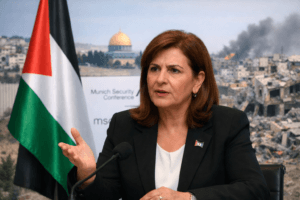
In an interview at the Munich Security Conference, Palestinian Foreign Minister Varsen Aghabekian Shaheen declared that peace with Israel is impossible under current conditions of ongoing Palestinian rights violations, citing illegal settlement expansions, annexation efforts, and the failure to fully implement ceasefire obligations in Gaza as key obstacles. Shaheen emphasized that unilateral Israeli actions in occupied territories violate international law and undermine any negotiated solution, while calling on the international community to move beyond rhetoric and enforce existing legal frameworks, including ICJ rulings and UN resolutions. She also urged Germany and Finland to join other European nations in recognizing Palestine as a logical step for those committed to the two-state solution, and highlighted Turkey’s significant role in humanitarian assistance and regional peace efforts.
Beyond the Headlines: Why Palestine’s Foreign Minister Says Peace with Israel Remains Impossible
A Conversation That Reveals the Deepening Fault Lines in Middle East Diplomacy
The statement landed with the weight of decades of disappointment. When Palestinian Foreign Minister Varsen Aghabekian Shaheen told Anadolu Agency on Sunday that peace with Israel is “not possible” under current conditions, she wasn’t merely issuing another diplomatic talking point. She was giving voice to a sentiment that has quietly taken root across Palestinian society and leadership—a growing conviction that the two-state solution, long the cornerstone of international diplomacy, may be slipping irretrievably away.
Speaking from the Munich Security Conference, one of the world’s premier forums for debating international policy, Shaheen’s words carried particular weight. Here, amid the careful choreography of global diplomacy, she chose to speak with unusual directness about what Palestinians experience daily: a reality where international law is routinely violated, where settlements expand relentlessly, and where the basic architecture of peace seems to be crumbling before their eyes.
The Meaning of Peace When Rights Are Denied
“What does peace mean to a family in Hebron whose children must pass through military checkpoints to reach school?” Shaheen might have asked, though her formal remarks focused on the legal and political framework. “What does negotiation mean to a farmer in the Jordan Valley watching his land being declared ‘state property’ after fifty years of cultivation?”
These are the unspoken questions behind Sunday’s declaration. When Shaheen argues that peace is impossible under “constant violation of Palestinian rights,” she points to a fundamental truth that diplomatic language often obscures: peace isn’t merely the absence of armed conflict. It requires a baseline of dignity, security, and hope.
The past year has offered Palestinians little of any of these. Since October 2023, Gaza has endured a military campaign that has reduced entire neighborhoods to rubble, claimed tens of thousands of lives, and created a humanitarian catastrophe that international agencies struggle to address. In the West Bank, settlement expansion has accelerated, with the Israeli government recently approving a proposal to register West Bank lands as “state property”—the first such move since 1967.
The Settlement Question: More Than Real Estate
Shaheen’s condemnation of Israeli settlements as “null and void” rests on solid legal ground. The International Court of Justice has repeatedly affirmed that settlements in occupied territory violate the Fourth Geneva Convention. UN Security Council Resolution 2334, passed in 2016 with rare American abstention, explicitly states that settlements have “no legal validity” and constitute a “flagrant violation under international law.”
But for Palestinians, settlements are not abstract legal questions. They represent the daily fragmentation of their hoped-for state. The West Bank today resembles a archipelago of Palestinian population centers surrounded by expanding Israeli settlements, connected by a network of roads largely inaccessible to Palestinians, and punctured by military checkpoints that turn a journey of thirty kilometers into an hours-long ordeal.
When Shaheen speaks of “unilateral actions” undermining peace prospects, she refers to this physical transformation of the landscape. Each new settlement outpost, each land registration, each demolition of a Palestinian home—documented routinely by UN agencies and human rights organizations—makes the two-state solution geographically more difficult. At what point, Palestinians increasingly ask, does the physical impossibility of a viable, contiguous Palestinian state render the entire peace framework obsolete?
Gaza: The Ceasefire That Isn’t
On Gaza, Shaheen offered a sobering assessment of the current situation. “We still see that we don’t have a complete ceasefire,” she said. “We have a partial ceasefire.”
This distinction matters enormously for the roughly two million Palestinians living in the strip. A “partial ceasefire” means that while major military operations may have paused, the conditions for normal life remain absent. The Rafah crossing, Gaza’s vital link to Egypt and the outside world, operates only sporadically. Humanitarian assistance enters at a fraction of what humanitarian agencies estimate is needed. Reconstruction, which should form the heart of any durable peace, has barely begun.
The ceasefire agreement’s phased approach—hostage and prisoner exchanges in phase one, reconstruction in phase two—requires trust that neither party currently possesses. Israel demands guarantees that hostages will be returned; Palestinians demand guarantees that Israeli military operations will not resume once hostages are freed. In this atmosphere of profound mutual suspicion, every provision becomes contested, every deadline uncertain.
Shaheen’s insistence that “phase one obligations are undertaken” before moving to phase two reflects a Palestinian concern born of bitter experience: that commitments made to Palestinians are frequently deferred, diluted, or simply abandoned once international attention shifts elsewhere.
The International Law Deficit
Perhaps the most striking element of Shaheen’s remarks was her direct appeal to the international community. “What we would like is for the world to stand up and say, ‘Look, enough is enough. International law is very clear.'”
This plea reveals a deepening Palestinian frustration with the gap between legal principle and political practice. International institutions have spoken clearly. The ICJ has issued rulings. The UN Security Council has passed resolutions. Human rights organizations have documented violations in exhaustive detail. Yet on the ground, little changes.
The contrast with other international conflicts is instructive. When Russia invaded Ukraine, Western nations mobilized unprecedented sanctions, military aid, and diplomatic isolation. When the ICJ issued a ruling related to the conflict, it was treated as binding. Yet in the Israeli-Palestinian context, similar legal findings produce endless discussion but limited action.
Palestinians notice this discrepancy. They note that UN resolutions on settlements remain unimplemented decades after passage. They observe that countries quick to condemn territorial annexation elsewhere maintain normal diplomatic and economic relations with Israel while it builds in the West Bank. They hear declarations of commitment to the two-state solution from the same governments that resist recognizing Palestine as a state.
The Recognition Question
Which brings us to Shaheen’s pointed comments on diplomatic recognition. Her message to Germany and Finland—countries yet to recognize Palestine—was carefully calibrated but unmistakable: “If you are a two-stater, if you believe in international law, if you want to comply with international law, you need to recognize, because there is no justification whatsoever for not recognizing.”
This argument carries logical force. If the two-state solution remains the internationally endorsed framework for resolving the conflict, and if a Palestinian state is therefore the intended outcome of that process, at what point does withholding recognition become merely delaying the inevitable? Several European countries—Sweden, Ireland, Spain, Norway—have moved toward recognition in recent years, arguing that it strengthens moderate Palestinians and signals that the two-state solution remains viable.
Yet others hold back, maintaining that recognition should come only through negotiated agreement with Israel. Shaheen’s comments challenge this position directly, suggesting that continued non-recognition in the face of settlement expansion amounts to complicity in foreclosing the two-state solution entirely.
Turkey’s Role: A Regional Perspective
Shaheen’s acknowledgment of Turkey as “an important player” in Palestinian diplomacy reflects the shifting regional landscape. While traditional peace brokers like the United States remain central, their perceived bias has opened space for other actors. Turkey’s humanitarian assistance, development programs, and diplomatic engagement offer Palestinians alternative channels of support.
“We expect that Turkey, as a key player in the region, to continue this role towards peace,” Shaheen said. This expectation carries both practical and symbolic weight. Practically, Turkish assistance helps address urgent needs that might otherwise go unmet. Symbolically, it demonstrates that Palestinians have options beyond waiting indefinitely for Western-led diplomacy to deliver results.
The Human Cost of Diplomatic Deadlock
Behind every diplomatic statement, every legal argument, every reference to resolutions and frameworks, stand human beings whose lives hang in the balance. In Gaza, families shelter in damaged buildings, uncertain whether the next shell will fall. In the West Bank, communities watch bulldozers approach, knowing that international protests will likely come too late. In East Jerusalem, Palestinians navigate a permit system that treats their presence in their own city as provisional.
These realities rarely feature in security conferences and diplomatic communiques. Yet they are the reason Shaheen spoke so bluntly in Munich. When she says peace is impossible under current conditions, she speaks for millions who have watched peace recede year after year, who have seen negotiations produce little but more settlements, who have heard endless expressions of international concern while their daily lives grow harder.
What Would Make Peace Possible?
Shaheen’s statement, for all its frankness, left implicit what might change the equation. What would make peace possible again? The answer lies in the conditions she identified as currently lacking: respect for international law, cessation of unilateral actions, genuine implementation of agreements, recognition of Palestinian rights.
None of these are new demands. They echo every peace proposal, every UN resolution, every diplomatic initiative of the past half-century. That they remain unmet after so many years explains much about Palestinian frustration.
But Shaheen’s remarks also hinted at what might break the impasse: concerted international action. “Enough is enough,” she urged the world to say. Not more statements, not more resolutions, not more expressions of concern—but a collective decision to treat violations of international law as having consequences.
The Path Forward
As the Munich Security Conference continues its deliberations, as diplomats shuttle between capitals, as ceasefire negotiations proceed haltingly, one question hovers over everything: Is there still a path to peace, or has the window closed?
Shaheen’s answer, carefully phrased but unmistakable, is that the path exists but requires the international community to finally walk it. Peace is not impossible in principle—only under the current conditions of Palestinian rights being constantly violated. Change those conditions, and peace becomes conceivable again.
The challenge facing diplomats, activists, and ordinary citizens on all sides is whether they can summon the will to create those changed conditions. International law provides the framework. UN resolutions provide the mandate. Human rights organizations provide the documentation. What has been missing is the political will to translate these into reality.
Shaheen’s message to the world, delivered from one of its most prominent diplomatic stages, was simple: The tools for peace exist. The question is whether they will finally be used.
You must be logged in to post a comment.