
Beyond the Headlines: Why an Edmonton Police Chief’s Trip to Israel Has Become a Flashpoint for Distrust
The controversy surrounding Edmonton Police Chief Warren Driechel’s trip to Israel highlights a deep community divide, where Jewish groups commend the visit as a vital opportunity to learn counter-terrorism tactics amid rising antisemitism, while Palestinian and Muslim communities condemn it as a profound betrayal, viewing it as an endorsement of a military apparatus linked to suffering in Gaza. The Edmonton Police Service defends the trip as a standard professional exchange focused on threat preparedness, but critics argue the timing and symbolism have severely damaged trust, forcing the city to confront whether a police chief can learn from a conflict zone without alienating the communities he is sworn to protect at home.
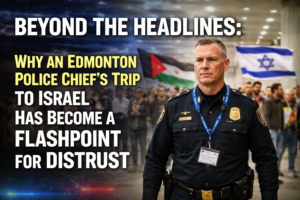
Beyond the Headlines: Why an Edmonton Police Chief’s Trip to Israel Has Become a Flashpoint for Distrust
The Divide at Home: Edmonton’s Police Chief, a Trip to Israel, and the Battle for Community Trust
In the complex tapestry of a modern multicultural city, the role of a police chief is often described as walking a tightrope. They must be a symbol of impartial justice, a strategic leader, and a bridge between the communities they serve. But when Edmonton’s Chief of Police, Warren Driechel, touched down in Israel last month as part of a North American policing delegation, he inadvertently stepped off that tightrope and into a geopolitical minefield. The fallout from that trip, now public knowledge, has done more than just spark debate; it has exposed deep fractures in community trust, forcing Edmontonians to confront a difficult question: Can local law enforcement separate universal policing strategies from the politics of the nations they visit?
The Edmonton Police Service (EPS) has framed the journey as a straightforward professional development opportunity. Sponsored entirely by the Major Cities Chiefs Association, the trip was intended to provide Chief Driechel with a first-hand look at how law enforcement operates in a “highly complex environment.” The stated goals were academic and tactical: to glean insights into critical incident response, threat preparedness, and community engagement in a region perpetually on high alert. On paper, it sounds like a logical move. After all, Canadian cities face their own evolving threats, from terror attacks to organized crime. Learning from a country with decades of experience in high-stakes security should, in theory, be invaluable.
But the logic of the briefing note collided with the reality of lived experience this week, creating a political and social firestorm that has left the city’s Jewish and Palestinian communities offering starkly different interpretations of the same event.
A “Serious Failure of Judgement”: The View from the Palestinian and Muslim Communities
For Mousa Qasqas, the spokesperson for the Canada Palestine Cultural Association in Edmonton, the news of the chief’s trip was met with a sense of profound betrayal. It wasn’t just a trip to a foreign country; it was a trip to a nation whose military actions have caused immeasurable suffering to his people.
“You’d have to be living under a rock to think this wouldn’t be highly offensive and controversial,” Qasqas told reporters, his words echoing the sentiment of a joint letter sent by Muslim community leaders demanding the chief’s immediate resignation.
This reaction is not born of a vacuum. It is rooted in the ongoing, devastating violence in Gaza, which human rights organizations and international bodies have scrutinized intensely. For Palestinians in Edmonton—whether they are recent refugees who have fled the rubble of their homeland or second-generation Canadians whose families carry the memory of the Nakba—the Israeli police and security forces are not neutral arbiters of safety. They are perceived as an integral part of a military apparatus that has, in the eyes of many, overseen mass displacement, restricted movement, and military operations in civilian areas.
To see their chief of police willingly travel to learn from that apparatus feels, to them, like an endorsement. The letter from Muslim communities articulated this pain, stating the decision demonstrates “a serious failure of judgement toward the communities he is sworn to serve and protect.”
The concern goes beyond symbolism. Qasqas highlighted the deep-seated fear this trip has ignited among those who have escaped conflict zones. “For Edmontonians, especially people who are running away from that stuff in Gaza, it’s so scary to them to think… they’re going to bring this to our streets in Edmonton,” he said. This is the crux of the anxiety: a fear that the tactics used in a conflict zone—heavy surveillance, racial profiling, aggressive counter-terrorism measures—could be imported and used against them or their communities here at home. It’s a fear of the criminalization of their identity and their protest.
The timing, as Alberta NDP Leader Naheed Nenshi pointed out, only exacerbates the issue. “Why Israel? Why now?” Nenshi asked, challenging the chief to justify his presence there amidst such intense global scrutiny. The question implies that context matters. Learning about counter-terrorism from a partner nation is one thing; doing so while that nation is engaged in a controversial military campaign creates an unavoidable political association that a public servant cannot simply wish away.
A Vote of Confidence Amidst Rising Fear: The View from the Jewish Community
If the Palestinian community saw the trip as a provocation, Edmonton’s Jewish community saw it as a necessary, and even brave, act of alliance.
In a statement released Thursday, the Jewish Federation of Edmonton offered a starkly different perspective, thanking the Edmonton Police Commission for approving the trip and Chief Driechel for “availing himself of the opportunity.” They framed their support not through the lens of international politics, but through the immediate, tangible threat of rising antisemitism at home.
“In the current climate of heightened security concerns for Jewish communities across Canada, we are saddened but not shocked at the libels and accusations that are divisive and seek to normalize anti-Israel sentiment and hate,” the statement read.
This response is rooted in a different kind of trauma. Over the past several years, and acutely since the October 7th Hamas attacks, Jewish communities across Canada have reported a dramatic spike in hate-motivated incidents. Synagogues have been targeted, community centers have received bomb threats, and individuals have been assaulted simply for being visibly Jewish. For a community under siege, the relationship with local police is paramount. They rely on the EPS for security during high holidays, for patrols near their schools, and for investigating hate crimes.
From this vantage point, a police chief seeking to learn from Israel—a country that faces constant security threats to its civilian population—is not an endorsement of a government, but a proactive measure to protect Jewish Edmontonians. They see the trip as an opportunity to gain intelligence on how to harden soft targets, how to build resilient communities in the face of terror, and how to better understand the threat landscape of global extremism that often finds its local expression in attacks on Jews.
For them, the calls for Driechel’s resignation are not just misguided; they are a part of the problem. They view the outrage as an attempt to “cancel” a legitimate law-enforcement exchange and to delegitimize the very real security concerns of the Jewish community by framing them through a political lens. In a sense, the trip has become a proxy battleground for the conflict itself, with each community projecting its own fears and needs onto the chief’s itinerary.
The Middle Ground: Pragmatism vs. Perception
Caught in the middle is the Edmonton Police Commission and Chief Driechel himself. Commission chair Ben Henderson has defended the approval, emphasizing that the trip was about connecting with “police services that are dealing with some of the same challenges that we are.” He stressed that Driechel was not meeting with the Israeli government or military, but with his policing counterparts.
“There’s no point in going to places that are telling us what we already know,” Henderson added, suggesting that the value lies in learning from a unique and pressure-tested environment. The EPS has also been careful to note that no contracts, equipment, or specific training programs were procured during the visit. It was, they maintain, purely an observational and networking trip—the kind of exchange that happens regularly between major city police forces around the world.
This pragmatic defense, however, runs headlong into the issue of optics. While the chief may have been talking shop about crowd control or suicide bomber prevention with his Israeli peers, the public perception is filtered through the 24-hour news cycle showing images of conflict. The nuance of a professional exchange is lost in the broad strokes of geopolitical symbolism.
This is the central dilemma for modern public institutions. In an era of hyper-awareness and instant communication, the act of where you go and who you are seen with carries as much weight as what you actually do there. For the Palestinian Edmontonians grieving family in Gaza, the image of the chief sharing a table with Israeli security officials is indelible. For Jewish Edmontonians fearing for their children’s safety at school, that same image represents a potential lifeline.
What Can Edmonton Really Learn?
Leaving the politics aside, one must consider the substantive question: What can a city like Edmonton learn from Israeli policing?
Israel’s police operate in a unique paradigm. They are a national police force with integrated border police and significant paramilitary capabilities. Their primary concerns are suicide bombings, stabbing attacks, rocket fire, and widespread civil unrest often tied to nationalistic and religious fault lines.
Edmonton’s challenges, while serious, are different. They include addiction and the opioid crisis, property crime, gang violence, and mental health calls. While terrorism is a threat, it is not the daily reality it is in Israel.
Proponents of the exchange would argue that the principles of threat preparedness are universal. The way Israeli police coordinate intelligence, mobilize rapid response units, and conduct community policing in a diverse and often hostile environment could offer valuable lessons. The concept of “situational awareness” drilled into Israeli citizens from a young age is something any Western city could study.
Critics, however, would argue that the context is inseparable from the tactics. Policing in a situation of occupation and armed conflict creates a fundamentally different relationship between the police and the public—one that is inherently more militarized and adversarial. Importing a “war-fighting” mindset into community policing in Canada could be disastrous, potentially eroding the very trust that agencies like the EPS are trying to build.
The Path Forward: Rebuilding a Fractured Trust
Chief Driechel has declined to comment this week, a silence that speaks volumes. When he does eventually speak, his words will need to be carefully chosen. He must explain not just what he learned, but how it will tangibly benefit all Edmontonians, especially those who feel alienated by his journey.
The Edmonton Police Commission and the Chief now face a steep hill to climb. The incident has reinforced for many in the Muslim and Palestinian communities that their concerns are secondary. For them, the trip is proof that the EPS is more interested in aligning with international security allies than in understanding the trauma of their own residents. For the Jewish community, the backlash against the trip is a chilling reminder that their security needs are often politicized and dismissed.
This controversy is far larger than a single trip. It is a case study in how global events have become intensely local. It demonstrates that for communities with direct ties to conflict zones, a police chief is never just a police chief; he is also a symbol, a diplomat, and a mirror reflecting the city’s values.
The only way forward is through a radical commitment to transparency. The chief must eventually share his findings publicly, not just with the commission. He must engage in difficult dialogues with the very communities that are now calling for his resignation, listening to their fears without defensiveness. He must find a way to bridge the gap between the tactical lessons of a foreign land and the delicate social fabric of his own city.
Whether he can do that remains to be seen. For now, the trip to Israel has brought a world of conflict back to Edmonton’s doorstep, leaving its citizens to wonder if their chief of police can truly serve and protect them all, or if he has, in their eyes, already chosen a side.
You must be logged in to post a comment.