
Beyond the Headlines: Trust, Turmoil, and the Threads That Connect a Fractured Day
The news events of January 4, 2026, collectively paint a portrait of a world grappling with profound breaches of trust and guardianship at every level, from the intimately personal to the globally geopolitical. A honey-trap robbery in Punjab exposes the weaponization of human intimacy and vulnerability, while a fatal water contamination crisis in Indore reveals a catastrophic failure of civic systems to protect public health, eroding the fundamental covenant between citizens and the state.
Simultaneously, the dramatic capture of Venezuela’s president by a foreign military power represents a seismic rupture in international norms and sovereign integrity, showcasing power politics that destabilize global order. Amidst these narratives of betrayal and fracture, the Indian Navy’s voyage to retrace ancient maritime routes offers a deliberate counter-narrative, emphasizing slower, enduring rhythms of historical connection and cultural exchange as an alternative to domination and rupture. Together, these stories underscore that the central crisis of the era is one of failed guardianship—whether in relationships, infrastructure, or geopolitics—and the arduous human pursuit to restore accountability, safety, and meaningful connection.
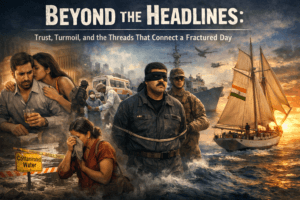
Beyond the Headlines: Trust, Turmoil, and the Threads That Connect a Fractured Day
January 4, 2026, presented not as a single story, but a mosaic of modern fractures—of trust between individuals, between citizens and the state, and between nations. To read the headlines is to witness symptoms; to understand their connection is to diagnose the age. This is a deeper look beyond the alerts, exploring the human and systemic truths underpinning a day of captured leaders, contaminated water, and stolen trust.
The Personal Betrayal: When Intimacy Becomes a Weapon
The story from Ropar and Chandigarh reads like a noir thriller: a businessman, a honey-trap, a orchestrated robbery. A man and a woman, Kaur and Bhardwaj, apprehended in Rajpura and Shimla. But reduce it to a salacious crime brief, and we miss its profound resonance. This isn’t just about theft; it’s about the weaponization of human connection.
In an increasingly digital and transactional world, the longing for genuine intimacy remains a profound vulnerability. The “honey-trap” is a centuries-old concept, but its persistence speaks to a core human weakness. The crime probes a unsettling question: in a society where surfaces are curated and motives often obscured, how do we truly know who to trust? The incident forces a conversation about loneliness, exploitation, and how modern isolation can make individuals targets. It’s a localized crime with a universal echo, reminding us that our deepest human needs can be our greatest points of entry for predators.
The Institutional Betrayal: A Crisis of Confidence in Essentials
Shift from Punjab to Madhya Pradesh, and the betrayal moves from the personal to the civic. The death of at least ten people in Indore from contaminated water is not an “incident”; it is a systemic failure of the most fundamental covenant between a state and its people: the promise of safe sustenance.
The image of 200 personnel on a citywide hunt for the contamination source is both reassuring and damning. It shows urgency, but also reveals the fragility of the infrastructure we take for granted. The directive for “proper maintenance” and “timely detection” across Madhya Pradesh underscores that this is often a failure of prosaic, unglamorous diligence—the slow rot of neglect. Water is life, and its pollution represents a breakdown in the very guardianship of life. This story connects directly to citizens everywhere, a stark reminder that progress is meaningless if the basic pillars of public health are compromised. It fuels a justifiable rage and a demand for accountability that transcends politics, touching the primal need for safety in our own homes.
The Geopolitical Gambit: Power, Theatre, and Uncharted Waters
Then, the narrative vaults to a scale that seems ripped from fiction: the capture of Venezuelan President Nicolás Maduro by U.S. forces. The blindingly theatrical image shared by a U.S. President, of a blindfolded leader on a U.S. warship, is a raw display of power politics that shatters norms. The declaration that “the US will run Venezuela” isn’t diplomacy; it’s a statement of imperial will.
This event, while geographically distant, sends shockwaves into global stability. It asks: What are the new rules? If regimes can be physically removed by external powers, what precedent does it set? The swift appointment of an acting president by Venezuela’s Supreme Court shows the instantaneous scramble to fill the vacuum, setting the stage for potential conflict. For the global reader, this isn’t just about Venezuela; it’s about a world where the old order of sovereignty and intervention is being violently rewritten in real time. The anxieties it fuels—about regional instability, energy markets, and the new face of intervention—are profound.
The Counter-Narrative: Sailing on the Rhythms of History
Amidst these stories of betrayal and rupture, the Indian Navy’s INSV Kaundinya offers a deliberate, poetic counterpoint. Its struggle against “inconducive” winds and tidal currents, before finding favorable winds toward Muscat, is a metaphor for perseverance. This voyage to retrace ancient maritime routes is an act of cultural and historical reconnection.
In a week of fractures, this is a story about seeking threads. It consciously reaches back to a time of trade and civilizational exchange across the Indian Ocean, a system built over millennia. It’s a silent rebuttal to the impulse of capture and domination, focusing instead on shared history and enduring connection. The 370 km covered is not just distance; it’s a journey back to a different model of interaction. It reminds us that beneath the churn of today’s headlines, there are deeper, slower, more enduring rhythms of human exchange that can offer a different kind of compass.
The Unifying Thread: A Crisis of Guardianship
So, what connects a honey-trap in Ropar, poisoned water in Indore, and a captured president in Caracas? At their core, each represents a catastrophic failure of guardianship.
- The individual is not guarded from predatory exploitation.
- The citizen is not guarded by public systems meant to ensure their basic safety.
- The national leader, for all his autocracy, is not guarded by the now-breached norm of sovereign integrity (just as his people were not guarded by his own failing state).
Conversely, the naval voyage and the protests for justice in Uttarakhand represent the active, often arduous pursuit of restoring that guardianship—of history, of truth, of accountability.
January 4, 2026, therefore, is not a random assortment of news. It is a snapshot of a world grappling with the consequences of broken trust at every level. It tells us that whether in relationships, civic life, or global politics, the vacuum created by failed guardianship is filled by chaos, violence, and profound uncertainty. The path forward, as the Kaundinya subtly suggests, may require looking to both the future and the past—navigating treacherous modern currents while remembering the older, more durable routes of human dignity, functioning systems, and genuine connection. The headlines are the alerts; our collective task is the arduous diagnosis and repair.
You must be logged in to post a comment.