
Beyond the Headlines: The Systematic Targeting of Journalists’ Families in Gaza and the War on Truth
A report from the Palestinian Journalists Syndicate alleges a systematic and brutal strategy by Israeli forces in Gaza, asserting that over 700 family members of Palestinian journalists have been killed since October 2023. This campaign, described as a deliberate form of collective punishment, represents a chilling escalation beyond the direct targeting of journalists themselves, aiming to psychologically terrorize and silence reporting by making the profession an existential threat that carries the price of loved ones’ lives. The ongoing killings, which have continued even in displacement camps, leave surviving journalists to bear witness to their families’ annihilation, inflicting profound trauma and effectively paralyzing the media ecosystem. This pattern, occurring with complete impunity, constitutes a grave assault on press freedom and international norms, setting a dangerous global precedent where the cost of bearing witness is calculated not in personal risk, but in the obliteration of one’s entire family to suppress the truth.
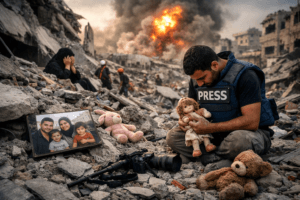
Beyond the Headlines: The Systematic Targeting of Journalists’ Families in Gaza and the War on Truth
Introduction: The Unseen Casualties of a Media War
When we read about journalists killed in conflict zones, the headline often focuses on the professional casualty—the reporter, the cameraperson, the voice silenced. But a chilling report from the Palestinian Journalists Syndicate (PJS) has shifted the lens to a darker, more intimate frontier of repression: the families. According to the PJS Freedoms Committee, Israeli forces have killed at least 706 family members of Palestinian journalists since October 2023. This isn’t presented as collateral damage, but as a deliberate strategy—a form of collective punishment designed to crush not just the individual behind the camera, but the very ecosystem that supports the act of witnessing.
This figure, spanning from parents and spouses to children and extended relatives, reveals a brutal calculus. It suggests that in the context of Gaza’s war, the pen and the camera are seen not as tools of a profession protected under international law, but as existential threats to be neutralized by any means. The home itself becomes a target. This report demands we look beyond the statistics of media worker deaths to understand a more comprehensive assault on truth-telling, one that aims to terrorize the truth out of existence.
The Strategy: From Individual Targeting to Collective Punishment
The PFS report details a “qualitative shift” in tactics. Historically, conflicts have seen journalists killed in crossfire or, alarmingly, in targeted attacks. The killing of Al Jazeera’s veteran correspondent Shireen Abu Akleh in the West Bank in 2022 is a searing example. However, the scale and pattern in Gaza point to a broader, more systematic approach.
- The Anatomy of an Attack:The committee notes that attacks have repeatedly struck journalists’ family homes, their places of forced displacement, and areas known to house their relatives. The case cited near Khan Younis is emblematic: the bodies of journalist Hiba al-Abadla, her mother, and approximately 15 members of their extended family were recovered nearlytwo years after an airstrike destroyed their home. This indicates a targeting of the family unit itself, regardless of displacement or the passage of time.
- The Numbers Tell a Story of Policy:The breakdown—436 relatives killed in 2023, 203 in 2024, and at least 67 in the reported period of 2025—is significant. While the overall tempo of the war influenced the figures, the continuation of these killings into 2025, amid a landscape of tents and makeshift camps, underscores persistence. It challenges the argument of mere battlefield coincidence and suggests a sustained policy of intimidation.
- The Objective: “Drying Up the Environment”As Muhammad al-Lahham, head of the Freedoms Committee, stated, this is a “comprehensive war on the truth.” By making journalistic work an “existential burden,” the goal appears to be psychological and societal rupture. If a journalist knows that their reporting could lead to a missile striking their sleeping children, the cost of bearing witness becomes unimaginable. This strategy aims to paralyze the media not just by eliminating reporters, but by terrorizing every potential reporter into silence. It seeks to “dry up the environment that nurtures the media”—to remove the social, emotional, and physical safety net that allows journalism to function.
The Human Cost: Survivors Bearing Witness to Annihilation
The psychological dimension of this campaign is perhaps its most devastating legacy. The report speaks of journalists who survive, only to bear witness to the annihilation of their entire family.
- The Trauma of Survival: These journalists are left with what one can only term “catastrophic guilt”—the unbearable burden of being alive because of the profession that caused their family’s death. This trauma renders the basic tools of their trade—the camera, the notebook—into triggers of profound grief and guilt.
- Family Breakdown and Forced Silence: Many have been psychologically broken, forced to flee, or compelled to suspend their work. The destruction is therefore twofold: a physical loss and a professional silencing. The voice of Gaza is not only killed; it is heartbroken into submission.
- A Society Intimidated: The impact radiates outward. When entire neighborhoods see that housing a journalist’s cousin or in-law can make a home a target, the community itself becomes wary. The journalist is isolated, not celebrated. This severs the vital connection between the reporter and their sources, their community, and their support system.
A Global Press Freedom Crisis in Microcosm
This pattern in Gaza sits within a terrifying global context, yet its scale is unprecedented. Reporters Without Borders (RSF) noted that Israel killed more journalists in 2025 than any other country. The monitoring site Shireen.ps records nearly 300 journalists and media workers killed in Gaza over 26 months—an average of 12 per month.
The Crisis of Impunity: A critical, damning thread runs through this narrative: absolute impunity. Israel has never arrested or charged any soldier for killing a journalist, let alone their families. This lack of accountability is the oxygen that allows such a strategy to continue. When legal and diplomatic mechanisms fail to even investigate, it signals that certain lives—and certain truths—are deemed expendable.
The Erosion of International Norms: International Humanitarian Law explicitly protects civilians, including journalists, and prohibits collective punishment. The deliberate targeting of civilians to intimidate or pressure another group is a war crime. The PJS report is, in essence, a documented allegation of such a crime, repeated hundreds of times over. The global response—often limited to condemnations from press freedom groups—has been woefully inadequate to stop the killing.
Conclusion: The Blood as a “Living Witness”
The blood of journalists’ families, as al-Lahham said, “will remain a living witness to the crime of trying to silence the Palestinian voice.” But a witness requires an audience that is willing to see and act.
This is not solely a Palestinian story. It is a stark warning about the future of conflict reporting and the sanctity of truth in wartime. If a strategy that targets journalists’ families is met with global inertia, it establishes a dangerous precedent. It tells every authoritarian regime and military force that the most effective way to control the narrative is to threaten not the journalist in the field, but the child in their home.
The defense of press freedom cannot stop at mourning the journalist who dies on camera. It must extend to protecting the human network that makes their courage possible. The 706 names behind the headline represent more than a statistic; they represent a frontier in the battle for truth. To look away is to accept a world where the price of bearing witness is calculated not in risk, but in the lives of one’s entire family. And in that world, the light of truth will inevitably, and tragically, be extinguished.
You must be logged in to post a comment.