
Beyond the Headlines: The Systematic Strategy of Violence and Displacement in the West Bank
The recent attacks in the West Bank, including the assault on a Palestinian child in Masafer Yatta and the sabotage of a critical water well serving 19 communities near Ramallah, are not isolated incidents but part of a deliberate and systematic strategy of displacement. This strategy employs direct physical violence to terrorize civilians, weaponizes control over essential resources like water to make Palestinian life unsustainable, and operates within a framework of legal impunity and political facilitation that encourages settlement expansion. The overarching goal is to fragment Palestinian territory through forced removal, a process that has accelerated dramatically since late 2023, displacing thousands and directly contravening the International Court of Justice’s ruling which declared the occupation and settlements illegal.
Beyond the Headlines: The Systematic Strategy of Violence and Displacement in the West Bank
In a recent series of coordinated attacks, the multifaceted nature of settler violence in the West Bank was laid bare. While an assault on a Palestinian child made the initial headline, the deeper story reveals a deliberate strategy that extends far beyond isolated clashes. From the hills of Masafer Yatta to the water wells east of Ramallah, a pattern emerges of ecological warfare, psychological terror, and systemic displacement, all unfolding under a specific legal and political framework that facilitates these actions and shields their perpetrators from accountability.
The following table summarizes key incidents from recent reports, illustrating the geographic spread and diverse tactics employed:
| Location | Type of Incident | Immediate Impact | Broader Strategic Goal |
| Masafer Yatta (S. Hebron) | Assault on child (12-year-old Salah Ismail Al-Hadra); attempted vehicular ramming of children. | Child hospitalized with bruises; pervasive fear among families. | Terrorize communities to force abandonment of land, especially in designated “Firing Zones”. |
| Ein Samiya (E. Ramallah) | Attack on technical crews and Well No. 6; blocking of repair access. | Complete shutdown of water pumping for 19+ communities. | Weaponize control over essential resources (water) to render Palestinian life unsustainable. |
| Ras Ein al-Auja (Jordan Valley) | Sustained violence, theft of livestock, denial of water access, and direct threats. | Displacement of ~450 of 650 residents; destruction of a centuries-old Bedouin community. | Clear land of Palestinian presence to facilitate settlement expansion and territorial fragmentation. |
The Attack on Lifelines: Water as a Weapon of War
While physical assaults on individuals capture urgent attention, the synchronized attack on the Ein Samiya wellfield represents a more insidious form of violence. By assaulting technical crews and blocking access to repair Well No. 6, settlers did not merely attack infrastructure; they weaponized a fundamental human need. This act cut off water to at least 19 Palestinian communities east of Ramallah, plunging thousands into a severe humanitarian crisis.
This incident is not an anomaly. The Ein Samiya wells, which have supplied the region since the 1960s, have faced repeated attacks. The strategy is clear: by targeting vital water resources, settlers and the forces that enable them aim to make Palestinian life in Area C of the West Bank untenable. It is a form of ecological pressure that complements physical violence, slowly strangling communities by depriving them of the means to sustain agriculture, livestock, and basic household life. As the Jerusalem Water Undertaking warned, without intervention to halt these attacks, the region faces an “unprecedented water crisis”.
A Landscape of Fear: Proximity, Impunity, and Psychological Warfare
The violence in Masafer Yatta, where a child was assaulted and others were chased by settlers, must be understood within its unique geographical and legal context. This area is largely designated as “Firing Zone 918,” an Israeli military training zone officially closed to civilians. In practice, however, this designation has become a primary tool for dispossession. While Palestinians are brutally enforced against, barred from building, and even from entering, illegal settler outposts within the same zone expand with impunity.
Residents describe a life of constant anxiety. Settlers establish “shepherding outposts” that mimic and directly compete with Palestinian Bedouin livelihoods, then launch attacks from these forward bases. As detailed in reports from villages like Tabaqat al-Jundi and Al-Mirkez, settlers graze livestock on Palestinian crops, attack shepherds, and vandalize property, often accompanied or followed by Israeli soldiers. The message is omnipresent and psychological: “If you sleep, the settlers will burn your house”. This relentless pressure—a combination of physical threat, economic sabotage (through poisoned sheep and stolen grazing land), and the trauma of nightly invasions—is designed not just to injure but to exhaust and ultimately expel.
The Architecture of Displacement: From Outposts to Annexation
The individual incidents of violence are threads in a larger tapestry of displacement. Data reveals a staggering scale: settler violence has forced out 44 Palestinian communities in the West Bank since October 2023, with 13 more partially transferred. In just the first two weeks of 2026, over 100 Bedouin households were displaced from five communities.
This mass displacement is facilitated by a clear political and legal architecture:
- Settlement Expansion: The number of settlements and outposts has surged by nearly 50% since 2022. In December 2025, Israel retroactively legalized 19 settler outposts, rewarding their illegal establishment.
- The E1 Plan: A critical flashpoint is the E1 settlement plan east of Jerusalem. Israel has approved tenders for 3,400 housing units there, a move described by the UN Secretary-General as an “existential threat to the two-state solution”. The International Commission of Jurists warns this plan would sever the West Bank, annex Palestinian land, and violate the Palestinian right to self-determination.
- International Law Violations: These policies directly contravene the landmark International Court of Justice (ICJ) Advisory Opinion of July 2024, which declared Israel’s occupation illegal and demanded it cease all settlement activity and evacuate settlements. The ICJ stated that Israel’s settlement policy violates the Fourth Geneva Convention by transferring its own population into occupied territory and forcibly transferring the occupied population.
Conclusion: A Coherent Strategy with a Clear Goal
The assault on a child in Masafer Yatta and the sabotage of a water well in Ein Samiya are not random acts of extremism. They are tactical components of a coherent strategy. This strategy employs direct violence to terrorize, resource control to suffocate, and legal manipulation to displace. It operates under a canopy of near-total impunity, where attacks on Palestinians are rarely prosecuted, while their homes are demolished for lacking permits that are systematically denied.
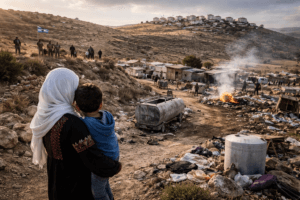
The end goal is the gradual, irreversible fragmentation of Palestinian territory and the consolidation of Israeli control. As families in Ras Ein al-Auja burn their own furniture before fleeing, not wanting to leave anything for the encroaching settlers, they are witnessing the erasure of a centuries-old way of life. The international community, bound by the ICJ ruling to not render aid or assistance to this illegal situation, now faces a critical test. Will it move beyond condemnation to take concrete measures to uphold international law, protect Palestinian civilians, and preserve the possibility of a just political future? The answer will determine whether the story of the West Bank continues to be written through violence and displacement, or through the restoration of rights and dignity.
You must be logged in to post a comment.