
Beyond the Headlines: The Supreme Court’s Fact-Check Unit Battle and the Fight for the Soul of the Internet
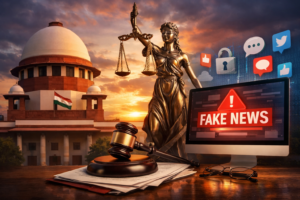
Beyond the Headlines: The Supreme Court’s Fact-Check Unit Battle and the Fight for the Soul of the Internet
On a Tuesday morning in March 2026, the Supreme Court of India stepped into one of the most contentious debates of the digital age. The courtroom, a theatre of legal and ideological conflict, saw the Union Government urgently plead for a stay on a Bombay High Court judgment that had dismantled its mechanism to police “fake news.” The bench, led by Chief Justice Surya Kant, refused to grant an interim stay but made one thing abundantly clear: the court would now definitively lay down the law on where the state’s power to label information ends, and a citizen’s right to free speech begins.
The issue at hand—the government’s appeal against the striking down of its Fact Check Unit (FCU) provisions—is far more than a dry legal tussle over IT Rules. It is a high-stakes drama that pits the government’s desire to control the chaotic information ecosystem against the fundamental fears of a regressive, state-sanctioned censorship. As the Chief Justice observed, the potential for “dangerous” fake news to damage everything from individual reputations to the very institutions of the state is immense. But so too is the danger of creating a government-appointed arbiter of truth.
The Nub of the Conflict: The ‘Safe Harbour’ and the Sinking Ship
To understand the gravity of this moment, one must first understand the mechanics of the 2023 amendment to the Information Technology Rules, 2021. At its core lies the concept of ‘safe harbour’—a legal principle enshrined in Section 79 of the IT Act that protects social media platforms (intermediaries) from being held liable for the content posted by their users. Think of it as the legal shield that allows platforms like X (formerly Twitter), Facebook, and Instagram to exist without being sued for every defamatory post or piece of misinformation uploaded by a billion users.
The 2023 amendment introduced a dangerous loophole in this shield. It mandated that once the government’s officially designated Fact Check Unit flagged a piece of content as “fake” or “false” relating to the business of the government, the intermediary would lose its safe harbour protection if it failed to take it down. In the legal world, this is what’s known as a coercive measure with chilling effects.
The petitioners before the Bombay High Court—a diverse coalition including satirist Kunal Kamra, the Editors Guild of India, and the News Broadcasters and Digital Association—argued that this wasn’t fact-checking; it was prior restraint by another name. They contended that the rule created a parallel system of censorship where the government became the judge, jury, and executioner of information pertaining to itself.
A House Divided: The Bombay High Court’s Legal Labyrinth
The legal journey of this case is a fascinating study in judicial disagreement, highlighting just how nuanced the issue is. In January 2024, a division bench of the Bombay High Court delivered a split verdict, a rarity that signals deep constitutional ambiguity.
Justice Gautam Patel, known for his staunch defence of civil liberties, delivered a powerful and detailed opinion striking down the rules. He saw the amendment as a direct assault on the freedom to practise one’s profession (Article 19(1)(g)), arguing that it created an arbitrary and unconstitutional distinction between digital and print media. Why, he asked, should a newspaper be free to publish government-critical content subject to post-publishing legal remedies, while a digital news portal or a social media post must be pre-emptively taken down at the behest of a government unit?
In stark contrast, Justice Neela Gokhale upheld the provisions. She viewed the petitioners’ fears as “unfounded,” arguing that the rule merely provided a mechanism for identification and did not, on its face, impose penal consequences on users. She placed her trust in the stated intent of the rule—to combat misinformation.
This legal impasse necessitated a third judge, Justice A.S. Chandurkar, who was tasked with being the tie-breaker. In a significant blow to the government, Justice Chandurkar aligned with Justice Patel’s view in September 2024. He delivered a scathing verdict, holding the amendments to be a violation of the fundamental rights to equality (Article 14), freedom of speech and expression (Article 19), and the right to life (Article 21). He found that the rules failed the crucial “test of proportionality”—a legal doctrine that asks whether the means used to achieve a goal (combatting fake news) are proportionate to the harm caused to fundamental rights (censorship).
The Supreme Court’s Tightrope Walk: Regulation vs. Repression
Now, the battleground has shifted to the Supreme Court. The Union Government, represented by Solicitor General Tushar Mehta, sought an immediate stay, hoping to resurrect the FCU’s powers. The bench’s refusal is telling. By stating, “No, not at this stage. We will decide the main matter itself,” the Chief Justice signalled that this was not a case for interim fixes. The court is acutely aware that granting a stay would effectively allow the government to immediately begin flagging content, potentially mooting the entire challenge before a final hearing.
Yet, the Chief Justice’s observations from the bench reveal the court’s own anxiety. “Look at the way some of these platforms are behaving… how dangerous are these…such fake news can damage reputation of the institution as well. Clear demarcated guidelines is needed,” he remarked.
This is the heart of the dilemma. On one hand, the court sees the unvarnished reality of the internet: a cesspool of misinformation that can spark communal violence, ruin lives, and undermine public trust in democratic institutions. The CJI’s mention of the army and police not being spared is a potent reminder that fake news is not a victimless crime. It has real-world, often violent, consequences.
On the other hand, the court is the ultimate guardian of the Constitution. It must ensure that the cure is not worse than the disease. Handing the government the exclusive power to define what is “fake” about itself is a recipe for authoritarian overreach. In a democracy, the government is the primary subject of public scrutiny. To allow it to silence scrutiny by simply labelling it “fake” would be to gut the very essence of democratic accountability.
The Shifting Sands: The 2025 IT Rules and the Question of Mootness
Adding a layer of procedural intrigue is the argument raised by Senior Advocate Arvind Datar, representing the respondents. He pointed to the newly notified IT Rules of 2025, arguing that the new framework makes the contested FCU provision redundant. This is a classic legal tactic: if the law has changed, the challenge to the old law becomes infructuous, or moot.
However, the Chief Justice’s refusal to accept this objection on grounds of delay suggests that the court views this issue as transcending the specific statutory provision. The underlying principle—of state-sponsored fact-checking and its impact on intermediary liability—remains a live and critical issue, even under a new statutory avatar. The government’s eagerness to pursue the appeal, despite the new rules, confirms that the policy intent to create a government-backed truth arbiter persists.
The Human Element: From Satirists to Newsrooms
This case is not just about abstract legal principles; it is about the people who create and consume content. For a satirist like Kunal Kamra, the FCU represented an existential threat. Satire, by its very nature, exaggerates and distorts to make a point. Under a strict “fact-check,” it would almost always be deemed “fake,” effectively criminalising a vital form of political commentary.
For news broadcasters and digital publishers, the rule threatened to turn them into passive conduits for government directives. An editor’s judgement would be replaced by a government bureaucrat’s flag. The chilling effect would be immediate: platforms, terrified of losing their safe harbour, would likely resort to “over-removal,” taking down any content flagged by the government just to be safe, regardless of its actual veracity.
What Lies Ahead: A Landmark Judgment in the Making
The Supreme Court has now signalled its intent to settle this matter definitively. The coming months will see the finest legal minds in the country debate the very nature of truth, power, and freedom in the 21st century.
The questions before the court are profound:
- Who decides what is true? Is it the state, a platform, an independent body, or the chaotic marketplace of ideas?
- How do we protect institutional integrity without sacrificing individual liberty? Can we build a system that punishes malicious misinformation without creating a Ministry of Truth?
- What is the future of the ‘safe harbour’? Is it an outdated principle for a bygone internet, or the last bastion protecting free speech online?
The CJI’s desire for “tighter regulations” is understandable, but the court’s ultimate ruling will need to craft those regulations with surgical precision, not a sledgehammer. The judgment in this case will not just decide the fate of a Fact Check Unit; it will define the relationship between the Indian state and the internet for a generation, determining whether the digital public square remains a space for robust, unfiltered debate or becomes a curated gallery, sanitized and approved by those in power. The world is watching.
You must be logged in to post a comment.