
Beyond the Headlines: The Strategic Pivot and Human Cost of Coca-Cola’s Bottling Restructuring in India
Hindustan Coca-Cola Beverages’ layoff of 300 employees is a direct result of Coca-Cola’s strategic shift to an “asset-light” franchise model in India, where it sells off capital-intensive bottling operations to partners. This move, following a 73% profit plunge, aims to boost margins by having the parent company focus on brand and concentrate sales while outsourcing manufacturing. Although framed as a minor adjustment for agility, the restructuring reflects deeper market pressures and carries a significant human cost, highlighting the tension between global corporate efficiency drives and their impact on local workforce stability in evolving economies.
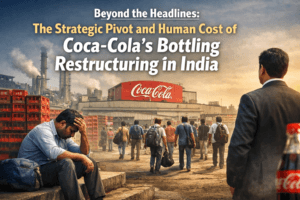
Beyond the Headlines: The Strategic Pivot and Human Cost of Coca-Cola’s Bottling Restructuring in India
The recent announcement that Hindustan Coca-Cola Beverages (HCCB), the primary bottling arm of the beverage behemoth in India, has laid off approximately 300 employees is more than a routine corporate downsizing. It is a critical juncture story, revealing the confluence of global strategic shifts, intense local market pressures, and the very human toll of corporate efficiency drives. While the company frames it as a minor, non-disruptive correction to stay “agile,” a deeper examination uncovers a narrative of sinking profits, a fundamental business model transformation, and the precarious reality for thousands in India’s fast-moving consumer goods (FMCG) sector.
Decoding the “Asset-Light” Strategy: A Global Blueprint Lands in India
At the heart of HCCB’s layoffs lies a strategic paradigm shift that Coca-Cola has been implementing worldwide: the move towards an “asset-light” franchisee model. For decades, HCCB operated as the company-owned anchor, controlling manufacturing and distribution for a significant portion of Coca-Cola’s portfolio in India, from iconic sodas like Coca-Cola, Thums Up, and Sprite to Minute Maid juices. However, direct ownership of bottling plants entails massive capital expenditure, workforce management, and logistical complexities.
The reported 73% plunge in net profit to ₹756.7 crore in FY25, alongside a 9% drop in revenue, is not merely a market slowdown. It is the direct financial reflection of HCCB selling its bottling operations in key regions like Rajasthan, Bihar, Northeast India, and parts of West Bengal to established franchise partners. When these assets are sold, the revenue they generate shifts off HCCB’s books. The profit from these sales might create a one-time boost, but the ongoing operational income disappears. Consequently, HCCB’s workforce, once essential for running these plants, becomes ostensibly redundant.
This model is not new; it’s a page from Coca-Cola’s global playbook. The company increasingly prefers to be a “concentrate seller and brand builder,” leaving capital-intensive bottling to trusted franchisees. It minimizes corporate risk, converts fixed costs into variable ones, and aims for higher margins on the concentrate it sells. The layoffs, therefore, are a painful but calculated step in shrinking the company-owned operational core to fit this new asset-light reality.
Leadership Change and Market Realities: A Perfect Storm
The timing of the downsizing, following closely on the heels of a CEO change, is telling. In September 2025, Juan Pablo Rodriguez was replaced by Hemant Rupani, a leader with experience overseeing Southeast Asian markets. Leadership transitions often provide a window for executing difficult, pre-planned restructuring. A new CEO can implement tough decisions while strategically distancing the move from the prior regime.
Beyond internal strategy, the Indian beverage market itself is a battleground. It is characterized by:
- Intense Competition: Rivalry with PepsiCo is perennial, but the market is also flooded with a resurgence of regional players, healthier alternatives, and innovative start-ups in juices, packaged water, and energy drinks.
- Volatile Input Costs: Sugar prices, packaging materials, and logistics expenses have been highly volatile, squeezing margins for all manufacturers.
- Evolving Consumer Tastes: A growing health consciousness, though slower to impact the mass market than in the West, pressures traditional carbonated soft drinks. HCCB’s portfolio diversification into juices like Minute Maid is a direct response, but these segments also face fierce competition.
In this environment, the old integrated model became a liability. The layoffs across sales, supply chain, distribution, and bottling operations are an attempt to strip the organization down to a leaner, more strategic entity focused on managing franchisee relationships, marketing, and overall brand health, rather than day-to-day plant operations.
The Human Capital Equation: “Minor” Cuts with Major Ripple Effects
Labeling the layoff of 300 employees—4-6% of a 5,000-strong workforce—as “minor in scale” is a corporate euphemism that belies the significant impact. For the individuals and their families, it is a major life disruption, especially in a challenging job market. These are not just numbers; they represent skilled professionals in sales, logistics engineers, plant supervisors, and distribution managers whose expertise was built around the integrated model.
The move sends a chilling signal to the remaining employees about job security and the future of company-owned operations. It also disrupts local economies where these plants are often significant employers. Furthermore, as operations shift to franchisees, there is no guarantee that employment conditions, salaries, or job security will be maintained at the same level, potentially leading to a “race to the bottom” in labor costs within the broader Coca-Cola India system.
Historical Context and the Road Ahead
This is not Coca-Cola’s first major restructuring in India. The company has navigated various challenges since its re-entry in the 1990s, from agricultural controversies to water scarcity issues. Each time, it has adapted its model. The current shift towards franchising mirrors its approach in other large markets and indicates a maturation of its Indian ecosystem—it now has capable, large-scale Indian bottlers (like Moon Beverages and Kandhari Global) who can take on more responsibility.
The road ahead for HCCB will be defined by several key questions:
- Can it successfully transition to a pure-play franchise manager? Its success will hinge on its ability to support bottlers with innovation, marketing brilliance, and supply chain efficiency without direct control.
- How will it reignite growth? With a leaner structure, the pressure will be on driving top-line growth through aggressive marketing and portfolio innovation (like healthier options or new flavors) to benefit the entire franchise system.
- What is the long-term future of its remaining company-owned plants? The current layoffs may not be the last if the asset-light strategy deepens.
A Case Study in Global-Local Business Dynamics
The HCCB layoffs story is a potent case study in how global corporate strategies, designed in boardrooms oceans away, manifest on the ground in complex local economies. It highlights the tension between shareholder value (through improved margins and capital efficiency) and stakeholder responsibility (towards employees and local communities).
For observers of business, it’s a lesson in corporate transformation. For the Indian FMCG sector, it’s a sign of increasing consolidation and strategic realignment. For the employees, past and present, it’s a personal story of uncertainty and change. Ultimately, the true measure of this “corrective action” will be whether it secures the long-term sustainability of Coca-Cola’s operations in India, not just on a balance sheet, but within the fabric of the market it serves. The fizz, it seems, is being recalibrated for a new era.
You must be logged in to post a comment.