
Beyond the Headlines: The Silent War That Never Ended in Gaza
On February 8, 2026, despite an official ceasefire, three Palestinians were killed in separate Israeli military actions across Gaza, highlighting the fragile and ongoing nature of the violence. A young man, Nassim Abu Al-Ajeen, was shot by Israeli forces east of Deir al-Balah, while in Rafah, young mother Dalia Khaled Asfour succumbed to older injuries sustained when her home was shelled, an attack that previously killed her four children. Earlier that day, another Palestinian was killed by artillery fire in Beit Lahia. These incidents brought the total number of Palestinian fatalities since the October 11, 2025, ceasefire began to 579, with 1,544 injured, underscoring how daily life remains permeated by lethal threat and that the agreement has failed to stem the loss of life or address the underlying conditions of conflict.
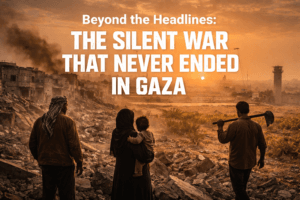
Beyond the Headlines: The Silent War That Never Ended in Gaza
The ceasefire was supposed to be a breath. A fragile, trembling pause in a storm of violence that had ravaged the Gaza Strip. It was a date etched into a weary collective memory: October 11, 2025. Yet, on a quiet Sunday morning, February 8, 2026, in the mundane act of tending to land or simply being at home, three more names were carved into the grim ledger of this “quiet.” Nassim Abu Al-Ajeen, 20. Dalia Khaled Asfour, a young mother. And an unnamed Palestinian in Beit Lahia. Their deaths, reported clinically as “violations of the ceasefire agreement,” are not mere footnotes; they are the central plot of a story the world has grown tired of reading—the story of a war that never truly ends, but simply changes its tempo.
The Ceasefire Mirage: A Landscape of Persistent Threat
To understand the killing of Nassim Abu Al-Ajeen east of Deir al-Balah is to dismantle the myth of the “post-war” Gaza. The ceasefire, in reality, often resembles not peace, but a reconfiguration of military rules. The areas near the perimeter fence, like the Abu Al-Ajeen family area, become perpetual “access-restricted zones,” deemed lawful targets by the Israeli military. Farmers like Nassim venture not into fields of combat, but into fields of existential risk, where Israeli military vehicles patrol and the definition of “threat” can be fatally broad.
Nassim’s story is the story of Gaza’s choked geography. With over 60% of arable land located in these high-risk border areas, farming becomes an act of profound courage and economic necessity. His death underscores a brutal paradox: the very act of attempting to rebuild a shred of sustenance—to anchor life to the land—can be the act that ends it. This isn’t a “violation” of peace; it is the enforcement of a permanent state of insecurity that strangles normalcy at birth.
Grief’s Long Arc: Dalia’s Story and the War After the War
Then there is Dalia Khaled Asfour, whose story stretches the timeline of violence beyond any official ceasefire. She didn’t die from a new shell on February 8th; she succumbed to injuries from an attack during the “hot war.” Her death in Rafah is a harrowing testament to Gaza’s secondary, silent massacre: the one conducted by a shattered healthcare system and the long tail of trauma.
When Israeli forces shelled her family home on Al-Dakhiliya Street, they took her four children instantly. Dalia, physically wounded and utterly shattered, entered a medical system on its knees. Hospitals in Gaza, chronically depleted of supplies, specialists, and power, struggle to perform complex surgeries or provide long-term critical care. What kills, then, is not just the projectile, but the blockade, the restrictions on medical imports, the denial of permits for treatment abroad. Dalia joined her children, a final, cruel reunion facilitated by a systemic dismantling of healing. Her death raises a disturbing legal and moral question: When does an attack truly end? Is it when the rubble settles, or when the last survivor, broken in body and spirit, finally fades away?
The Architecture of Erosion: From Bullets to Bulldozers
The Sunday killings in Gaza cannot be viewed in isolation. They are part of a cohesive architecture of control and erosion. The same day, reports noted the demolition of an agricultural room in Ramallah and the detention of dozens of Palestinian workers near Jerusalem. These are not disconnected events. They form a pattern: the physical narrowing of space in Gaza through lethal enforcement of “buffer zones,” and the parallel suffocation of life in the West Bank through property destruction and arbitrary arrest.
This simultaneous pressure on multiple fronts creates an inescapable reality. The Palestinian worker detained at a checkpoint, the farmer killed near a fence, the mother dying of old wounds, and the family watching their livelihood be bulldozed are all victims of the same strategy: the deliberate erosion of the foundations of a dignified life. The goal is not only territorial but psychological, manufacturing a reality where resilience itself is punished.
The Human Tally: When Numbers Obscure Names
The WAFA report provides the sterile calculus: 579 killed, 1,544 injured, 717 bodies recovered since the October 2025 ceasefire. These numbers risk anesthetizing us. We must re-animate them.
Behind “579” are 579 worlds extinguished. Students, teachers, poets, engineers, children who dreamed of the sea they cannot access. It includes those like the man in Beit Lahia, whose name we do not yet know, but whose family’s world has just collapsed. “1,544 injured” means thousands living with permanent disability, chronic pain, and PTSD in a society with minimal psychosocial support. “717 bodies recovered” speaks to a war so intense it left corpses beneath the concrete, families denied even the closure of a burial for months.
This is the true “ongoing attack.” It is the attack on the future. It is the trauma embedded in a generation of children who have known nothing but fear. It is the economic asphyxiation that makes a 20-year-old feel he must risk his life in a militarized field. It is the collective punishment that turns a home into a tomb.
A Call for Reframing: From Ceasefire Management to Accountability
The international response to these “ceasefire violations” is often a muted call for “restraint.” This framing is inadequate. It treats these incidents as sporadic cracks in peace, rather than the predictable output of a system built on occupation, blockade, and impunity.
The genuine insight for readers is this: The story is not about a ceasefire failing. The story is about a structure of power that remains fundamentally unchallenged. True value lies in shifting the conversation from managing violence to demanding accountability for its root causes. It means moving beyond counting the dead to challenging the policies that create the killing fields—the expansion of buffer zones, the siege on healthcare, the West Bank annexation moves condemned by the OIC, the arbitrary detention regimes.
Nassim, Dalia, and the unnamed man from Beit Lahia did not die in a “conflict.” They died in a world meticulously designed to be unlivable for them. Their stories are the most powerful argument not for a better ceasefire, but for a radical, justice-based peace that dismantles the architecture of their deaths. Until then, the headlines will continue, the numbers will tick up, and the quiet war will claim its next breathless victims on another ordinary Sunday. Remembering that truth is the first, necessary step toward ending it.
You must be logged in to post a comment.