
Beyond the Headlines: The Perfect Storm Behind IndiGo’s Operational Meltdown
IndiGo, India’s largest airline, faced a severe operational crisis in late 2025, culminating in over 1,200 November flight cancellations and a significant drop in punctuality, which prompted an investigation by the aviation regulator (DGCA). This meltdown was triggered by a “perfect storm” of factors, primarily the stringent new pilot rest rules (FDTL) that drastically reduced scheduling flexibility and caused over 60% of the cancellations, compounded by a mandatory global software update for its Airbus fleet that grounded multiple aircraft simultaneously.
These core issues were exacerbated by adverse weather, systemic airport congestion, and minor technical glitches, creating a cascading failure that stranded thousands of passengers and led to widespread social media outrage and a sharp decline in the airline’s stock value. In response, IndiGo issued a public apology, initiated a 48-hour recovery plan, and is working with the DGCA on long-term solutions to bolster crew planning and operational resilience, highlighting a critical inflection point for the infrastructure-strained Indian aviation industry.
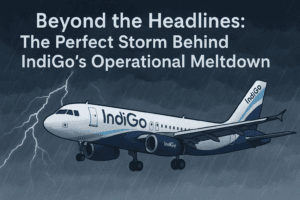
Beyond the Headlines: The Perfect Storm Behind IndiGo’s Operational Meltdownr sustainable growth.
In the final weeks of 2025, India’s aviation system, long celebrated for its rapid growth, hit a turbulent patch that left thousands of passengers stranded and exposed the fragile underpinnings of its success. At the center of the storm was IndiGo, the nation’s largest carrier, which found itself in the midst of an unprecedented operational crisis. The numbers alone are staggering: over 1,200 flights cancelled in November, hundreds more delayed, and a punctuality rate that plummeted from 84% to below 68% in a single month .
This was not a simple case of bad weather or a one-off technical glitch. Instead, it represented a cascading systems failure, a “perfect storm” where regulatory changes, global safety mandates, seasonal pressures, and infrastructural limitations converged to bring a meticulously efficient airline to a near-standstill. The crisis triggered an immediate probe by the Directorate General of Civil Aviation (DGCA) and ignited a firestorm of passenger fury on social media, with travelers reporting being stranded for over 12 hours without clear information or recourse . This analysis delves beyond the headlines to unpack the complex, interlinked causes of the disruption, its immediate human and financial toll, and the critical questions it raises about the resilience of Indian aviation.
The Scale of the Disruption: A Nationwide Travel Snarl
The crisis did not occur in isolation but rippled across India’s busiest aviation hubs, creating a domino effect of delays and cancellations.
Table: Snapshot of Flight Cancellations (December 3-4, 2025)
| Airport | Reported Cancellations (Dec 3) | Reported Cancellations (Dec 4) | Key Impact |
| Bengaluru (BLR) | 42+ flights | 73 flights | Services to Delhi, Mumbai, Chennai, Hyderabad affected |
| Hyderabad (HYD) | 40+ flights | 68 flights (likely) | 19 departures, 21 arrivals cancelled on Dec 3 |
| Delhi (DEL) | 38 flights | Ongoing disruptions | A major hub, cancellations had network-wide effects |
| Mumbai (BOM) | 33 flights | – | 17 departures and 16 arrivals cancelled |
The human impact of these numbers was immediate and severe. Airports like Kempegowda International in Bengaluru and Rajiv Gandhi International in Hyderabad became scenes of frustration, with terminals crowded with stranded passengers, many of whom had received little or no prior intimation about their cancelled flights . Social media platforms were flooded with angry testimonials. One passenger lamented on X that “#Indigo staff are leeches who are lying & passengers have been stranded for over 12+ hours with no confirmation,” while another described the “deeply unfortunate” sight of Ayyappa devotees forced to protest at Hyderabad Airport due to hours-long delays .
Anatomy of a “Perfect Storm”: The Multi-Layered Causes
IndiGo’s official statement cited a “multitude of unforeseen operational challenges” that had a “negative compounding impact” . This phrasing points to the core of the issue: not one single cause, but several that reinforced each other.
- The Regulatory Shock: New Crew Rest Rules (FDTL)
The most significant trigger was the full implementation of the updated Flight Duty Time Limitations (FDTL) norms, effective November 1. Mandated by the DGCA following a Delhi High Court order, these rules were designed to enhance safety by reducing pilot fatigue . The key changes—increasing weekly rest periods to 48 hours, extending the definition of “night hours,” and crucially, slashing the maximum permitted night landings from six to just two—dramatically altered roster mathematics .
For an airline like IndiGo, which operates a massive 2,200-2,300 flights daily with a lean, highly utilized crew, this change removed critical scheduling flexibility. As one analysis noted, the new rules created “rosters with almost zero slack” . The data is telling: of the 1,232 flights cancelled in November, 755 (over 61%) were directly attributed to crew and FDTL constraints .
- The Global Safety Mandate: The Airbus Software Patch
Just as the airline was adjusting to the new FDTL reality, a global airworthiness directive struck. Following an incident involving a JetBlue aircraft in October, regulators worldwide ordered an emergency software update for approximately 6,000 Airbus A320-family jets .
IndiGo, with its fleet of over 360 aircraft predominantly from the A320 family, had to take a significant portion of its planes out of service for this mandatory update over the November 29-30 weekend . This rushed maintenance cycle, while essential for safety, knocked crew schedules—already brittle under the new FDTL rules—completely out of balance. The airline’s signature single-fleet strategy, praised for cost efficiency, became a vulnerability in this scenario, as it had no alternative aircraft types to substitute seamlessly .
- The Compounding Factors: Weather, Congestion, and Technology
The two primary shocks were exacerbated by several other persistent challenges:
- Winter Schedule & Weather: The transition to the winter schedule, combined with adverse weather conditions like fog, traditionally strains operations .
- Systemic Congestion: Indian aviation is operating at near-peak capacity. The DGCA itself noted that 258 November cancellations were due to “airport/airspace restrictions,” and 92 were due to ATC system failures—factors often beyond an airline’s direct control .
- Minor Technology Glitches: While described as “minor,” even small IT system hiccups can have outsized effects when the entire operation is already under severe stress .
The result was a vicious cycle: an initial delay would cause a crew to exceed their strictly limited duty hours under the new FDTL. With no spare crew immediately available due to the tighter rosters, the aircraft would be grounded, leading to cascading cancellations down the line.
Consequences: Reputational Damage and Financial Fallout
The crisis quickly moved from operational headaches to tangible business impacts.
Reputational Damage: Trust is paramount in aviation. The wave of disruptions and reports of poor communication have led to a public relations disaster. The DGCA’s swift probe and demand for a “concrete mitigation plan” underscore the seriousness with which authorities view the breakdown . As the Airline Pilots Association of India (ALPAI) stated, this episode represents “a failure of proactive resource planning” .
Financial and Market Impact: The disruption translated directly to the stock market. Shares of InterGlobe Aviation, IndiGo’s parent company, fell sharply, hitting a five-month low and extending losses for a fifth straight session . While analysts from firms like Motilal Oswal remain confident in IndiGo’s long-term strategy due to healthy demand, the immediate financial hit from refunds, accommodations, and lost revenue is significant .
Passenger Rights and the Path Forward
For the thousands of affected passengers, understanding their rights is crucial. Under DGCA regulations, airlines are mandated to provide:
- Alternate travel arrangements or a full refund in case of cancellation.
- Meals and refreshments for delays over a certain period.
- Hotel accommodation for overnight delays, along with possible compensation capped at ₹10,000–20,000 for domestic routes, depending on the circumstances .
IndiGo has stated it is offering alternate arrangements and refunds and is working on a “calibrated” 48-hour plan to restore normalcy . However, the broader path forward requires systemic solutions. The DGCA has advised IndiGo to strengthen crew planning and rostering, enhance coordination with airports and ATC, and improve disruption-management processes . Ultimately, this crisis serves as a stark warning. It highlights the need for greater resilience planning within airlines, more collaborative infrastructure development to ease congestion, and a balanced approach to regulation that prioritizes safety without inadvertently destabilizing the entire network. As Indian aviation continues its ascent, building systems that can withstand such “perfect storms” will be essential for sustainable growth.
You must be logged in to post a comment.