
Beyond the Headlines: The Human Toll of Iran’s Missile Strikes on Dimona and Arad
On Saturday, Iranian missile strikes struck the Israeli towns of Dimona and Arad—the latter landing near a nuclear facility—wounding over 100 people, leaving ten in serious condition, and causing widespread destruction that included a five-meter crater and collapsed apartment buildings. Despite air defense systems, one missile was not intercepted, a rare failure that intensified the shock for residents like 17-year-old Ido Franky, who described the blasts as “terrifying” and unlike anything the desert communities had experienced. The attacks, part of the ongoing US‑Israeli conflict with Iran that began in February, inflicted some of the heaviest damage on Israeli soil to date, prompting Prime Minister Benjamin Netanyahu to vow continued strikes against enemies while local authorities worked through the night to clear rubble and account for all residents. Beyond the strategic implications, the events left deep psychological scars, forcing ordinary families to confront the collapse of their sense of security and begin the slow work of rebuilding their lives amid the uncertainty of a widening war.
Beyond the Headlines: The Human Toll of Iran’s Missile Strikes on Dimona and Arad
When the Unthinkable Became Reality in Israel’s Desert Towns
The desert air over southern Israel has always carried a particular stillness—a quiet that residents of Dimona and Arad learned to appreciate, even cherish. It’s the kind of silence that settles into bones after decades of living in the shadow of uncertainty, where the distant hum of the nearby nuclear facility in Dimona became less a source of fear and more a familiar backdrop to daily life. But on Saturday evening, that silence shattered.
Seventeen-year-old Ido Franky was doing what teenagers do—probably scrolling through his phone, perhaps arguing with a sibling about something trivial, maybe just waiting for dinner. Then the sirens cut through the evening. What followed, he told an AFP correspondent near the impact site in Arad, was unlike anything this town of approximately 25,000 people had ever experienced.
“There was a ‘boom, boom!’, my mother was screaming,” Franky recalled, his words carrying the particular rawness of someone still processing what they’ve witnessed. “This was terrifying… this town had never seen anything like this.”
But Arad wasn’t alone. Hours earlier, about 25 kilometers southwest, the city of Dimona had absorbed its own blow—a missile strike that landed approximately five kilometers from the facility that the world has long understood to be the heart of Israel’s undeclared nuclear arsenal. The proximity was close enough to send shudders through strategic analysts worldwide, but for the residents of Dimona, the geography of the strike was far more immediate. It landed in their neighborhood.
The Anatomy of an Attack: What Actually Happened
In the hours since the strikes, a more complete picture has emerged, though many questions remain. Israel’s Magen David Adom emergency medical service reported that 84 wounded individuals were transported to hospitals from the Arad scene alone, with ten listed in serious condition. From Dimona, approximately 30 people required medical attention.
Military spokesman Brigadier General Effie Defrin offered a brief but significant acknowledgment on X (formerly Twitter): “Air defence systems operated but did not intercept the missile, we will investigate the incident.” Those words—”did not intercept”—carry enormous weight. They represent a rare admission of failure in Israel’s vaunted multi-layered air defense network, which has been tested repeatedly since the war began on February 28 with US-Israeli air raids on Iran.
Security camera footage circulating on Israeli networks captured the visceral reality of these moments. In one clip, residents can be seen thrown to the ground by the force of the blast as windows explode inward, glass fragments becoming airborne shrapnel. These are not the sanitized images of military briefings or the abstract numbers of news reports. They are the actual experiences of people whose evening was violently interrupted.
At the Arad impact site, an AFP correspondent described three damaged buildings, with firefighters reporting a blaze. A crater approximately five meters wide gaped amid the bombed-out structures—a wound in the earth that will remain long after the debris is cleared. In the early hours of Sunday, dozens of people remained at the site, not as first responders but as residents, taking photographs, making phone calls, trying to make sense of the destruction through the lens of their smartphones.
The Cities That Were Struck: More Than Strategic Targets
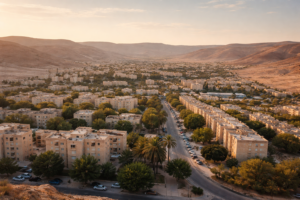
Dimona and Arad occupy a particular place in Israel’s geography and psyche. Dimona, established in the 1950s in the middle of the Negev desert, was intended to be a development town—a place where Israel could spread its population and establish a presence in the country’s vast southern expanse. The nuclear research center that came later gave the city an outsize strategic importance, but for the roughly 35,000 residents, it has always been home. It’s a place of modest apartment buildings, community centers, and the particular resilience of people who chose to live far from Tel Aviv’s coastal bustle.
Arad, slightly smaller, was founded in 1962 and developed a reputation as a quieter, almost alternative community—a place where artists and intellectuals settled alongside the workers who maintained the nearby Dead Sea industries. Both cities exist in the sharp, clear light of the desert, where distances seem deceptive and the sky stretches endlessly overhead. Until Saturday, that sky had been a source of natural beauty. Now it represents something else entirely.
Police spokesman Dean Elsdunne told reporters that clearing the scenes would take hours, with authorities working to ensure all residents were accounted for. The operation was painstaking—security forces patrolling with flashlights, rescuers searching rubble, the careful accounting of every life touched by the explosions.
The Human Calculus: Numbers That Tell Only Part of the Story
According to official figures, Iranian missile attacks since the war began have claimed 15 lives in Israel and four Palestinian women in the occupied West Bank. Saturday’s strikes in Dimona and Arad, while not the deadliest in terms of fatalities, appear to represent some of the most significant property damage inflicted on Israeli soil in this conflict.
But numbers, as always, obscure as much as they reveal. Behind the 84 wounded in Arad are 84 families whose lives were disrupted in ways that won’t be captured in any official tally. There are the parents who will now struggle to sleep through the night, the children who will flinch at unexpected loud noises, the elderly residents who must now navigate recovery in bodies less resilient than they once were.
The ten individuals listed in serious condition represent the most urgent human cost—people whose recovery will be measured not in days but in months, if it’s possible at all. And for every physical wound, there are countless psychological ones that may never fully heal.
A War That Has Reshaped Daily Life
Since February 28, when the conflict began with US-Israeli air raids on Iran, Israelis across the country have adapted to a new normal. It’s a normal that includes sirens, shelters, and the particular anxiety of not knowing when or where the next strike will come. But for residents of southern Israel, this reality has always been more acute, more present, more difficult to push to the margins of consciousness.
The missile that struck Dimona landed near the city’s nuclear facility—a location that has long been understood as a potential target but that most residents preferred not to think about in concrete terms. The facility itself, officially a research center, maintains Israel’s policy of ambiguity regarding its nuclear capabilities. But its presence has always created a particular vulnerability for the surrounding community—a sense that if the unthinkable were to happen, it might happen here.
Prime Minister Benjamin Netanyahu, in a statement from his office, described it as “a very difficult evening in the battle for our future.” Speaking with Arad’s mayor, Netanyahu added that “We are determined to continue striking our enemies on all fronts.” The language was resolute, the posture defiant. But for the residents sifting through damaged apartments and shattered windows, the evening was difficult in ways that transcend political rhetoric.
The Global Context: Strikes That Echo Far Beyond the Negev
These attacks did not occur in isolation. They came as the United States and Israel continue to pound targets across Iran, claiming to have degraded the Islamic republic’s military capabilities. The tit-for-tat nature of this conflict has created a rhythm of escalation that seems to accelerate with each passing week.
What makes Saturday’s strikes noteworthy is not just the damage inflicted but the location. The Dimona facility has long been considered one of Israel’s most sensitive strategic sites. A strike landing within five kilometers of its perimeter sends a message that goes beyond the immediate physical damage—it demonstrates a willingness to test boundaries that have traditionally been considered red lines.
For Iran, these attacks represent a continuation of its stated strategy of retaliation. For Israel, they are another data point in a conflict that shows no signs of de-escalation. And for residents of the Negev, they are simply the latest chapter in a story they never asked to be part of.
The Night After: Searching for Normal in the Rubble
By the early hours of Sunday, a grim routine had established itself at the Arad impact site. Police warned residents on loudspeakers not to approach, even as many lingered at the edges of the cordoned area. People took photos—perhaps to document, perhaps to process, perhaps because in the age of smartphones, witnessing has become inseparable from recording.
An AFP correspondent on the scene described a crater surrounded by bombed-out buildings, the physical evidence of force that is almost impossible to comprehend. Security forces worked methodically, their flashlights cutting through the darkness as they searched for any remaining casualties. The operation was careful, deliberate, the work of people who understood that every moment mattered.
For the 17-year-old Franky and his family, the immediate danger had passed. But the aftermath of such an event lingers in ways that can’t be captured in news reports or official statements. There will be the insurance claims, the repairs, the conversations with neighbors about what happened. There will be the nights when every siren, even a false alarm, sends the heart racing. There will be the slow, difficult process of rebuilding—not just buildings, but a sense of security.
What Comes Next: The Unanswerable Questions
In the hours and days following these strikes, there will be investigations. Military analysts will pore over the failed interception, asking hard questions about how a missile penetrated Israel’s defenses. Officials will make statements about resolve and retaliation. The cycle of violence that has defined this conflict will continue its grim momentum.
But for the residents of Dimona and Arad, the immediate future is more mundane and more pressing. There are apartments to repair, injuries to treat, routines to rebuild. There are children who need to feel safe enough to return to school, adults who need to find the courage to resume their daily commutes, elderly residents who need support to navigate the aftermath of trauma.
The desert will remain, as it always has. The sky will stretch overhead, as it always does. But something has changed in these communities—something that won’t be fully captured in any news report, any official statement, any strategic analysis. The unthinkable happened. And now, like communities throughout history who have endured similar moments, the people of Dimona and Arad must find a way to continue.
Conclusion: Beyond the Headlines
There is a tendency in coverage of conflict to focus on the strategic, the political, the macro-level analysis. These things matter, of course. Understanding the broader context of the US-Israeli campaign against Iran, the capabilities and limitations of missile defense systems, the geopolitical calculations of all parties involved—these are important pieces of a complex puzzle.
But what happened Saturday in Dimona and Arad was, at its core, something simpler and more tragic. It was the interruption of ordinary lives by extraordinary violence. It was the destruction of places where people lived, loved, argued, laughed, and planned for futures that now seem more uncertain. It was the imposition of fear on communities that had learned, over decades, to live with a particular kind of uncertainty.
The headlines will move on. There will be new developments, new attacks, new statements from world leaders. The news cycle will turn, as it always does. But for the 84 wounded in Arad, the 30 in Dimona, the families whose apartments are now uninhabitable, the teenagers who will never forget the sound of those explosions—the story continues. It continues in hospital rooms and temporary housing, in therapy sessions and insurance claims, in the slow, difficult work of putting lives back together.
This is the reality that exists beyond the headlines. It is less dramatic than the strategic analysis, less satisfying than the political rhetoric, less clear-cut than the official statements. But it is, perhaps, the most important story of all—the story of how ordinary people navigate extraordinary circumstances, how communities absorb violence and somehow continue, how human beings find the strength to rebuild even when the foundations have been shaken.
In the Negev desert, as the sun rose over Dimona and Arad, that work had already begun.
You must be logged in to post a comment.