
Beyond the Headlines: The Human Toll of India’s LPG Crisis as West Asia Conflict Disrupts Supply
Beyond the Headlines: The Human Toll of India’s LPG Crisis as West Asia Conflict Disrupts Supply
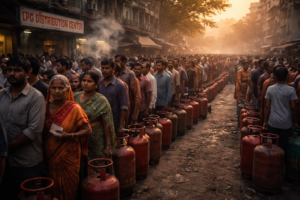
The queue snaked around the block before dawn. In Kolkata’s Lake Gardens neighborhood, nearly 200 people had gathered outside an LPG distribution center by 5:30 a.m. on Saturday—many carrying empty cylinders, others clutching ration cards, all wearing expressions of quiet anxiety.
“I’ve never seen anything like this in 15 years,” said Purnima Das, a 58-year-old homemaker who had been waiting since 4 a.m. “Not during COVID, not during any crisis. My family has eaten one meal a day for the past three days because I’m afraid to use the last bit of gas I have.”
Das is one of millions of Indians navigating an unexpected cooking gas crunch that has exposed the fragility of energy supply chains and tested the resilience of households and businesses alike. While headlines focus on geopolitical tensions and shipping routes, the real story lies in the daily struggles unfolding across the country.
The Ship That Carries a Nation’s Hope
Somewhere in the Arabian Sea, an Indian-flagged vessel named Shivalik is making its way toward Indian shores. With a cargo capacity exceeding 54,000 tonnes of liquefied petroleum gas, this single ship represents nearly a full day’s worth of India’s LPG imports.
When marine tracking websites showed the vessel had successfully crossed the Strait of Hormuz on Friday night, it offered a glimmer of relief to officials monitoring the crisis. The ship departed Qatar’s Ras Laffan port on March 7—originally destined for the United States—but its journey has taken on new significance amid the disruptions.
Yet even as Shivalik approaches Indian waters, its arrival won’t solve the underlying problem. The vessel’s owner, the Shipping Corporation of India, has operated this ship since acquiring it in its fifth ownership change. Built in 2008, it represents the kind of infrastructure India relies upon but perhaps takes for granted—until a crisis hits.
The Geography of Vulnerability
To understand why a conflict thousands of kilometers away has Indian citizens queueing for cooking gas, one must look at a map. The Strait of Hormuz, a narrow waterway between Iran and Oman, serves as a maritime bottleneck through which nearly 90% of India’s LPG imports must pass.
When U.S.-Israeli strikes on Iran plunged the region into war on February 28, that bottleneck transformed into a potential chokepoint. Shipping traffic through the strait has plummeted—Lloyd’s List Intelligence reports that only 77 vessels crossed in the first eleven days of March, compared to 1,229 during the same period last year.
“Most of the vessels now traversing the strait belong to the so-called shadow fleet—ships operating outside conventional regulatory frameworks, typically linked to Russia and Iran,” a Lloyd’s analyst noted. For legitimate cargo vessels carrying Indian-bound gas, the risks have become prohibitive.
The Two-Tiered Crisis: Domestic vs. Commercial
What makes this shortage particularly complex is its uneven impact. Government officials insist that domestic LPG supplies remain adequate—and in many areas, that’s true. But the commercial sector tells a different story.
In Kerala’s Kochi city alone, more than 100 hotels have shut their doors. The Kerala Hotel and Restaurant Association reports that commercial cylinder supplies have “nearly dried up,” forcing establishments to make impossible choices.
Samridhi, a budget eatery chain run jointly by the Kochi Corporation and Kudumbashree Mission, exhausted its LPG reserves on Friday. By afternoon, workers were hauling firewood to the central kitchen—a fuel source they hadn’t used in decades.
“Cooking is considerably slower, and we need up to 1.5 tonnes of firewood daily, costing around ₹6,000 including transportation,” a manager explained. The irony isn’t lost on anyone: in 2026, one of India’s fastest-growing cities has restaurants reverting to pre-industrial cooking methods.
The Migrant Worker Dilemma
Perhaps the crisis’s most overlooked human dimension involves Kerala’s migrant workforce. Thousands of workers from West Bengal and Assam staff the state’s restaurants and hotels—employers who now face losing them at a critical juncture.
G Jayapal, state president of the Kerala Hotel and Restaurant Association, explains the timing couldn’t be worse. “Migrant workers from West Bengal and Assam typically return home a week before elections in their states. With hotels closing, they’re leaving early—and with Ramzan approaching next week, they may not return until after the elections.”
Binoy Peter of the Centre for Migration and Inclusive Development estimates that roughly 50% of Kerala’s migrant workforce comes from the poll-bound states of Assam and West Bengal. “Reserved train tickets to these states are already on waiting lists,” he notes. “The combination of hotel closures, Ramzan, and elections has created a perfect storm.”
For restaurant owners trying to retain staff, the situation is desperate. Small-scale operators find it particularly hard to maintain workers when their shops are closed, creating a cascade of economic dislocation that extends far beyond the immediate fuel shortage.
The Black Market Emerges
Wherever shortages appear, profiteers follow. Across the country, enforcement agencies have launched crackdowns on hoarding and black market sales.
In Mumbai’s Worli area, Food Distribution Department officials raided “Suraj Vallabhdas Chawl” on Ganpatrao Kadam Road, seizing 64 filled 4-kg cylinders, 19 filled 12-kg cylinders, and dozens of empties from multiple gas companies. The operation targeted a gang allegedly selling cylinders at inflated prices to desperate buyers.
In Lucknow, authorities conducted raids at 1,483 locations, arresting six individuals and registering 24 FIRs. The scale of enforcement—spanning an entire state within days—suggests authorities recognize the potential for the crisis to spiral.
“We’re seeing diversion of domestic cylinders to commercial users, illegal stockpiling, and price gouging,” a senior official admitted. “When people panic, unscrupulous elements exploit the situation.”
Chhattisgarh has seized 741 cylinders from 102 locations, with Raipur district alone accounting for 392 confiscated cylinders. The numbers tell a story of opportunity seized upon by those willing to profit from others’ distress.
Government Response: Assurance and Action
Prime Minister Narendra Modi addressed the crisis at the NXT Summit in Delhi, accusing certain groups of “creating unnecessary panic” and warning that such actions harm the nation. He urged state governments to intensify action against hoarders and black-marketers while assuring citizens that India is taking all steps to safeguard energy security.
At the bureaucratic level, Joint Secretary Sujata Sharma of the Petroleum Ministry acknowledged that LPG imports are a “slight issue of concern” but emphasized that no distributor has reported a complete dry-out. She urged consumers against panic booking—advice that often goes unheeded when people see neighbors hoarding.
State governments have responded with varying approaches. Gujarat decided to provide new piped natural gas connections to restaurants, hotels, and institutions in areas with pipeline infrastructure. Haryana’s Minister Rajesh Nagar warned of strict action against rumormongers while insisting domestic supplies remain normal. Telangana activated a toll-free number (1967) for reporting hoarding and lodging grievances.
Some responses border on the creative. In Kamarhati, West Bengal, Municipal Councillor Bimal Saha distributed cow dung cakes to people queueing outside LPG dealerships—a “symbolic protest” highlighting the absurdity of a crisis that forces modern citizens to consider traditional fuels.
The Industrial Fallout
Beyond households and restaurants, industrial consumers face their own challenges. Jindal Stainless Ltd, India’s largest stainless steel manufacturer, announced it’s operating plants at “rationalized capacity” due to shortages of industrial gases including propane, LPG, and natural gas.
“Several processes across our plants have been adversely impacted,” Managing Director Abhyuday Jindal stated, calling on the government for clarity on supplies to industrial consumers. The statement underscores how fuel shortages ripple through the economy, affecting production, employment, and ultimately consumer prices.
The Confederation of All India Traders warned that Bhopal’s hospitality sector faces “complete shutdown” if commercial supplies aren’t restored. CAIT district president Dharmendra Sharma noted that while business owners have ordered induction-based cooking systems, equipment may take seven to ten days to arrive—and restaurants would need to increase power capacity, which can’t happen immediately.
“The entire hospitality and food service sector may face closure, hitting thousands of livelihoods and disrupting daily food services for citizens,” Sharma warned.
The Regional Ripple Effects
India’s crisis extends beyond its borders, affecting neighbors dependent on its supply chains. Nepal, the landlocked Himalayan nation of 30 million, relies almost entirely on India for fossil fuel transportation—and roughly 90% of India’s LPG passes through the Strait of Hormuz.
Nepal has begun selling half-filled cooking gas cylinders to curb hoarding and panic buying, officials confirmed—a measure that reflects the severity of supply disruptions filtering through the region.
Further afield, African nations face potentially devastating consequences. Fuel shortages caused by the war could knock up to three percentage points off African economic growth if they persist, according to Geoffrey Aori, CEO of the Regional Association of Energy Regulators for Eastern and Southern Africa.
“Most African countries have fuel reserves for just 15 to 25 days, compared to the International Energy Agency standard of 90 days,” Aori noted, calling on governments to introduce rationing and subsidies to cushion the blow of inflation and weakening currencies.
The Price of Panic
In Bengaluru’s Jayanagar neighborhood, locked “darshinis” (local eateries) tell the story of a city adjusting to scarcity. Smaller establishments report they can manage for at least a week—but the uncertainty of when normalcy will return haunts every conversation.
Meanwhile, international oil markets reflect the broader anxiety. Brent crude closed at $103.14 per barrel on Friday, having soared more than 42% since the conflict began. Serbia cut fuel taxes by 20% through mid-April. Portugal renewed temporary tax cuts on petrol and diesel. Airlines including IndiGo and Air India introduced fuel charges ranging from ₹425 to ₹2,300 on flights.
The financial markets responded predictably—benchmark indices dipped 2% as crude prices remained high, with both Nifty and Sensex declining to 23,151.10 and 74,563.92 respectively.
Looking Ahead: Adaptation and Resilience
As India navigates this crisis, longer-term questions emerge about energy security, diversification of supply sources, and the resilience of critical infrastructure. The Shivalik‘s successful passage through Hormuz offers temporary relief, but it doesn’t address the fundamental vulnerability exposed by this conflict.
For now, citizens adapt. In Kerala, sawmills and plywood factories report flood of firewood inquiries despite rising prices. In Tamil Nadu, political alliances plan protests. In Manipur, officials combat misinformation on social media about shortages that don’t exist—at least not yet.
Purnima Das, still waiting in that Kolkata queue as the morning sun climbs higher, represents millions of Indians hoping that the ship carrying their nation’s gas arrives before their own cylinders run empty.
“I’ve cooked on firewood as a child,” she reflects. “I never thought I’d have to consider it again.”
Her words capture the strange paradox of this crisis: a modern economy thrown back on traditional solutions, a globalized supply chain disrupted by distant conflict, and ordinary people adapting to circumstances they never anticipated—as they always have, and always will.
You must be logged in to post a comment.