
Beyond the Headlines: The Human Cost of Broken Pipes and a Crisis of Trust in India’s Urban Water Woes
The Indore water contamination tragedy exposes the hidden human cost of India’s urban infrastructure failures, where broken pipelines and ignored citizen complaints allowed sewage to enter drinking water, leading to deaths and widespread illness in a city celebrated as the country’s “cleanest.” Beyond the official statistics, the crisis reveals a deeper collapse of trust between citizens and civic authorities, particularly in poorer neighbourhoods that depend entirely on public water systems. The failure was not sudden but foretold by months of foul-smelling water and administrative inaction, highlighting how reactive governance, neglected maintenance, and overreliance on visible cleanliness rankings mask systemic risks. Ultimately, the episode underscores the need for a shift from supply-driven urban expansion to accountable, technology-enabled water quality management that treats early warnings as emergencies and restores the most basic promise of urban life: safe water and public trust.
Beyond the Headlines: The Human Cost of Broken Pipes and a Crisis of Trust in India’s Urban Water Woes
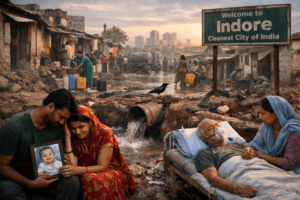
The story from Indore begins with a heartbreakingly simple act: a father diluting cow’s milk with tap water for his five-month-old son, Avyan. It’s a practice rooted in generations of childcare wisdom, meant to protect. Instead, it became a lethal delivery system. This single, intimate detail frames a catastrophe that is at once a sudden public health emergency and a slow-burning failure of urban infrastructure—a story not just of contaminated water, but of fractured trust.
Indore, proudly crowned India’s “cleanest city” for seven consecutive years, now grapples with a grim paradox. The very symbol of civic order has been breached from within, not by litter on streets, but by an invisible enemy in its pipes. The official narrative, as it often does in such crises, revolves around numbers: four confirmed deaths, eight suspected, fourteen alleged by locals; over 200 hospitalised; 2,450 cases identified. But in the narrow lanes of Bhagirathpura, the arithmetic of grief is personal. For Sunil Sahu, the number is one: his son. For tailor Sanjay Yadav, it is his 69-year-old mother, gone in less than a day. For Sudha Pal, her 76-year-old father, Nandalal.
The Unheeded Whisper Before the Outbreak
A critical insight emerges not from the outbreak itself, but from the timeline preceding it. Residents report complaining about foul-smelling, visibly tainted water for over two months. This is the chronicle of a disaster foretold. The human nose, a primitive but effective sensor, raised the alarm long before lab tests or epidemic curves. The tragedy, therefore, is not merely a technical failure—a leaking pipeline allowing sewage ingress—but a profound failure of responsiveness. It reveals a dangerous gap between civic perception and administrative action, where the daily concerns of a largely poor and lower-middle-class neighbourhood are discounted until they erupt into a statistic that cannot be ignored.
This pattern is tragically familiar across India’s rapidly urbanising landscape. Cities swell, but their skeletal, often colonial-era water and sewage networks do not keep pace. New lines are laid over old, maintenance is deferred, and maps of these subterranean labyrinths are sometimes non-existent. The infrastructure exists in a state of precarious invisibility, only noticed when it fails catastrophically. As local BJP councillor Kamal Waghela admitted, the pipelines need “a lot of repairs,” an acknowledgement that comes too late for the grieving families.
The Illusion of Safety and the Burden of Vigilance
The Sahu family’s case pierces another layer of assumed security. They knew the tap water was unsafe.所以他们煮了它 (So they boiled it). Boiling is the universal, grassroots water-purification technique, a ritual in millions of Indian homes. It represents a transfer of responsibility—from the state providing potable water to the citizen actively making it potable. Yet, this trust in a basic precaution was betrayed. While boiling kills biological pathogens, it does not remove chemical contaminants, heavy metals, or the sheer physical disgust of sewage. The family did everything a resource-constrained household is expected to do, yet it wasn’t enough. This shatters the social contract of urban living, where citizens pay taxes and follow “best practices” in return for fundamental services like safe water.
The aftermath sees a familiar scramble: the leaking pipeline “fixed,” a committee formed, officials suspended, water tankers deployed. These are necessary crisis-management steps, but they are also a script played out repeatedly in different cities. They treat the symptom, not the disease. The real investigation must ask why preventive maintenance and grievance redressal systems are so weak that only deaths trigger action.
A Political Churn in Polluted Waters
Inevitably, the crisis flows into political channels. The opposition Congress accuses the BJP of “misgovernance” and hiding the true toll. The BJP, dominant in Madhya Pradesh and in Indore, is on the defensive, promising accountability. This political friction, while part of democratic accountability, often obscures the deeper, apolitical nature of the problem. Infrastructure decay is a bipartisan legacy. It points to a systemic malaise where urban planning is frequently reactive, underfunded, and loses out to more visible, vote-friendly projects. “Indore has consistently given votes to the BJP but they have given poisoned water instead,” says Congress’s Jitu Patwari. This rhetoric, however potent, risks reducing a complex engineering and governance failure to a mere partisan slugfest, allowing the broader, structural issues to escape scrutiny once the immediate news cycle passes.
Beyond Indore: A National Insight
The Indore tragedy is not an outlier; it is a stark case study. It offers several crucial insights for India’s urban future:
- The Inequality of Risk: Crises like this disproportionately affect neighbourhoods like Bhagirathpura. Affluent areas often have building-level purification systems, stored water reserves, and the agency to demand quicker fixes. The poor rely on the last mile of the public network, which is most vulnerable. Contamination becomes a silent driver of urban inequality.
- The Myth of the “Model City”: Awards and rankings, while incentivising certain aspects of cleanliness, can create a dangerous complacency. Sweeping streets and managing waste are visible; maintaining underground pipes is not. A city can be superficially clean while its lifeblood—water—is under threat.
- The Need for a Paradigm Shift: The solution lies beyond fixing leaks. It requires investing in smart water management: digitised mapping of networks, continuous water quality monitoring sensors at nodal points, predictive maintenance using data, and, most importantly, a transparent public dashboard where citizens can see water quality reports for their locality in real-time. Accountability must be built into the system, not just activated after a disaster.
A Path Forward: From Grief to Governance
For the families of Bhagirathpura, no committee report can bring back Avyan or Nandalal Pal. Their grief is the ultimate cost of this failure. The only meaningful tribute is a transformation in how Indian cities value their water infrastructure.
This involves moving from a supply-centric model (laying more pipes to more areas) to a quality-centric and resilience-centric model. It means training and empowering a new cadre of civic workers who are plumbers, data analysts, and public health responders rolled into one. It demands that citizens’ complaints about water smell or colour are treated with the urgency of a pending catastrophe, because that is what they are.
The contaminated water of Indore is a tragic metaphor. It signifies the mixing of the pure and the impure, the intended and the neglected, the promise of a rising India and the harsh reality of its foundational cracks. Healing requires more than tankers and suspensions; it requires a fundamental reckoning with what it truly means to build a clean, livable, and just city—where every tap delivers not just water, but trust. The children of Bhagirathpura deserve nothing less.
You must be logged in to post a comment.