
Beyond the Headlines: The Human Cost of a Ceasefire That Never Was
Despite a U.S.-brokered ceasefire agreement that began in October 2025, Israeli forces have continued lethal operations in Gaza, killing at least two Palestinians in Gaza City in a single incident that exemplifies the 875 reported violations of the truce, which have resulted in over 400 Palestinian deaths since its inception. Concurrently, Israel has systematically choked the flow of humanitarian aid, allowing only 244 trucks per day on average against a stipulated 600, exacerbating a catastrophic humanitarian crisis for 1.3 million displaced people who face winter storms without adequate shelter, food, or medicine. This reality renders the ceasefire a diplomatic fiction on the ground, where sporadic violence and a suffocating aid blockade sustain a state of pervasive suffering and instability, underscoring a profound failure of international enforcement and allowing a devastating, protracted crisis to persist.
Beyond the Headlines: The Human Cost of a Ceasefire That Never Was
Meta Description: As violations mount and aid is choked, the Gaza ceasefire appears in name only. An on-the-ground look at the stark reality for Palestinians enduring rain, ruin, and relentless violence.
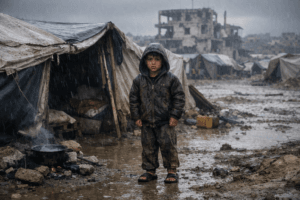
The photograph is haunting in its simplicity: a young Palestinian boy, his frame dwarfed by a makeshift shelter, stands in the rain outside Gaza City. His world is reduced to tarp, mud, and the relentless drizzle of a winter storm. This image, captured in November 2025, is not a relic of the past year’s most intense bombardment. It is a snapshot of the present, a stark testament to a de facto reality that mocks the very term “ceasefire.”
On December 22, 2025, Israeli forces opened fire in the Shujayea neighbourhood of eastern Gaza City, killing two Palestinians. These were not the first deaths since the U.S.-brokered truce began on October 10, nor, tragically, will they be the last. According to Gaza’s Government Media Office, this incident was one of at least 875 violations of the ceasefire by Israeli authorities—a litany that includes aerial attacks, artillery fire, home demolitions, and over 265 incidents of troops shooting civilians. The office reports that these breaches have killed 411 Palestinians and wounded over 1,100 since the truce began. The arithmetic is grim: a “ceasefire” under which an average of nearly three Palestinians have been killed every day.
This is the central, agonizing contradiction of Gaza today. A diplomatic mechanism designed to pause a war and alleviate suffering has instead become a framework for its continuation by other means. The violence has mutated, not ceased. The wholesale destruction of the 2023-2024 war has given way to a more sporadic, but no less deadly, pattern of strikes and raids. Meanwhile, the parallel obligation of the ceasefire—to allow a “surge” of humanitarian aid into the starved enclave—has been systematically undermined.
Israel, as the occupying power, is bound by international law to ensure the welfare of Gaza’s population. The ceasefire agreement explicitly stipulated the entry of 600 aid trucks daily. Yet the data reveals a chasm between promise and practice: only 17,819 trucks have entered since October, averaging a mere 244 per day. This is not a logistical failure; it is a policy. The withheld aid includes the very materials needed for survival—winterized tents, blankets, durable shelter equipment—as storms lash the coastal strip. The result is a man-made disaster layered upon a natural one. Over 1.3 million displaced people, nearly 90% of Gaza’s population, are trapped in a cycle of exposure, disease, and despair.
The UN’s repeated, almost ritualistic calls for “the lifting of all restrictions” echo into a void. As spokesperson Stéphane Dujarric noted, operations are continually disrupted by the very violations the ceasefire was meant to halt. Humanitarian partners scramble to distribute meager supplies, but the need is apocalyptic in scale. Meanwhile, Gaza’s health system, targeted into collapse during the war, cannot cope with the casualties from ongoing violence or the illnesses born of squalid conditions. The Palestinian Ministry of Health warns of a critical shortage of drugs and supplies, turning survivable conditions into death sentences.
The Architecture of a Failed Truce
What does it mean when a ceasefire is violated hundreds of times? It means the agreement itself becomes a tool of control and a narrative battleground. For the families in Gaza, the term “ceasefire” is a cruel semantic fiction. It does not stop the sound of gunfire in Shujayea or the dread of drones overhead. It does not keep rainwater from flooding their makeshift tents in Bureij camp. It does not put sufficient food on their plastic plates.
The violations are not random accidents; they form a pattern that suggests strategic calculation. By maintaining a low-intensity pressure—a raid here, a shooting there, a constant throttling of aid—the status quo of displacement and desperation is frozen in place. This prevents any meaningful recovery or return, effectively reshaping the facts on the ground. The goal appears less about achieving military victory over Hamas at this moment, and more about making Gaza unlivable, thereby cementing a new, terrible normal.
This strategy exacts its deepest price from the most vulnerable. The child in the rain-soaked photograph represents a generation growing up knowing only trauma, loss, and instability. Their education has been obliterated, their healthcare shattered, their homes reduced to rubble. The psychological wounds inflicted by this protracted, simmering violence are profound and will span decades. When a ceasefire is not peace but merely a less intense form of war, it denies people the very space to grieve, heal, or hope.
The International Complicity of Silence
The mounting violations and the aid blockade occur under the watch of a global community that brokered the truce. The tepid diplomatic responses, the careful parsing of condemnations, and the ongoing provision of military aid to Israel send a clear message: the suffering of Palestinians remains a permissible cost. Each stalled aid truck at the Rafah or Kerem Shalom crossings is a testament to a failure of international will. As one UN official put it off the record, “We are documenting a moral collapse in real-time.”
The path forward is obscured, but it must begin with truth-telling. The first step is to retire the euphemism “ceasefire violations” and call this what it is for Palestinians: a continued war. Pressure must be applied not only to halt the shootings and raids but to force open the aid gates unconditionally. The delivery of shelter, food, and medicine is not a bargaining chip; it is a non-negotiable obligation under international law.
Ultimately, the story of Gaza’s “ceasefire” is a lesson in how words can be weaponized to disguise reality. For the two men killed in Gaza City this week, for the children shivering in flooded tents, and for the medical teams working without supplies, the truce exists only on paper. Their daily reality is one of endurance against a cascade of hardships, both violent and bureaucratic. Until the international community finds the courage to match its diplomatic frameworks with enforceable action, the rain will keep falling, the shots will keep ringing out, and the ceasefire will remain nothing but an empty word, drowning in the winter mud of Gaza.
You must be logged in to post a comment.