
Beyond the Headlines: The Human and Strategic Reckoning in the Iran-Israel War
This analysis reveals that the two-week-old Iran-Israel war represents a fundamental breakdown of the old rules of engagement, transforming the conflict into a multi-front conflagration with global stakes that extend far beyond the battlefield. The U.S. deployment of the 31st Marine Expeditionary Unit and USS Tripoli isn’t merely a troop increase but a strategic signal of a credible over-the-horizon ground option, while Israel’s precision strike on a crowded Tehran rally during Quds Day demonstrates a new era of psychological warfare designed to undermine the regime’s legitimacy in plain sight.
Compounding this volatility is the ghost-like absence of Iran’s new Supreme Leader Mojtaba Khamenei, whose invisibility breeds internal confusion and weakens command authority just as Iran’s effective closure of the Strait of Hormuz weaponizes the global economy by threatening one-fifth of the world’s oil supply. With the conflict metastasizing from Lebanon to Oman to Turkey, and American forces now squarely back in the crosshairs across the region, the war has entered an unpredictable phase where the human cost—measured in shattered lives, terrified civilians at rallies, and cascading economic disruption—is only beginning to be counted, leaving the world to wonder if any party has a viable endgame.
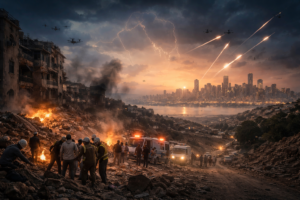
Beyond the Headlines: The Human and Strategic Reckoning in the Iran-Israel War
The news feeds are a torrent of dramatic developments: “U.S. orders 2,500 marines to Mideast.” “Blast rocks Tehran during large rally.” “Israel strikes more than 7,600 targets.” These headlines, pulled from the front lines of a rapidly escalating conflict, paint a picture of a region on fire. But to understand the true gravity of this moment—almost two weeks into a war between Israel and Iran—we must look beyond the raw data of troop movements and casualty counts. We must examine the strategic chess game, the psychological warfare playing out in the streets of Tehran, and the profound human and economic stakes that threaten to reshape the Middle East and the world.
This isn’t just another skirmish. It is a full-blown, multi-front war that has effectively pitted the world’s two great powers—the United States and its ally Israel against the Islamic Republic of Iran and its network of proxies—in a direct and unrelenting confrontation. The “rules of the game” that governed this conflict for decades have been utterly discarded.
The Signal of the 31st MEU: A Message in Boots and Steel
The reported deployment of the 31st Marine Expeditionary Unit (MEU) and the amphibious assault ship USS Tripoli from Japan to the Middle East is not merely an addition of 2,500 troops; it is a powerful piece of strategic signaling.
A Marine Expeditionary Unit is a self-contained “kick down the door” force. Embarked on amphibious ships, it is a floating fortress and a landing force rolled into one. It contains its own ground combat element, its own aviation combat element (with attack helicopters and Harrier or F-35B jump jets), and its own logistics element. The USS Tripoli is specifically designed to operate as a “lightning carrier” for F-35Bs, the stealth jump-jet variant of the Joint Strike Fighter.
By dispatching this particular asset from the Pacific, the U.S. is sending a clear message to Tehran: we have a credible, versatile, and sustainable force that can project power onto your coastline, secure a beachhead, or conduct a non-combatant evacuation of American citizens without relying on vulnerable local infrastructure. It is the ultimate expression of flexibility and a stark warning. While the official line will be about force protection and deterrence, the presence of a MEU significantly raises the potential cost for Iran of any action against U.S. personnel or interests in the Gulf. It transforms the U.S. posture from one of purely aerial bombardment to one with a credible, over-the-horizon ground option. As the article notes, this doesn’t mean a ground invasion is imminent, but it forces Iranian military planners to now account for that terrifying possibility in every decision they make.
The Explosion in Tehran: A War of Nerves in Ferdowsi Square
Perhaps the most chilling scene described is the explosion that rocked Ferdowsi Square in Tehran during the annual Quds Day rally. This was not a random act of war; it was a calculated piece of psychological warfare playing out in real-time, witnessed by thousands.
The Israeli military’s Farsi-language X account warned people to clear the area shortly before the blast. This is a new and terrifying dimension of modern warfare. It turns a civilian space, thick with political and religious symbolism, into a target, while attempting to absolve the attacker of responsibility by issuing a digital warning. The fact that the rally proceeded anyway, with thousands chanting “death to Israel,” speaks to the regime’s iron determination to project normalcy and defiance. To cancel the rally would have been to admit defeat, to show that the leaderless (or newly-led) nation could be cowed by Israeli threats.
For the average Iranian at that rally, the moment must have been surreal. One second they are part of a sea of people, a collective voice for a cause; the next, a blast sends smoke and terror through the crowd. The cry of “God is greatest” that went up is a common reflex in moments of shock and defiance in the Muslim world, a way to reclaim a sense of divine protection in the face of mortal danger. This is the human face of the war: a people caught between their government’s belligerence and an enemy’s willingness to strike at the heart of their capital during a public gathering.
The targeting of such a rally, and Israel’s open acknowledgment of it, signals a shift in strategy. It suggests a belief in Tel Aviv and Washington that the regime in Tehran is brittle. By demonstrating its inability to protect even a massive, state-sanctioned event, Israel is trying to sow public doubt in the regime’s competence and legitimacy, amplifying the whispers of discontent that were already present after the death of the old Supreme Leader and the ascension of a new, untested one.
The Ghost Leader and the New Iran
The war has created a bizarre and dangerous power vacuum at the top of the Iranian hierarchy. The new Supreme Leader, Ayatollah Mojtaba Khamenei, has issued statements vowing to fight on and open “other fronts.” But he is a ghost. He has not been seen or heard publicly since the war began, fueling rampant speculation about his health and whereabouts. The report that he was “lightly” injured in the same strike that killed his father, and U.S. Secretary of War Pete Hegseth’s unsubstantiated claim that he is “likely disfigured,” only adds to the fog of uncertainty.
This absence is a critical vulnerability for Iran. In a Shia theocracy, the Supreme Leader is not just a political figure; he is the ultimate source of religious and political authority, the “Vali-ye Faqih” (Guardian Jurist). His visibility is a crucial tool for rallying the populace and projecting strength. His invisibility, by contrast, breeds confusion, weakens morale, and empowers competing factions within the regime’s complex power structure—the Islamic Revolutionary Guard Corps (IRGC), the regular military, the clerics, and the security apparatus. Is he injured? Is he dead, with the regime hiding the fact to prevent a leadership crisis during wartime? Is he simply hiding in a deeply fortified bunker, directing the war remotely? Each possibility weakens Iran’s hand. It makes it difficult for allies like Hezbollah in Lebanon or the Houthis in Yemen to coordinate a unified response, and it makes it easier for the U.S. and Israel to gamble on the regime’s internal collapse.
The Global Chokepoint: The War on the Economy
While the bombs fall on military targets and the missiles streak through the night sky over the Gulf, a slower, more insidious battle is being waged in the waters of the Strait of Hormuz. Iran’s effective closure of this vital waterway, through which a fifth of the world’s oil passes, is a strategic masterstroke of asymmetric warfare. It is an attack not just on its immediate enemies, but on the entire global economy.
This is the “other front” that Khamenei promised. By targeting tankers and threatening the flow of oil, Iran is applying maximum economic pressure. The attacks on infrastructure in Gulf Arab states, the drone strikes in Saudi Arabia, the damaged building at the Dubai International Financial Center—these are all designed to send a message to the world: “Our war is your problem.” The goal is to create global economic pain that will, in turn, create political pressure on Washington and its allies to force a ceasefire on terms more favorable to Tehran.
For energy and trade experts, this is the nightmare scenario. The “cascading effects” are already being felt. Insurance premiums for tankers transiting the region have skyrocketed. Oil prices are spiking, feeding global inflation. Supply chains, already fragile, are being further disrupted. Every ship that is delayed or diverted is a cost that is passed on to consumers everywhere. The U.S. and its allies face a cruel dilemma: do they risk a wider war by trying to forcibly reopen the strait, a monumental naval undertaking, or do they accept the economic bleeding as the price of prosecuting the war against Iran?
The Widening Circle of Fire
The war is no longer contained within the borders of Iran and Israel. It is a regional conflagration. The report of deaths in Oman from drone crashes, the downing of a missile over NATO member Turkey, the Hezbollah-Israel exchanges that have killed hundreds in Lebanon, and the ongoing attacks on Saudi Arabia all point to a conflict metastasizing across the Middle East.
This is a direct result of Iran’s “forward defense” doctrine, which seeks to push its borders outward by arming and funding proxies. For decades, this kept the fight away from Iran’s homeland. But now that the homeland is under direct assault, those proxies are being activated in a desperate, coordinated, and perhaps uncoordinated, response. The killing of a French soldier in the north of “the country” (presumably Iraq or a neighboring state) and the crash of a U.S. refuelling plane in Iraq show that the American footprint, which was supposed to have been drawn down, is now squarely back in the crosshairs. Every American base, from Al-Udeid in Qatar to Incirlik in Turkey, is now a potential flashpoint.
This is the point where a war of choice can become a war of consequence. A single misstep—a missile that hits a crowded market instead of a military base, a downed plane that leads to a rescue mission gone wrong, an attack that kills a significant number of American soldiers—could trigger an even more dramatic escalation. The deployment of the marines is meant to deter that, but it could just as easily create more targets.
As the world watches the smoke rise over Tehran and the U.S. Navy intercept missiles over Turkey, the central question remains unanswered: what is the endgame? For Israel and the U.S., is it the decapitation of the regime and the complete destruction of its nuclear and military capabilities? For Iran, is it the expulsion of American influence from the region and the annihilation of Israel, as its rhetoric suggests, or is it a brutal, painful struggle for survival that leaves it permanently scarred but still standing?
There are no easy answers. What is clear is that nearly two weeks of war have not brought a resolution. Instead, they have broken the old rules, shattered the established deterrence, and unleashed forces that will be difficult, if not impossible, to put back in the bottle. The human cost, measured not just in the 1,300 dead in Iran or the 773 dead in Lebanon, but in the shattered lives, the terrified children at rallies, and the global anxiety, is only beginning to be counted. The war has entered a new, terrifyingly unpredictable phase, and the world can only watch and wait for the next explosion.
You must be logged in to post a comment.