
Beyond the Headlines: The Freeze on Aid and the Deepening Winter of Despair in Gaza
Israel’s decision to suspend the operations of major international aid groups, including Doctors Without Borders (MSF), for non-compliance with new registration rules requiring staff details, threatens to drastically worsen an already catastrophic humanitarian crisis in Gaza, where a harsh winter is destroying flimsy shelters and overwhelming a decimated health system. While Israel frames the move as a necessary security measure to prevent Hamas from exploiting aid—a claim contested by a prior U.S. review finding no evidence of widespread theft—aid agencies and a coalition of ten countries warn it will cost lives by blocking essential care for hundreds of thousands. The crisis unfolds amid a stark geopolitical divide, with European nations and the UN condemning the suspension as a dangerous obstruction, even as Israeli Prime Minister Netanyahu finds alignment with U.S. President Trump, framing future stability solely on the disarmament of Hamas, a condition rejected by the group and one that leaves the civilian population trapped in a desperate and escalating struggle for survival.
Beyond the Headlines: The Freeze on Aid and the Deepening Winter of Despair in Gaza
As a harsh winter descends upon the Gaza Strip, a different kind of chill is taking hold—one born not of weather, but of policy. The announcement that Israel will suspend the operations of several major international aid groups, including the pivotal Médecins Sans Frontières (MSF), from January 1st, 2026, marks a dangerous inflection point. It’s a move framed by Israeli authorities as a bureaucratic necessity for security, yet decried by humanitarians as a potential death sentence for a population already clinging to survival. This isn’t merely a regulatory dispute; it’s a crisis layered with the politics of war, the principles of humanitarian action, and the raw, desperate reality of over two million displaced lives.
The Bureaucratic Battlefield: Registration as a Strategic Tool
At the heart of the conflict lies Israel’s new registration requirement. Aid organizations must submit detailed personal information of their staff to the Israeli Ministry of Diaspora Affairs to renew their operational licenses. Israel’s stated aim is unequivocal: to prevent Hamas from exploiting international aid, a claim reiterated by its Foreign Ministry as safeguarding “the integrity of humanitarian activity.”
However, for the agencies on the ground, this demand strikes at the core of their operational ethics and safety protocols. In a territory where humanitarian workers have been killed, detained, and harassed—and where communications are fraught—submitting staff lists to a party to the conflict is seen as an unacceptable risk. As Oxfam articulated, it raises “serious protection concerns.” The Humanitarian Country Team for the Occupied Palestinian Territory calls the criteria “vague, arbitrary, and highly politicized.”
This creates an impossible dilemma: comply and potentially endanger your team, or refuse and lose the ability to serve a population in extremis. MSF’s position exemplifies this standoff. While Israel’s COGAT claims the group “chose not to cooperate,” MSF asserts it has been engaged since July 2025 and submitted most information, seeking further dialogue. This gap in narratives isn’t just about paperwork; it’s about fundamental distrust and conflicting priorities—state security versus humanitarian imperatives.
The Human Canvas: Winter Exposes the Fragility of Existence
To understand the stakes of this suspension, one must look beyond the political statements to the conditions in Gaza. Ten foreign ministers—from Canada and the UK to Japan and Switzerland—have jointly warned of a “renewed deterioration” into “catastrophic” conditions. Their words are not hyperbolic.
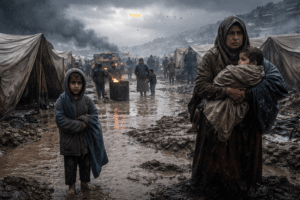
Gaza lies in ruins. Over 1.3 million people require urgent shelter, often in flimsy, waterlogged tents that offer scant protection against relentless winter rains and plunging temperatures. Recent storms have killed at least 20 people as makeshift structures collapsed. This isn’t just discomfort; it’s a systemic emergency. With over half of health facilities only partially functional due to supply shortages, and sanitation infrastructure collapsed—leaving 740,000 vulnerable to toxic flooding—the health risks are multiplying exponentially.
Into this void step organizations like MSF. They are not just aid distributors; they are pillars of a decimated system. MSF supports nearly half a million people with medical care, water, and lifesaving support. Their potential removal, as Refugees International states, will “deepen exposure, illness, and preventable deaths.” When COGAT claims over 4,200 trucks weekly will continue via other channels, aid groups counter that bureaucratic denials have been constant, even during ceasefire. The suspension, therefore, isn’t replacing one channel with another; it’s dismantling a critical, specialized infrastructure of care during its most needed hour.
The Geopolitical Chill: Alignments and Condemnations
The crisis unfolds against a revealing geopolitical backdrop. The chorus of condemnation is notably Western and allied: the EU’s humanitarian chief warned the rules would block “life-saving aid,” while UN Human Rights Chief Volker Türk condemned the suspension as “outrageous.” This friction contrasts sharply with the warm meeting in Florida between Israeli Prime Minister Benjamin Netanyahu and U.S. President Donald Trump. Netanyahu noted they “saw eye to eye,” and he perceived no frustration from Trump regarding recent Israeli strikes.
This diplomatic divide is crucial. The supportive stance from the U.S. administration, juxtaposed with the concerns of European partners, underscores a fragmented international response. Israel’s Foreign Ministry dismissed the ten nations’ joint statement as “false but unsurprising,” reflecting “detached criticism” that ignores the “essential requirement of disarming Hamas.” Herein lies Israel’s framing: humanitarian improvement is contingent on total security control, and aid must be subordinated to that goal.
Yet, a critical piece of context undermines a key Israeli premise. A U.S. government review earlier in the year found no evidence of widespread Hamas theft of aid. This fact, often lost in the narrative, challenges the foundational justification for the stringent registration rules, suggesting that the measures may be more about control than proven diversion.
The Impossible Equation: Disarmament vs. Survival
Netanyahu’s vision, as stated in his Fox News interview, presents the ultimate catch-22. “A new government in Gaza is possible if you disarm Hamas,” he said, adding that no international force would enter if Hamas remains armed. Hamas, predictably, rejects disarmament while the occupation persists. Meanwhile, the civilian population is trapped in the middle of this existential stalemate, with their lifelines of aid now being frayed by the very bureaucratic mechanisms touted as pathways to security.
The suspension of aid groups becomes a tragic lever in this larger political struggle. It risks weaponizing humanitarian access, using the vulnerability of a population as pressure in a conflict that has no end in sight. As one displaced Palestinian in Nuseirat might attest, the debate over registration criteria feels surreal when your immediate concern is whether your tent will survive the next storm or if your sick child can see a doctor.
Conclusion: A Threshold of Conscience
The coming weeks in Gaza will test the limits of international humanitarian law and the global conscience. The suspension of organizations like MSF isn’t a simple administrative transition; it is the deliberate removal of specialized, independent actors at a time of acute systemic collapse. The winter weather is an act of nature; the withdrawal of aid is an act of policy.
True security and stability are born from human security—from shelter, medicine, clean water, and hope. By sidelining key agencies over a contested bureaucratic demand, the immediate future for Gaza is not one of renewed order, but of deepened vulnerability. The world is left to watch whether diplomacy can thaw this freeze before the winter, in every sense, proves unforgivably fatal. The story is no longer just about aid delivery; it’s about whether, in the complex calculus of conflict, the basic human right to survive will be honored or bargained away.
You must be logged in to post a comment.