
Beyond the Headlines: The Complex Reality of Youth, TikTok, and Global Conflict
Hillary Clinton’s warning that TikTok is fueling misinformation about the Israel-Palestine conflict among young Americans highlights a critical democratic concern: a generation is forming its worldview from algorithmically amplified, emotionally charged short-form videos often stripped of historical context. However, this concern exists alongside research showing that young people are not merely passive victims; they actively distrust social media news, fact-check information, and value these platforms for firsthand perspectives traditional media overlooks.
The core challenge, therefore, is not simply a misinformed youth but a systemic failure where the engaging format of platforms like TikTok outcompetes slower, contextual education, creating a polarized environment where visceral reaction replaces reasoned debate. Addressing this requires moving beyond blame to invest in systemic media literacy, demand more responsible platform design that promotes verified context, and create compelling historical content that can compete in the digital attention economy.
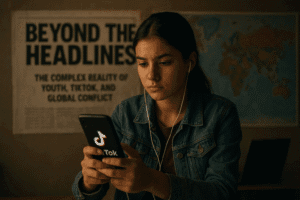
Beyond the Headlines: The Complex Reality of Youth, TikTok, and Global Conflict
In an era where historical context often loses out to viral trends, the political views of a new generation are being shaped in 60-second clips. The recent warning from Hillary Clinton about TikTok’s role in spreading misinformation on the Israel-Palestine conflict has ignited a fierce debate. While her concerns highlight a genuine democratic dilemma, they also open a window into a far more complex landscape of how young people today consume news, form opinions, and engage with the world’s most intractable issues.
Clinton’s remarks, made at the Israel Hayom Summit, strike at the heart of a modern anxiety: that “smart, well-educated young people” are forming their worldview based on social media clips she describes as “pure propaganda”. This fear, however, exists alongside research showing that teenagers are not passive consumers but active, critical participants in digital civic life. The true story lies in the tension between these two realities.
The Dual Narrative: Concerns vs. Research
The following table summarizes the core concerns raised by public figures and the counterpoints emerging from contemporary youth research:
| Aspect | The Concern (Voiced by Clinton, Politicians) | The Research & Youth Perspective |
| Primary News Source | Over-reliance on social media, especially TikTok, for complex news. | A majority of young people do get news from social media, but many value it for “insider” perspectives not found in traditional media. |
| Critical Engagement | Lack of historical knowledge and context makes youth vulnerable to misinformation. | Young people report a strong sense of distrust toward social media news and often fact-check before sharing. |
| Nature of Content | Exposure to one-sided propaganda and emotionally charged, graphic short-form videos. | Content is valued for showing firsthand, visual experiences of global events, making distant conflicts feel real. |
| Civic Outcome | Misinformed opinions that are difficult to engage in reasoned debate. | Creating and sharing media about issues builds political confidence, efficacy, and a sense of empowered voice. |
The Psychology of the Scroll: Why Short-Form Video Captivates and Convinces
The power of platforms like TikTok lies in a potent, psychologically compelling format. As Clinton noted, young people are “seeing short-form videos, some of them totally made up,” and this is where they get their information. The platform’s algorithm excels at delivering visceral, emotionally resonant content—often raw footage from conflict zones—that can bypass critical analysis and embed itself in memory more effectively than text or even longer-form video.
- The “Insider” Illusion: Young users report valuing social media because it shows them things they “wouldn’t normally be able to get access to,” like seemingly unfiltered experiences from Gaza or Ukraine. This creates a powerful, if sometimes misleading, sense of direct witness and truth.
- The Context Collapse: A 60-second video of an explosion in Gaza or a testimonial from an Israeli can convey immense emotional power but carries zero historical explanation. As Clinton experienced with her Columbia University students, this leads to discussions where participants have “very little context”. The complex history of the region, spanning decades, is invisible.
A Platform Under the Microscope: TikTok’s Specific Role
The criticism of TikTok is particularly intense for structural and geopolitical reasons. Data suggests a significant imbalance in content; for instance, pro-Palestinian hashtags like #freepalestine have garnered billions more views than their pro-Israel counterparts. U.S. lawmakers like Senator Josh Hawley have cited this as evidence of the app “radically distort[ing] the world picture” for young Americans.
- Algorithmic Amplification: The platform’s engagement-driven model can create a feedback loop. As one analyst noted, because a certain narrative gains traction, creators are incentivized to produce more content supporting it to grow their following, further skewing the informational ecosystem.
- Moderation at Scale: TikTok has removed hundreds of thousands of videos for policy violations related to the conflict. However, experts argue that content moderators are “outgunned” by the sheer volume of posts, and the short-video format is inherently “not wholly conducive to providing accurate, verifiable context”. This allows graphic misinformation and hate speech to slip through at scale.
The Real-World Consequences: From Campuses to Global Policy
The impact of this digital ecosystem extends far beyond the phone screen. It fuels campus activism and divisive debates, as Clinton witnessed. It also has darker, more dangerous ramifications.
- Erosion of Shared Truth: The Yale analysis points to a “fundamental flaw”: the viral spread of atrocity-denying content and hate speech, which undermines the very possibility of a shared factual baseline for public discourse.
- Offline Violence and Polarization: Misinformation aims to “manipulate public opinion and justify collective punishment”. In the U.S., homeland security experts fear rising antisemitic and anti-Muslim hate speech online could lead to real-world violence. Instances like the anti-Semitic riot at an airport in Dagestan, Russia, allegedly incited by Telegram channels, show the potential for lethal consequences.
Charting a Path Forward: Beyond Blame and Toward Solutions
Blaming a platform or a generation is not a solution. The path forward requires a multi-faceted approach that addresses the complexity of the problem.
- Invest in Systemic Media Literacy: This is the most critical intervention. Research from CIRCLE shows that students who learn media literacy skills in school are twice as likely to be engaged creators of media. Education must move beyond identifying “fake news” to teaching how to trace sources, recognize emotional manipulation, and seek historical context.
- Responsible Platform Design: Social media companies must move beyond reactive content removal. This includes demoting unverified content during crises, not just removing it, and designing features that nudge users toward contextual information. As one researcher stated, platforms need more human moderators with relevant cultural and linguistic expertise to check authenticity.
- Elevating Credible Voices & Historical Context: Institutions and educators must compete in the attention economy. This means supporting credible journalists and historians to create compelling, platform-native content that provides the depth short-form clips lack.
The challenge Hillary Clinton identified is real: a generation forming political consciousness in an information environment fraught with manipulation. However, the answer isn’t to dismiss their engagement or solely restrict their access. It is to take their desire to understand and participate seriously—by equipping them with better tools, demanding more from the platforms that connect them, and tirelessly championing the value of nuanced, contextual truth in a democracy. The goal is not to silence the conversation on TikTok, but to ensure it is informed by history and a commitment to human dignity for all involved.
You must be logged in to post a comment.