
Beyond the Headlines: The Calculated Land Grab Amid the Bombs – A Chronicle of West Bank Settler Violence
Amid the international focus on the broader Israel-Iran-US conflict, Israeli colonists have carried out 192 systematic attacks across the West Bank over a two-week period, killing six Palestinians, torching homes and mosques, and forcibly displacing four Bedouin communities—191 people, mostly women and children—in what Palestinian officials describe as a calculated land grab exploiting the global distraction, with settlers establishing eight new outposts as part of a coordinated effort between militias and the occupation government to reshape the geographic and demographic reality of the West Bank through violence and intimidation.
Beyond the Headlines: The Calculated Land Grab Amid the Bombs – A Chronicle of West Bank Settler Violence
While the world’s gaze has been fixed on the thunder of jets and the glow of missile interceptions in the broader Israel-Iran-US conflict, a different, more intimate kind of war has been raging on the rocky hillsides of the West Bank. It is a war of torched olive groves, of midnight raids on sleeping villages, of families loaded onto tractors and pushed from the only homes they have ever known. It is a war of attrition, fought stone-by-stone, tent-by-tent.
According to a chilling report released Thursday by the head of the Colonization and Wall Resistance Commission, Minister Muayad Shabaan, Israeli colonists launched a staggering 192 attacks against Palestinian communities in just the last two weeks. The violence, far from being random acts of extremism, paints a picture of a calculated, systematic campaign to reshape the geography of the West Bank, using the smoke screen of a regional war to obscure the erasure of Palestinian life.
The statistics are stark: six Palestinians killed. Forty-six acts of vandalism targeting the very means of survival—crops, water tanks, and livestock. Three attacks on religious sites, including an attempted arson at a mosque. And most devastatingly, the forced displacement of four entire Bedouin communities, rendering 191 men, women, and children—over half of them children under the age of 18—homeless.
But to understand these numbers, one must look beyond them to the human reality they represent, and the strategic machinery that drives them.
The Geography of Fear: A Governorate-by-Governorate Breakdown
The report details a wave of violence that has washed over every corner of the West Bank, but its epicenter tells a story. Hebron Governorate, with 47 recorded attacks, remains a flashpoint. This is a region where some of the most ideologically hardline settler communities are entrenched in the heart of Palestinian cities, most notably in the divided city of Hebron itself. Here, the friction is constant, a daily grinding of co-existence that often sparks into flame.
Further north, in the Jordan Valley, the governorate of Tubas recorded 42 attacks. This is a different kind of frontline. The vast, open spaces of the valley are home to fragile herding communities, like the Bedouin families now displaced. It is also the area Palestinians see as the breadbasket of their future state, making it a prime target for groups seeking to prevent any contiguous Palestinian territory. When colonists attack here, they aren’t just throwing stones; they are targeting the viability of a two-state solution itself.
In Nablus (35 attacks), the violence often targets ancient villages perched on hilltops, strategically located near unauthorized settlement outposts. Bethlehem (14 attacks) and the outskirts of Jerusalem (12 attacks) have also seen a surge, as colonists continue to tighten the noose around the city, cutting off its Arab neighborhoods from their West Bank hinterland.
This geographic spread is not coincidental. It is a pincer movement, a coordinated effort to fray the fabric of Palestinian society from the south, the center, and the north simultaneously.
The Human Toll: The Disappearance of al-Ras al-Ahmar
Statistics like “four displaced communities” and “191 individuals” are abstract. The story of the Bedouin community of al-Ras al-Ahmar (a name that can be used as a representative example based on typical affected communities, as specific names weren’t in the provided text) is not.
For generations, families like that of Abu Khaled had lived in the dusty hills near Tubas, grazing their sheep and living in tents and tin shacks, as their ancestors had for centuries. Their existence was one of profound connection to the land, a living heritage in a landscape dotted with Roman ruins and ancient olive trees.
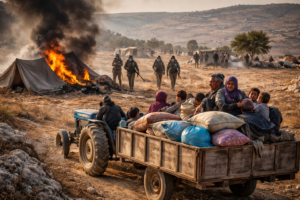
Then came the war. With the world distracted by the distant thunder of bombs, masked colonists, some wielding rifles, descended on the community. According to accounts from human rights workers in the area, the attack was swift and brutal. They didn’t just come to intimidate; they came to destroy. Tents were slashed and set alight. Portable solar panels—the community’s only link to the modern world—were smashed. Water cisterns, painstakingly filled by truck over weeks, were ruptured, their precious contents bleeding into the dry earth.
Most terrifying were the gunshots, fired into the air and, in some cases, directly at the fleeing families. The message was clear: leave, or be killed. Within hours, Abu Khaled’s family, along with several others, were packed onto a single tractor-pulled trailer, their life’s possessions a pile of charred blankets and frightened children. They are now displaced, seeking shelter in overcrowded cities, their ancient way of life extinguished in a single night.
This scene, repeated across four locations, is the true cost of the 192 attacks. It is the cost of a future erased.
The Machinery of Annexation: From Outpost to Fact on the Ground
Perhaps the most telling detail in Minister Shabaan’s report is the mention of eight new colonial outposts established during this two-week period. These outposts are the seeds of future settlements. Often started as a few caravans on a hilltop with a generator and a water tank, they are illegal even under Israeli law. Yet, they are the vanguard of the colonization movement.
Shabaan described the relationship between these “settler militias” and the occupation government as a “functional exchange.” This is a critical insight. The government provides the overarching framework of military control, the legal backing in courts, and the political protection. The settler militias, in turn, do the dirty work on the ground. They chase shepherds from their grazing land, they uproot ancient olive trees, they burn fields, and they establish the initial outposts. Their violence creates a “fact on the ground.”
Once the fact is established—the land is cleared, the Palestinians are gone, and an outpost stands—the official system often moves in to legitimize, connect, and protect it. A dirt road is paved and connected to the settler-only highway network. A military checkpoint appears to “protect” the new residents. Eventually, the outpost may be retroactively approved and turned into a full-fledged settlement. It is a seamless, predatory cycle.
This dynamic is supercharged during a time of war. With the Israeli military’s attention and resources diverted to fronts in Gaza, Lebanon, and the potential for conflict with Iran, the West Bank is left more vulnerable. The absence of a strong military deterrent on the ground gives settlers a sense of impunity. The international community, focused on preventing a wider regional conflagration, has little bandwidth to monitor or condemn events in a few Palestinian villages.
The Siege on the Sacred: A War of Symbols
The attacks are not just on land and bodies, but on the soul. The attempted arson at the Muhammad Fayyad Mosque in Duma is a potent symbol. Duma has a tragic history; it was the site of a 2015 firebombing by settlers that killed a Palestinian toddler and his parents. The targeting of a mosque is an attempt to sever the spiritual connection of Palestinians to their land, to declare that not even God’s house is safe from their fury.
Simultaneously, the continued, organized incursions by settlers into the Al-Aqsa Mosque compound in Jerusalem, under the protection of Israeli police, represent a different kind of assault. For Palestinians, Al-Aqsa is a red line, the holiest site in Islam. For religious Zionists and nationalists, it is a place to assert sovereignty, to pray in defiance of the status quo, and to push for a new temporal and religious order. Denying Palestinian access while facilitating settler entry is a powerful exercise in control, a daily performance of dominance in the most contested square kilometer in the Middle East.
A Call in the Wilderness
Minister Shabaan’s plea to the international community—to uphold legal and moral obligations—echoes a familiar and heartbreaking refrain. It is a call that has been made for decades, through multiple intifadas, countless reports, and endless cycles of violence.
The question his report implicitly poses is: what will be different this time? As the world watches the high-tech war in the skies, a low-tech war for land is being won on the ground. The Colonization and Wall Resistance Commission’s warning on February 28—to remain vigilant against a surge in settler crimes amid “media polarization and international distraction”—has proven tragically prophetic.
The 192 attacks are not just a news item from a single news agency (WAFA). They are a testament to a strategy of ethnic cleansing through attrition. They are a reminder that for the Palestinians, the “regional war” is not an abstraction. It is a very real, very local experience of loss, fear, and displacement. While the world’s attention is fixed on the big picture, the canvas of Palestine is being meticulously and violently redrawn, one destroyed village at a time. The question remains whether the international community will look back from the telescope to see the destruction under its very feet before it is too late.
You must be logged in to post a comment.