
Beyond the Headlines: The Al-Aqsa Mosque Closure and the Fight for Jerusalem’s Soul
The League of Arab States has strongly condemned Israel’s closure of Al-Aqsa Mosque gates to worshippers during Ramadan’s final ten nights, calling it a violation of international law, an infringement on freedom of worship, and an unprecedented provocation to nearly two billion Muslims worldwide. The League affirmed Palestinian sovereignty over East Jerusalem, emphasized the exclusive role of the Jordanian-administered Jerusalem Islamic Waqf as the site’s legal custodian, and warned that such actions risk escalating regional tensions. Beyond the diplomatic condemnation, the closure represents a profound human and spiritual crisis for Palestinian worshippers—particularly those who saved for years or navigated arduous checkpoints to reach Jerusalem—who now find themselves barred from one of Islam’s holiest sites during its most sacred nights, highlighting the collision between political occupation and religious freedom that lies at the heart of the enduring conflict over Jerusalem’s contested holy places.
Beyond the Headlines: The Al-Aqsa Mosque Closure and the Fight for Jerusalem’s Soul
Understanding the Latest Crisis at One of Islam’s Holiest Sites
The news arrived with the weight of familiar tragedy: another closure, another condemnation, another chapter in the long and painful history of Jerusalem’s most sacred compound. When the League of Arab States issued its statement on March 15, 2026, condemning the Israeli occupation authorities’ decision to shut the gates of Al-Aqsa Mosque to worshippers, it marked yet another flashpoint in a conflict that transcends politics and enters the realm of faith, identity, and human dignity.
But beneath the diplomatic language and political posturing lies a story far more complex than any official statement can capture. It’s a story about what it means to be barred from your holiest site during your holiest days, about the weight of history carried by every stone of the Old City, and about the millions of hearts broken by each locked gate.
The Sacred Calendar: Why Ramadan’s Final Ten Nights Matter
To understand the gravity of this closure, one must first understand what the last ten nights of Ramadan mean to Muslims worldwide. These are not ordinary days on the calendar. They represent the period when the Quran was first revealed to Prophet Muhammad, a time when the divine and earthly realms are believed to draw closer together.
The 27th night, Laylat al-Qadr or the Night of Power, is described in Islamic scripture as “better than a thousand months.” Muslims who spend this night in prayer and devotion are promised rewards beyond ordinary comprehension. For those in Jerusalem, spending these nights at Al-Aqsa represents the convergence of two sacred streams—the sanctity of time and the sanctity of place.
“When you pray at Al-Aqsa during these nights, you’re not just performing a ritual,” explains Umm Khaled, a 58-year-old Jerusalemite who has spent every Ramadan of her life in the city. “You’re connecting with something eternal. Your voice joins with the voices of millions who came before you, who stood on this same ground, who faced the same qibla, who whispered the same supplications.”
The current closure severs that connection. It’s not merely an inconvenience or a political statement—it’s a spiritual amputation.
The Gates of Grief: A City Divided by Concrete and Checkpoints
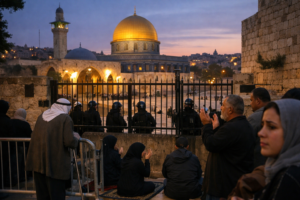
The scene outside the sealed gates tells a story that statistics cannot capture. Elderly men leaning on canes, their faces etched with decades of devotion, now stand helplessly before locked metal barriers. Women who prepared all day for night prayers find themselves redirected, turned away, or worse—subjected to the humiliating calculus of military checkpoints where entry depends not on faith but on arbitrary security assessments.
“The gates of mercy have been locked, and we are left outside like strangers in our own home,” says Abu Ahmad, a resident of the Old City who has watched his neighborhood transform over seven decades from a vibrant, interconnected community to a fragmented landscape of separation and suspicion.
His words echo a sentiment that runs deep in Palestinian consciousness—the feeling of being rendered foreign in one’s own land, of watching sacred spaces become politicized battlegrounds where worship itself becomes an act of resistance.
The Waqf: Guardians of a Sacred Trust
At the center of this confrontation stands an institution little understood outside the region: the Jerusalem Islamic Waqf. Operating under Jordanian authority, the Waqf has administered the Al-Aqsa compound for centuries, maintaining not just the physical structures but the spiritual character of the site.
“The Waqf is not merely a bureaucratic entity,” explains Dr. Sami Abdel-Shafi, a historian specializing in Jerusalem’s religious institutions. “It represents an unbroken chain of custodianship stretching back to the Islamic conquests of the 7th century. When we speak of the ‘status quo’ at Al-Aqsa, we’re referring to arrangements that have governed the site for over 1,300 years.”
This historical continuity faces its greatest challenge in the modern era. Since 1967, when Israel captured East Jerusalem, the Waqf has operated under occupation, maintaining religious authority while lacking sovereign power. The current closure represents what many see as the latest attempt to erode that authority and reshape the fundamental character of the site.
The Hashemite Custodianship: A Kingdom’s Sacred Responsibility
Beyond the Waqf lies another layer of protection rarely discussed in Western media: the Hashemite custodianship of Jerusalem’s holy sites. Since 1924, this responsibility has been carried by Jordan’s royal family, a role that has survived wars, political upheavals, and shifting regional alliances.
For King Abdullah II, this custodianship represents more than diplomatic positioning—it connects his family directly to the Prophet Muhammad through his Hashemite lineage. When Jordan protests Israeli actions at Al-Aqsa, it speaks not merely as a neighboring state but as a family defending its ancestral trust.
“The custodianship is not about politics,” a Jordanian diplomat insisted during an off-the-record briefing last year. “It’s about preserving something sacred for all Muslims, for all time. When we see violations at Al-Aqsa, we see an attack on something we are bound by blood and history to protect.”
The International Response: Words Without Weight
The League of Arab States’ condemnation joins a long list of international statements expressing concern, urging restraint, and calling for adherence to international law. The United Nations Security Council has issued numerous resolutions regarding Jerusalem’s status. The Organization of Islamic Cooperation regularly denounces Israeli actions at the holy sites.
Yet the gates remain closed. The worshippers remain outside. The violations continue.
“We have reached a point where diplomatic statements have become meaningless,” argues Khalil Touma, a political analyst based in Ramallah. “The international community speaks, Israel acts, and nothing changes. At what point do words become complicity? At what point does the failure to enforce resolutions become endorsement of the violations they condemn?”
This question haunts the corridors of international diplomacy. For all the careful language of the League’s statement—its references to “international law,” “relevant UN resolutions,” and “the historical status quo”—the underlying reality remains unchanged: a occupying power has restricted religious freedom at one of the world’s most sensitive sites, and the world responds with press releases.
The Human Calculus: What Closure Means for Ordinary Lives
Beyond the geopolitics, beyond the diplomacy, beyond the statements and condemnations, there are human beings whose lives are being shaped by these events in profoundly personal ways.
Consider Layla, a 23-year-old university student who saved for months to travel from Gaza to Jerusalem for Ramadan. The journey itself required navigating a labyrinth of permits, checkpoints, and bureaucratic hurdles. She arrived three days ago, filled with anticipation for the spiritual experience she had dreamed of since childhood.
Today, she stands outside the closed gates, tears streaming down her face.
“I don’t know if I’ll ever get this chance again,” she whispers. “Getting permission to leave Gaza is nearly impossible. The checkpoints, the permits, the wait—it took years to arrange this trip. And now this.”
Or consider Muhammad, a 45-year-old father of five from East Jerusalem who has prayed at Al-Aqsa every Friday for as long as he can remember. For him, the closure represents something more than a disrupted routine—it’s an erasure of identity.
“My grandfather used to bring me here when I was small. He would tell me stories about his own grandfather, who also prayed here. This mosque is in my blood. It’s in my bones. And now they’re telling me I can’t enter? On what authority? By what right?”
These questions hang in the air, unanswered, as the faithful gather outside the sealed gates, praying in the streets, determined to maintain their connection to the sacred space even when denied physical access.
The Historical Context: Layers of Meaning in Every Stone
To truly understand the current crisis, one must appreciate the layers of history embedded in every stone of the Haram al-Sharif. This is not merely a mosque—it’s a compound covering 144 dunums (approximately 35 acres), containing the Dome of the Rock, the Qibli Mosque, numerous smaller shrines, ancient olive trees, and centuries of Islamic architecture and art.
The site’s significance extends beyond Islam. It stands on the Temple Mount, revered in Judaism as the location of the First and Second Temples. For Christians, it represents the physical setting of numerous biblical events and the ongoing reality of interfaith tension in the city where Jesus walked.
This convergence of sacred histories creates a volatility that few other locations on earth can match. Every action at the site reverberates through three faiths, through millennia of history, through the consciousness of billions of believers worldwide.
“The tragedy of Jerusalem,” writes historian Karen Armstrong in her work on the city, “is that it has become a symbol of division rather than unity, a place where people emphasize what separates them rather than what connects them to the divine.”
The Legal Framework: Occupation and Sovereignty
The League of Arab States’ statement carefully frames its objections within international law, and this legal dimension deserves attention. Under the Fourth Geneva Convention, an occupying power has specific obligations regarding religious sites and the civilian population’s rights.
Article 27 of the convention explicitly protects “the religious convictions and practices” of protected persons, while Article 58 of the Hague Regulations requires occupying powers to “respect the laws in force in the country” regarding religious institutions.
Israel’s position as occupying power in East Jerusalem has been affirmed repeatedly by the United Nations Security Council, most notably in Resolution 478, which declared Israel’s annexation of East Jerusalem “null and void.” The International Court of Justice has also addressed these issues in its 2004 advisory opinion on the separation barrier.
Yet legal frameworks collide with political realities. Israel maintains that all of Jerusalem is its unified capital, a position recognized by some nations but rejected by the overwhelming majority of the international community. This fundamental disagreement about sovereignty underlies every confrontation at the holy sites.
The Regional Dimension: Beyond Palestine
While the immediate crisis centers on Jerusalem, its reverberations extend throughout the Middle East and beyond. The League of Arab States represents 22 member nations, home to hundreds of millions of Muslims who look to Al-Aqsa as their third holiest site.
“When Al-Aqsa is threatened, it’s not just Palestinians who feel the pain,” notes Dr. Fatima Al-Zahra, a professor of Islamic studies at Cairo’s Al-Azhar University. “Every Muslim from Morocco to Indonesia carries Al-Aqsa in their heart. The mosque belongs to the entire ummah, and attacks on it resonate across the Islamic world.”
This pan-Islamic dimension complicates efforts to manage the crisis through bilateral negotiations. Even if Palestinian leadership were inclined toward compromise on access arrangements, the broader Muslim world maintains a stake in the outcome that cannot be ignored.
The Jordanian role becomes crucial here, as the Hashemite custodianship provides a mechanism for representing broader Islamic interests while maintaining practical administration of the site. When Jordan speaks on Al-Aqsa matters, it speaks for more than itself—it speaks for a tradition of custodianship that transcends national boundaries.
The Way Forward: Between Principles and Realities
As the final ten nights of Ramadan continue and the gates remain closed, the question becomes what can be done. The League of Arab States has called on the international community to “assume its responsibilities,” but the mechanisms for doing so remain unclear.
Some advocate for renewed diplomatic pressure, perhaps through the Quartet on the Middle East or direct engagement with Israel by key powers. Others suggest that only economic consequences will produce change, pointing to the effectiveness of boycott movements in other contexts. Still others argue for strengthening Palestinian institutions and the Waqf’s capacity to maintain the site’s character despite occupation.
What seems clear is that the status quo cannot continue indefinitely. Each closure, each restriction, each violation adds another layer to the wound, making eventual reconciliation more difficult. The worshippers outside the gates today will remember this Ramadan—not for spiritual elevation, but for the humiliation of being turned away from God’s house.
Conclusion: The Gates That Divide Us
The story of Al-Aqsa’s closure during Ramadan 2026 is not merely a news item to be consumed and forgotten. It’s a window into a conflict that has defied resolution for generations, a reminder that in Jerusalem, politics and faith can never be separated.
The League of Arab States has spoken. The international community has been notified. The condemnations have been issued. But until the gates reopen and worshippers can again fill the courtyards with prayer, these words remain hollow.
Perhaps the most powerful response came not from any official statement but from an elderly woman outside the sealed gates. Denied entry, she spread her prayer rug on the sidewalk, faced the direction of the mosque she could see but not enter, and began to pray. Around her, others followed suit. Soon the street filled with worshippers, their voices rising in the night air, their faith undiminished by the locked barriers before them.
“You can close the gates,” one of them said afterward, “but you cannot close our hearts. You can block the entrances, but you cannot block our connection to this place. We will pray here, in the streets, in our homes, in our hearts. We will always find a way to reach Al-Aqsa.”
It is this indomitable spirit that the gates cannot contain, that checkpoints cannot filter out, that closures cannot defeat. And it is this spirit that will ultimately determine the fate of Jerusalem’s holy places—not the statements of politicians, not the resolutions of international bodies, but the unwavering faith of millions who refuse to be separated from what they hold sacred.
The gates may remain closed for now. But those who love Al-Aqsa know that no lock can secure what belongs to God, and no power can permanently separate believers from the objects of their devotion. The night of power approaches, and somewhere in Jerusalem, someone is praying that before it arrives, the gates will open once more.
You must be logged in to post a comment.