
Beyond the Headlines: Israel’s West Bank Land Grab and the Digital Battle for Palestine
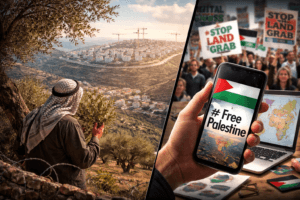
Beyond the Headlines: Israel’s West Bank Land Grab and the Digital Battle for Palestine
The Quiet Annexation: Understanding Israel’s Historic Land Registration Decision
In a move that has sent shockwaves through the international community, the Israeli government approved a proposal on February 15, 2026, to register large areas of the occupied West Bank as “state property”—the first such measure since Israel captured the territory in the 1967 Six-Day War. While the headline numbers and official statements tell one story, the human reality behind this bureaucratic-sounding decision reveals a far more complex and troubling picture of life under occupation.
The approval, submitted by a triumvirate of hardline ministers—Finance Minister Bezalel Smotrich, Justice Minister Yariv Levin, and Defense Minister Israel Katz—represents what many analysts describe as the most significant shift in West Bank land policy in nearly six decades. But to understand why this matters, we need to look beyond the political rhetoric and examine what this actually means for the people who call the West Bank home.
The Mechanism Behind the Decision
Under the Oslo II Accord of 1995, the West Bank was divided into three administrative zones. Area A, comprising approximately 18 percent of the territory, was designated for full Palestinian civil and security control. Area B, about 21 percent, was placed under Palestinian civil control but Israeli security control. And Area C—the remaining 61 percent—was kept under full Israeli military and civilian authority.
What the newly approved measure does is activate a land registration mechanism that has lain dormant since 1967. The Land Registration Authority within Israel’s Justice Ministry will now begin systematically registering land in Area C, with dedicated funding and personnel allocated specifically for this purpose. On paper, it sounds administrative, even mundane. In reality, it’s anything but.
Here’s the critical detail that gets lost in official statements: approximately two-thirds of West Bank land has never been formally registered. This includes vast swaths of Area C. The registration process now authorized allows land to be declared “state property” if it cannot be proven as privately owned through formal registration documents.
But here’s where the human element becomes crucial. The process of land registration was suspended by Israel in 1967 and never resumed. For generations, Palestinian families have lived on, farmed, and passed down land through informal systems of ownership recognized under Ottoman, British Mandate, and Jordanian law—systems that were functional and legitimate before the occupation began. Now, they face an impossible bureaucratic hurdle: prove ownership through a process that hasn’t existed for 59 years, or lose your land forever.
The Human Cost of Bureaucracy
I spoke with Mahmoud Abu Aisha, a farmer from the village of al-Mughayyir near Ramallah, whose family has cultivated olive trees on the same hillside for seven generations. “My grandfather’s grandfather planted these trees,” he told me, gesturing across terraced slopes that have been in his family since Ottoman records. “We have no piece of paper that Israel recognizes because the paper we have is from the Jordanian period, and they don’t accept that. They tell us we need Ottoman registration documents. Who has documents from 150 years ago?”
This is the cruel arithmetic of the new registration process. Families who can trace their connection to the land through centuries of continuous cultivation, through tax records, through village oral histories, through the very existence of ancient olive groves and family burial plots—none of this matters under a system that demands paperwork that was never required before 1967 and was impossible to obtain after.
Peace Now, the Israeli anti-occupation organization, estimates that under these conditions, “hundreds of thousands of dunams” will be declared state land available for settlement development. A dunam, roughly equivalent to a quarter-acre, might sound like an abstract unit of measurement until you understand that a dunam of olive trees can support an entire Palestinian family. A hundred dunams can sustain an entire extended family network. Hundreds of thousands of dunams represent the livelihoods of tens of thousands of people.
The Ideological Drivers
To understand why this is happening now, we need to understand the people behind it. Finance Minister Bezalel Smotrich, who celebrated the approval on social media with the declaration “We are continuing the settlement revolution to control all our lands,” is not merely a politician pursuing policy. He is an ideological settler who lives in the West Bank settlement of Kedumim and has long advocated for Israeli sovereignty over the entire territory.
Smotrich heads the Religious Zionist Party, which emerged from the ideological stream of the settlement movement that views Israeli control of the West Bank—which they call by its biblical names Judea and Samaria—as not just a political goal but a religious imperative. For Smotrich and his supporters, this land registration isn’t about bureaucracy or security. It’s about fulfilling what they believe is a divine promise.
Defense Minister Israel Katz framed the move in more secular terms, calling it “an essential security and governance measure designed to ensure control, enforcement, and full freedom of action for the State of Israel in the area.” But the distinction between ideological and security rationales often blurs in practice. When settlements expand onto land claimed by Palestinians, when roads connect settlements while bypassing Palestinian villages, when military zones are declared that later become settlement outposts—the security justification becomes difficult to separate from the settlement project itself.
Justice Minister Yariv Levin was perhaps most direct when he called the decision “a real revolution in Judea and Samaria” and declared that “The Land of Israel belongs to the people of Israel.” This framing—the entire land, all of it, belongs exclusively to one people—leaves no room for Palestinian claims, no space for compromise, no recognition that another people also calls this land home.
International Law and the ICJ Ruling
The international legal framework regarding occupied territory is, on paper, quite clear. The Fourth Geneva Convention, to which Israel is a signatory, explicitly prohibits an occupying power from transferring parts of its own civilian population into occupied territory or from confiscating land in those territories. United Nations Security Council resolutions, including Resolution 242 passed after the 1967 war and Resolution 2334 passed in 2016, have repeatedly affirmed the illegality of settlement construction and land confiscation.
In July 2024, the International Court of Justice issued an advisory opinion that went even further, declaring Israel’s occupation of Palestinian territory illegal and calling for the evacuation of settlements in the West Bank and East Jerusalem. While advisory opinions are not legally binding in the same way as court judgments, they carry significant weight as statements of international law.
Yet here we are, less than two years later, witnessing the most significant land registration initiative since the occupation began. The gap between international law and on-the-ground reality has never been wider.
Political analyst Xavier Abu Eid offered a stark assessment to Al Jazeera: “People should understand this is not just a step towards annexation, we are experiencing annexation as we speak today.” This distinction—between moving toward something and actually doing it—matters because it affects how the international community responds. Steps toward annexation can be condemned, can be criticized, can be met with diplomatic pressure. Actual annexation demands a different response entirely.
The Palestinian Response
The Palestinian Authority, despite its limited authority and ongoing legitimacy challenges, condemned the decision in strong terms. The Presidency called it a “serious escalation” that “effectively nullifies signed agreements while contradicting United Nations Security Council resolutions.” The reference to “signed agreements” is particularly poignant given that the Oslo process, whatever its flaws, was built on the premise that land issues would be resolved through negotiation, not unilateral action.
Hamas, which controls Gaza and maintains significant presence in the West Bank despite Israeli security operations, went further, calling the decision “a null and void decision issued by an illegitimate occupying power.” The language reflects Hamas’s consistent position that no Israeli decision regarding Palestinian land has any validity.
But between these official responses lies the reality of ordinary Palestinians who must now navigate an even more uncertain future. In villages across Area C, families are consulting with lawyers, searching for any documentation that might help them prove ownership, and facing the grim likelihood that for many, no documentation will be sufficient.
The Broader Context
This decision doesn’t exist in isolation. It comes amid the most right-wing government in Israeli history, one that includes ministers who openly advocate for what they call “full sovereignty” over the West Bank. It follows years of steady settlement expansion that has made the two-state solution geographically increasingly difficult to envision. And it coincides with international attention divided among multiple global crises—the war in Ukraine, tensions in the South China Sea, economic instability—that make sustained pressure on Israel less likely.
According to Israel Hayom newspaper, the initial goal involves gradually settling 15 percent of Area C by 2030. That target, if achieved, would fundamentally reshape the West Bank’s demographics and geography. Area C currently contains the vast majority of the West Bank’s agricultural land, water resources, and land reserves. Transferring effective control of that area from Palestinian communities to Israeli settlements would make a contiguous, viable Palestinian state nearly impossible.
The Digital Counter-Battle: Google, YouTube, and the Power of Online Activism
If the West Bank land registration represents a physical battle over territory, a parallel battle is being fought in the digital realm—and there, the outcomes have been surprisingly different.
On February 16, 2026, just one day after the Israeli government’s land registration approval, two major digital platforms reversed controversial actions against Palestine-supporting content following intense user pressure. The timing was coincidental, but the juxtaposition was striking: on the ground in the West Bank, a bureaucratic mechanism advancing Israeli control; in the digital sphere, grassroots activism forcing two of the world’s most powerful tech companies to back down.
The UpScrolled Story
UpScrolled, a TikTok alternative developed by Palestinian-Australian software engineer Issam Hijazi, had been gaining traction amid growing allegations that mainstream platforms engage in “shadow banning” of pro-Palestinian content. Launched in June 2025, the app positioned itself as a platform where Palestinian voices could be heard without algorithmic suppression.
When Google temporarily removed UpScrolled from the Play Store, the reaction was swift. Within days, the platform’s user base exploded from approximately 150,000 to millions. The growth wasn’t organic in the traditional sense—it was reactive, driven by users who saw the removal as confirmation of exactly the bias the app was designed to counter.
The platform announced the issue was resolved through “close cooperation” with Google, diplomatic language that likely masks more tense negotiations. But the bottom line was clear: faced with a coordinated user response, Google reversed its decision.
The Christensen Case
Simultaneously, YouTube faced its own pressure campaign over the suspension of Guy Christensen, a US activist known for anti-Israel and pro-Palestine content. Christensen’s channel had been suspended without, his supporters argued, clear justification. Online protests followed, and YouTube reinstated both his channel and monetization.
Christensen announced the development on X (formerly Twitter), celebrating the outcome as a testament to “the power of collective action and solidarity.” His language was notably different from the careful diplomacy of UpScrolled’s statement—this was framed as a victory, as proof that organized digital activism could influence even the largest tech platforms.
What These Reversals Signify
For observers of tech platform content moderation, these incidents reopen long-standing questions about how companies handle politically sensitive material. Critics have long accused platforms of inconsistent enforcement that disproportionately affects Palestine supporters while allowing content they consider problematic from the other side.
The cases also demonstrate something more fundamental: the growing power of coordinated digital activism. When UpScrolled’s user base grew from 150,000 to millions in a week, it sent a message that couldn’t be ignored. When Christensen’s supporters organized effectively across multiple platforms, they created reputational pressure that YouTube ultimately decided wasn’t worth bearing.
For global audiences, including in Türkiye where public opinion strongly supports Palestinian rights, these incidents offer a template for how digital activism might influence corporate behavior. The traditional avenues of political pressure—diplomatic statements, United Nations resolutions, academic boycotts—move slowly and often ineffectively. Digital activism moves at internet speed.
The Limits and Possibilities
It’s important not to overstate what these reversals mean. Google and YouTube reversed specific decisions about specific content; they didn’t change their overall content moderation policies. UpScrolled remains a relatively small platform facing the challenge of sustaining growth and engagement. Christensen’s channel being reinstated doesn’t guarantee it won’t be suspended again.
But the incidents demonstrate something significant about the current moment: the same digital tools that enable surveillance, algorithmic bias, and content suppression also enable rapid organization and coordinated response. The platforms that removed UpScrolled and suspended Christensen also provided the infrastructure for the campaigns that reversed those actions.
Connecting the Physical and Digital Battles
There’s a temptation to see these as separate stories—one about land and occupation, one about tech platforms and activism. But they’re connected by more than just timing.
The Israeli government’s land registration decision is, in part, a response to decades of Palestinian sumud—steadfastness—the refusal to leave land despite pressure. It’s an acknowledgment that the slow erosion of Palestinian presence hasn’t worked quickly enough, that a more aggressive mechanism is needed.
The digital activism victories are, in part, a response to years of frustration with mainstream platforms that seemed unresponsive to Palestinian concerns. They represent a recognition that if existing platforms won’t accommodate Palestinian voices, new platforms can be built, and if platforms act against those voices, coordinated pressure can force reconsideration.
What Comes Next
The land registration process will move forward despite international condemnation, just as similar measures have moved forward for decades despite similar condemnation. Bureaucracy, once set in motion, is difficult to stop. The registration of hundreds of thousands of dunams as state land will proceed case by case, parcel by parcel, with each decision presented as administrative rather than political.
The digital activism that forced Google and YouTube to reverse their decisions will continue, likely growing more sophisticated and coordinated. The same activists who organized around UpScrolled and Christensen will organize around the next case, and the next, building networks and sharing strategies.
Between these two battles—one physical, one digital—the future of Palestine is being shaped. On the ground in the West Bank, families face the loss of land they’ve held for generations through a process that demands documentation they were never given the chance to obtain. Online, activists test whether digital pressure can create space for Palestinian voices that traditional political channels have failed to secure.
Neither battle will be decided quickly. Land registration processes take years to complete. Digital activism campaigns rise and fall with each new controversy. But the direction is clear: on the ground, the mechanism of control accelerates; online, the mechanism of resistance evolves.
For those watching from outside, the question is what role they choose to play. International law provides clear frameworks for understanding what’s happening in the West Bank, but frameworks alone don’t stop bulldozers or prevent families from being displaced. Digital platforms provide tools for organizing and amplifying voices, but tools alone don’t create the sustained pressure needed to change policies.
The answer, perhaps, lies in connecting these spheres—using digital tools to organize pressure that translates into political action, using political platforms to amplify digital campaigns, refusing to accept that the physical and digital realms operate separately. In the West Bank, land is being registered as state property through a process designed to make Palestinian claims invisible. Online, activists are working to make Palestinian voices impossible to ignore. The connection between these struggles isn’t coincidental—it’s fundamental.
You must be logged in to post a comment.