
Beyond the Headlines: Israel’s ‘Ex Gratia’ Dilemma—Can Compensation Buy Back Legitimacy in Gaza?
Israel is considering making “ex gratia” payments—compensation without legal admission of fault—to Palestinian families in select high-profile cases where civilians were killed during the Gaza war, as a strategic move to begin rebuilding the country’s global legitimacy. Drawing on the precedent of Netanyahu’s 2016 payment to Turkey following the Mavi Marmara incident, proponents argue this approach allows Israel to acknowledge Palestinian suffering and demonstrate human empathy without conceding the legality of its military actions or drawing moral equivalence with Hamas. While the proposal faces fierce domestic opposition and is unlikely to satisfy hardline critics, advocates see it as a necessary gesture to reach “fair-minded” international observers, offering a nuanced middle ground in a debate often reduced to binary absolutes, as Israel’s full legal counter-narrative remains withheld from international courts.
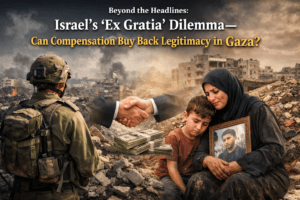
Beyond the Headlines: Israel’s ‘Ex Gratia’ Dilemma—Can Compensation Buy Back Legitimacy in Gaza?
In the labyrinthine world of international diplomacy and conflict resolution, gestures often speak louder than admissions. A new and deeply controversial strategy is quietly being debated in the corridors of Israeli power: paying compensation to some Palestinian families who lost loved ones in the Gaza war. It’s a move that, on the surface, seems simple—a check, a handshake, a statement of regret. But beneath the surface lies a complex web of legal precedent, political strategy, national trauma, and the raw, unending grief of two peoples.
According to exclusive reporting by The Jerusalem Post, some Israeli officials are considering making “ex gratia” payments in a select number of high-profile cases where civilians were killed during the IDF’s operation against Hamas. The concept, which translates from Latin to “by favor” or “out of grace,” is a legal and diplomatic tool that allows a state to provide monetary compensation without admitting legal liability or fault. It is, in essence, a way of saying, “We are deeply sorry for your loss,” without uttering the words, “We were wrong.”
This is not an admission of war crimes. It is not an acknowledgment of moral equivalence with an enemy that perpetrated the October 7 massacre. Instead, it is being framed by its proponents—a mix of former and current top legal officials in Israel—as a pragmatic, strategic tool to begin the painstaking and perhaps impossible task of rebuilding Israel’s shattered global legitimacy.
The Trap of the Binary Debate
Since the horrific Hamas attacks of October 7, 2023, and the subsequent Israeli military campaign in Gaza, the international discourse has often been reduced to a binary shouting match. In one corner, Israel’s defenders point to the genocidal intent of Hamas, the use of human shields, and the staggering civilian death toll in Gaza as a tragic but unavoidable consequence of a war forced upon a nation fighting for its survival. In the other corner, critics paint the IDF campaign as a disproportionate and indiscriminate assault, leveling entire neighborhoods and causing a humanitarian catastrophe.
Between these two poles, the “fair-minded” observer—the citizen in Kansas, the voter in Berlin, the diplomat in Tokyo—is often left in a state of confusion and moral fatigue. They are inundated with images of destruction and lists of the dead, yet offered a choice between two absolutist narratives that seem to leave no room for nuance.
“Ex gratia,” its advocates argue, offers a third way. It is a mechanism to acknowledge the undeniable human suffering caused by Israel’s military actions—the flattened homes, the families buried under rubble, the aid workers struck by “misguided” munitions—without conceding the larger legal and moral battle over the war’s justification.
“The world has been inundated with the suffering of Gazans,” the original report notes, “and frequently it seems that the world thinks that Israel doesn’t care.” A payment made “out of grace” is a tangible demonstration of care, a signal that the Jewish state sees the Palestinian civilians not just as collateral damage in a necessary war, but as human beings whose lives were lost, however justifiably, in a conflict they did not start.
A Precedent Set by Netanyahu
The most potent precedent for this strategy comes from Prime Minister Benjamin Netanyahu’s own playbook. In 2010, the Mavi Marmara incident saw Israeli commandos boarding a Turkish-led flotilla attempting to break the naval blockade of Gaza. The operation went disastrously wrong; met with violent resistance from activists wielding clubs, the soldiers opened fire, killing nine Turkish citizens.
Israel maintained its soldiers acted in self-defense, a position partially supported by a UN inquiry. Yet, the diplomatic fallout was severe, crippling a once-strong strategic relationship with a major regional power. The solution, brokered in 2016, was a $20 million ex gratia payment to the families of the victims. Netanyahu authorized the payment, not as an apology for a wrongful act, but as a “goodwill gesture” to mend fences with a key nation.
If it worked for Turkey, the logic goes, why not for the Palestinians? The stakes, however, are exponentially higher. The scale of destruction in Gaza dwarfs the Mavi Marmara incident by several orders of magnitude. The intended audience is not a single, aggrieved nation, but the entire international community, whose faith in Israel’s moral compass has been deeply shaken.
The Devil in the Details: Who Gets Paid and Why?
The proposal is not to write a blank check to all of Gaza. Instead, the plan under discussion is surgically precise: a series of high-profile, emblematic cases where the chain of events leading to civilian death was clearly a tragic error, an intelligence failure, or a targeting mistake, rather than a systematic policy.
Which cases might be chosen? The list is a who’s who of the war’s most damaging headlines:
- The World Central Kitchen Strike (April 2024): The Israeli military’s “precise” drone strike that killed seven aid workers, including an Australian, a Pole, a Briton, and a Palestinian, as they traveled in a marked, deconflicted convoy. The international outcry was immediate and immense.
- The Islamic Red Crescent and Other Aid Worker Deaths (March 2025): The tragic killing of up to 15 first responders, which sparked further condemnation of the IDF’s targeting in active war zones.
- The Jabalia Mass Casualty Events (2023-2024): The multiple strikes in the densely packed Jabalia refugee camp that resulted in the deaths of dozens, and in some instances, over a hundred civilians at a time.
- The “Flour Massacre” and Related Incidents: Cases where Palestinians were killed while approaching aid distribution points, a catastrophic failure of crowd control and situational awareness in a landscape of extreme desperation.
- Deaths from Preventable Conditions: The children who died from malnutrition or lack of access to medical care in besieged areas, a consequence of war that, while perhaps unavoidable in the fog of conflict, paints a harrowing picture of civilian suffering.
In each of these instances, the payment would be accompanied by a clear statement: this is an ex gratia payment, made as a humanitarian gesture and an expression of regret for the loss of innocent life, without acknowledging any legal wrongdoing. In cases where Israeli soldiers are indicted for criminal behavior, the judicial process itself would serve as the state’s acknowledgment of fault.
The Strategic Clock is Ticking
Why now? The timing is not accidental. With the major ground phase of the war concluded, all hostages returned, and the Trump administration’s vision for Gaza’s future beginning to take shape, Israel has a window—perhaps a narrow one—to influence its own narrative.
The report highlights a critical and somewhat paradoxical challenge: Israel is delaying the release of its comprehensive legal counter-narrative to war crimes allegations, fearing that information shared with international bodies like the ICJ and ICC will be used against it in politically motivated forums. This defensive crouch means that for months, or even years, the dominant narrative will remain one of Israeli destruction and Palestinian suffering, unanswered by Israel’s side of the story.
In this vacuum, the image of the conflict is being set in stone. “Ex gratia” is seen as a stopgap measure, a way to inject some human empathy into the story while the legal battles grind on in The Hague. It is an attempt to show the world, and particularly the “fair-minded” people in the US and Europe, that Israel is capable of introspection and compassion, even in victory.
The Domestic and International Pushback
The idea is, in a word, explosive. For many Israelis, still raw from the trauma of October 7, the notion of paying “compensation” to Gazans feels like a profound injustice. They will ask: Where is the compensation for the 1,200 Israelis massacred, the families burned alive, the women raped, the hundreds taken hostage? Where is Hamas’s ex gratia payment? The moral hazard seems insurmountable. Paying for dead Palestinians, to many, feels like rewarding the very human-shield strategy that Hamas employed.
The political right in Israel will almost certainly decry it as a sign of weakness, a concession to international pressure that will only invite more criticism. Netanyahu, who leads the most right-wing government in Israel’s history, would face immense coalition pressure if he were to authorize such payments.
Internationally, the move is unlikely to satisfy Israel’s harshest critics. For those who have already judged Israel guilty of war crimes, a check will be seen as a paltry and cynical attempt at blood money, an insult rather than a gesture. They will demand accountability, not charity.
A First Step, Not a Silver Bullet
The proponents of this plan are not naive. They do not believe that a few million dollars will erase the images of a year-and-a-half of war or magically restore bipartisan support for Israel in the US Congress. Antisemitism and hardline anti-Zionism will not be bought off.
The goal is more modest, yet perhaps more significant. It is to create a crack in the wall of absolutism. It is to offer a sliver of light to those fair-minded people who are struggling with the complexity of it all. It is to say, “We see the pain we have caused, and we mourn it with you,” without betraying the core belief that the war itself was just and necessary.
It is a deeply human, deeply imperfect, and deeply political gesture. It acknowledges that in the brutal arithmetic of war, there are debts that cannot be calculated in a ledger of combatants versus civilians. There is a human cost that transcends legal arguments and strategic justifications.
The ex gratia proposal is not a solution to the Israeli-Palestinian conflict. It is not a blueprint for peace. But it may be an acknowledgment of a painful truth: that even a war fought with the purest intentions against the most barbaric of enemies leaves behind a trail of human wreckage. And sometimes, the long, slow process of rebuilding a nation’s soul—and its standing in the world—must begin not with a declaration of innocence, but with a simple, graceful gesture of shared grief.
You must be logged in to post a comment.