
Beyond the Headlines: Is AI the Gavel or the Defendant in India’s Judicial Revolution?
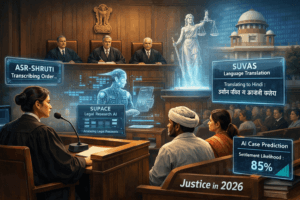
The India AI Impact Summit 2026 highlighted AI’s transformative, yet cautiously managed, role within the Indian judiciary, where tools like ASR-SHRUTI for transcription, SUPACE for legal research, and SUVAS for multilingual translation are being deployed to tackle massive case backlogs, improve efficiency, and democratize access to justice by breaking the English-language barrier. However, the integration of predictive analytics and generative AI also brings significant challenges, including the risks of algorithmic bias, the opaque “black box” nature of decisions, AI “hallucinations” that could fabricate legal precedents, and data privacy concerns—prompting the Supreme Court to establish ethical oversight committees to ensure that technology serves as a supportive tool for, rather than a replacement of, human judicial wisdom and constitutional values.
Beyond the Headlines: Is AI the Gavel or the Defendant in India’s Judicial Revolution?
The year is 2026. At the India AI Impact Summit in New Delhi, the conversation isn’t just about autonomous vehicles or fintech algorithms. In a packed hall, a panel of Supreme Court judges, legal scholars, and tech developers is deep in discussion about a topic that, until recently, seemed the stuff of science fiction: the silent, profound, and irreversible integration of Artificial Intelligence into the very heart of India’s judiciary.
The headlines from the summit, as captured in the provided notes, paint a picture of a system on the cusp of a digital renaissance. We read about ASR-SHRUTI, the AI that transcribes a judge’s words into an official order. We learn about SUPACE, the research assistant that can sift through decades of legal precedents in seconds. We see SUVAS, the digital polyglot breaking down the linguistic barriers that have kept millions from accessing the majesty of the law.
But a news snippet, by its nature, is a snapshot. It captures the “what” but rarely the “so what.” To truly understand this transformation, we need to step into the courtroom, sit beside the overburdened district judge, and stand in the shoes of a litigant from a rural village. This is the story of how AI is not just changing India’s legal ecosystem—it is challenging its very soul.
The Algorithm as a Clerk: Solving the Crisis of Pendency
To appreciate the desperate need for AI in Indian courts, one must first confront the staggering reality of pendency. As of early 2026, over 5 crore cases are stuck in a judicial logjam, from the Supreme Court down to the taluka levels. For a citizen, justice delayed is not just justice denied; it is often a life ruined—a family stuck in a land dispute for generations, an accused undertrial spending years in jail beyond any potential sentence.
This is where AI’s first and most welcome role emerges: as a tireless, super-efficient clerk.
Consider the plight of a District and Sessions Judge in a place like Moradabad or Gaya. Her day is a blur of arguments, paperwork, and administrative duties. Tools like ASR-SHRUTI (Automated Speech Recognition for Supreme Court Hearing & Reporting using Technological Innovation) are her new silent partners. Instead of painstakingly dictating every word to a court stenographer or writing notes by hand, she can speak naturally. The AI converts the spoken word into text in real-time, creating an instant, accurate record. This isn’t just about speed; it’s about freeing the judge’s cognitive load, allowing her to listen more intently to the arguments, to watch the body language of the witnesses, to be more present.
Then there’s SUPACE (Supreme Court Portal for Assistance in Court Efficiency) . Imagine a junior lawyer is tasked with finding every precedent related to a complex nuance of property law. This could take weeks of dusty library work. SUPACE acts as a hyper-intelligent research associate. It scans millions of digitized case files, identifies relevant statutes, and even summarizes complex judgments like those provided by the Saransh tool. It doesn’t make the decision, but it equips the human decision-maker with a comprehensive, unbiased dossier of information in a fraction of the time.
The Great Equalizer: Speaking to the Court in Your Mother Tongue
Perhaps the most profound human impact of AI lies in its ability to democratize justice. For centuries, India’s higher judiciary has functioned primarily in English. This creates an invisible but impenetrable wall for the vast majority of Indians who think, dream, and argue in Hindi, Tamil, Bengali, or Telugu. A litigant from a village in Maharashtra, whose case is being heard in the Bombay High Court, often has to rely entirely on a lawyer to translate not just the law, but their own story.
SUVAS (Supreme Court Vidhik Anuvaad Software) is the battering ram against that wall. It is an AI-powered translation tool that can convert judicial orders, judgments, and even arguments between English and multiple vernacular languages. At the summit, one could envision a demonstration where a complex legal principle is translated on the fly, making it instantly comprehensible.
This isn’t just a matter of convenience; it is a matter of constitutional morality. Access to justice, enshrined in the spirit of Article 39A, is meaningless if the very language of justice is foreign. By enabling a litigant to read a judgment concerning their land in Marathi, or a woman to understand a protection order in her native Bhojpuri, AI is giving people back their agency. It transforms them from passive observers of a foreign ritual into active participants in their own legal destiny.
The Oracle in the Machine: Predictive Analytics and the Settlement Culture
The most ambitious, and perhaps controversial, application discussed at the summit is predictive analytics. The idea is that by analyzing the outcomes of thousands of similar past cases, an AI could indicate the likely outcome of a pending case. On the surface, this is a powerful tool for case management. If an AI predicts that a commercial dispute has a 90% chance of being decided in favor of the plaintiff, both parties might be more inclined to sit down for mediation and reach an out-of-court settlement.
This is the ultimate promise of AI: reducing the burden on courts by preventing cases from going to trial in the first place. It encourages a shift from a confrontational, winner-takes-all model of justice to a more conciliatory, problem-solving approach. For the citizen, it could mean a resolution in months rather than years, saving time, money, and emotional turmoil.
The Human Verdict on AI: Navigating the Perils
But as the panel at the India AI Impact Summit would surely acknowledge, this technological marvel is a double-edged sword. The very algorithms designed to dispense efficiency could, if left unchecked, perpetuate injustice. This is where the human insight becomes critical.
The first and most dangerous pitfall is Algorithmic Bias. An AI is only as good as the data it is trained on. India’s legal history is filled with societal biases related to caste, gender, and community. If you train an AI on this historical data, it will learn these biases as truth. A predictive algorithm might, for instance, subtly learn to associate certain communities with higher recidivism rates, not because of any inherent truth, but because of historical patterns of policing and conviction. If a judge were to unconsciously rely on such a tool, it would be a direct violation of Article 14 (Right to Equality) . The promise of blind justice would be replaced by the reality of biased code.
Closely linked is the “Black Box” Problem. Many advanced AI models are inscrutable. They can produce an output, but even their creators cannot fully trace the logical steps that led to it. In a judicial system, transparency is paramount. A judgment must be reasoned; a litigant has the right to know not just the “what,” but the “why.” If an AI provides a case summary or a piece of research, how does a lawyer challenge its logic if the logic is hidden? This opacity undermines the very foundation of a fair procedure guaranteed under Article 21.
Then there is the spectre of “Hallucinations” —a term used when a generative AI confidently invents information. There have already been documented cases in other jurisdictions where lawyers submitted briefs citing fictitious cases completely fabricated by AI. Imagine the chaos if an AI tool assisting a judge were to “hallucinate” a precedent. It poses an existential risk to judicial integrity and the rule of law.
Finally, the integration of sensitive case data into digital platforms controlled by third-party vendors raises profound security and privacy concerns. A cyber breach could expose personal details, witness statements, and confidential legal strategies, causing irreparable harm.
The Road Ahead: A Symbiosis, Not a Surrender
The response to these challenges, as hinted at by initiatives like the Supreme Court AI Committee and the e-Courts Project Phase III, is not to reject technology, but to govern it with wisdom. The goal is a symbiosis where AI handles the clerical and analytical heavy lifting, while the human judge retains sole responsibility for the moral and intellectual act of judging.
The Supreme Court AI Committee, chaired by a sitting judge, is a crucial safeguard. Its role is to ensure that every tool adopted—from ASR-SHRUTI to SUVAS—is vetted for ethical compliance, accuracy, and transparency. The eSCR (Electronic Supreme Court Reports) portal is a foundational element, creating the open, accessible, and digitized database of judgments that is the prerequisite for any fair AI system.
The transformation of India’s legal ecosystem by AI is not a distant future; it is a present reality, showcased and debated in the halls of the 2026 summit. It holds the potential to finally unclog our courts, to make justice accessible in a hundred languages, and to empower judges to be wiser, faster, and fairer.
But as we stand on this frontier, the message from Delhi is clear: the algorithm is not the new gavel. It is a tool in the hand of the judge. The final verdict on justice in India will always belong to a human heart and a human mind. The challenge now, and for the years to come, is to ensure that the technology serves the Constitution, and not the other way around.
You must be logged in to post a comment.