
Beyond the Headlines: Inside Qabatiya’s Lockdown and the Anatomy of Occupation in the West Bank
In late December 2025, Israeli forces imposed a full lockdown on the occupied West Bank town of Qabatiya, sealing entrances, conducting mass arrests, and forcibly converting Palestinian homes into military outposts and interrogation centers following a stabbing and car-ramming attack in Israel that Defense Minister Israel Katz linked to a resident. This operation, involving multiple army divisions and security agencies, exemplifies Israel’s escalating strategy of “forceful action” in the West Bank since the Gaza war began, which human rights groups condemn as collective punishment. The incursion highlights the daily realities of occupation for Palestinians—where entire communities face economic strangulation, traumatic displacement, and indefinite detention without charge—and reinforces a cycle of violence and control that fragments Palestinian territory and deepens despair.
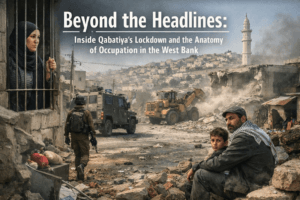
Beyond the Headlines: Inside Qabatiya’s Lockdown and the Anatomy of Occupation in the West Bank
Meta Description: An in-depth analysis of Israel’s military operation in Qabatiya, exploring the mechanisms of lockdowns, home seizures, and the escalating strategy of “forceful action” in the occupied West Bank. This piece provides historical context, human impact, and the broader implications for Palestinians under prolonged occupation.
On a cold December morning in the occupied West Bank, the town of Qabatiya awoke to a new reality. The familiar hum of daily life was replaced by the grinding of armored vehicle treads and the bark of orders through megaphones. Israeli forces had sealed every entrance, imposing a total lockdown. For the residents, it was not an unprecedented shock, but a brutal escalation of a familiar strain of life under occupation. This operation, ordered directly by Israel’s Defense Minister to “act forcefully,” transcends a simple security raid. It is a stark case study in the evolving mechanisms of control, collective punishment, and the profound human cost endured within fragmented Palestinian territories.
The Blueprint of a Lockdown: Strategy as Spectacle
The Qabatiya operation followed a now-familiar blueprint, yet its scale was noteworthy. Reports describe soldiers converting family homes into makeshift interrogation centers, forcibly displacing occupants. Bulldozers leveled land, not just for tactical advantage but as a psychological and physical assertion of dominance. The military confirmed deploying troops from multiple divisions, border police, and the Shin Bet security service—a significant mustering of force for a single town.
This approach serves multiple purposes. Tactically, it aims to root out suspected militants and weapons. Psychologically, it is a spectacle of power designed to deter future resistance by making an example of an entire community. Politically, it fulfills a promise by officials like Defense Minister Israel Katz to respond aggressively to attacks, such as the recent stabbing and car-ramming incident in northern Israel, which he linked to a resident of Qabatiya.
However, this strategy operates in a legal and ethical gray zone. International human rights organizations, including Amnesty International and Human Rights Watch, have consistently condemned the practice of home demolitions and mass cordons as collective punishment, prohibited under Article 33 of the Fourth Geneva Convention. By sealing a town of thousands, detaining dozens without charge, and displacing families from their homes, the punishment extends far beyond any individual suspect.
The Human Architecture of a Sealed Town
To understand the impact, one must move beyond the term “lockdown” and visualize its human architecture. For Qabatiya’s residents, the cordon meant:
- Medical Emergencies in Limbo: Patients needing dialysis, pregnant women facing complications, and the critically ill found themselves trapped, requiring complex coordination with the International Committee of the Red Cross for passage—if granted at all.
- Economic Strangulation: Daily wage laborers, shopkeepers, and farmers were cut off from their livelihoods. Perishable goods rotted, appointments were missed, and an already crippled local economy seized up entirely.
- The Home as a Battleground: The seizure of homes for use as military outposts is a uniquely invasive tactic. It transforms the most private, secure space—the center of family life—into a public, hostile asset of an occupying power. The trauma of displacement is compounded by the violation of seeing soldiers occupy one’s bedroom, kitchen, and living room. The material damage inflicted during these occupations is often extensive, and the return home offers no guarantee of safety or privacy.
- The Fog of Arrests: The mass arrests described—eight here, a dozen there—follow a well-documented pattern. Detainees are often blindfolded, zip-tied, and taken to undisclosed locations for interrogation. With over a third of the 9,300 Palestinians currently in Israeli jails held under administrative detention (without charge or trial), as reported by prisoner rights groups, the fear for those taken is not of a legal process, but of indefinite disappearance into a prison system.
Qabatiya in Context: The West Bank’s Accelerating Fragmentation
The Qabatiya raid did not occur in isolation. It is a data point in a steeply rising curve of violence and expansion of control in the West Bank since the war in Gaza began in October 2023. Israeli military incursions, once more sporadic, have become near-daily occurrences. Settler violence, often with the acquiescence or accompaniment of the army, has surged, aiming to displace Palestinian communities from strategic areas.
This creates a self-reinforcing cycle: militant attacks from the West Bank, often by individuals acting alone, prompt massive Israeli military responses. These responses, involving home demolitions, killings, and mass arrests, fuel greater resentment and despair, creating the conditions for further violence. Qabatiya, located near the historical resistance stronghold of Jenin, is acutely caught in this cycle.
Furthermore, these operations advance a deeper, long-term goal: the physical and administrative fragmentation of the West Bank. Each raid, each new checkpoint, each closed road makes the possibility of a contiguous Palestinian state more geographically implausible. The lockdown of Qabatiya is a microcosm of the larger lockdown of Palestinian life—movement restricted by a permit regime, development hamstrung by military zones, and communities isolated from each other.
The Language of Power and the Narrative of Security
The public statements surrounding the operation reveal much about the narratives at play. The Israeli military’s communiqués are clinical, focusing on “locating weapons,” “arresting wanted individuals,” and “scanning locations.” The term “collective punishment” is absent; the action is framed as a necessary, targeted security measure.
Palestinian sources and human rights reports use a different lexicon: “incursion,” “displacement,” “torture,” “abuse.” For them, the operation is not an anomaly but a continuation of a 57-year-old occupation, now intensifying.
This clash of narratives is central to the conflict. One side sees a discrete action prompted by a specific threat. The other sees a systemic tool of subjugation. Bridging this interpretive chasm is perhaps the greatest obstacle to any meaningful dialogue. For the international community, the challenge is to look past the immediate “trigger” and assess the action against the consistent framework of international law, which does not permit military necessity to void fundamental protections for civilians.
Conclusion: The Indelible Aftermath
When the armored vehicles eventually withdraw from Qabatiya and the curfew is lifted, the aftermath will set in. The physical damage will be assessed—shattered doors, ransacked belongings, scarred roads. The detained may or may not return, forever changed by their experience. The psychological scars, however, are less visible and more enduring. A child’s bedroom that was a soldier’s post is no longer a sanctuary. The road where a checkpoint stood is now a place of anxiety, not passage.
The “lockdown” is temporary, but its lessons are permanent for the people of Qabatiya. It teaches that their collective life is subject to the unilateral command of an outside power. It demonstrates that their homes are not inviolable. It underscores their profound vulnerability.
Ultimately, the events in Qabatiya are a powerful reminder that occupation is not a static condition but a dynamic, violent process. It is a process of constant reassertion, of managing a population through calibrated applications of fear and force. Until the structures that enable such sweeping, collective actions—the military law applied to one people, the seizure of land, the lack of political horizon—are fundamentally addressed, the cycle witnessed in Qabatiya will continue to repeat, with only the names of the towns changing.
You must be logged in to post a comment.