
Beyond the Headlines: India on the Move – A Deep Dive into February 28, 2026
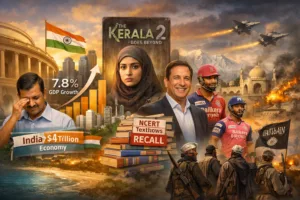
The article transforms the day’s news headlines into a deeper analysis of the forces shaping India, examining the political vindication of Arvind Kejriwal and its implications for justice and democracy, the record 7.8% GDP growth and its connection to environmental challenges, and the cultural and legal battles surrounding ‘The Kerala Story 2’ and a recalled NCERT textbook. It further explores the global business appeal of the IPL and, most alarmingly, the potential for regional destabilization following the Taliban’s unprecedented claim of airstrikes on Pakistani military installations, ultimately weaving these events together to illustrate how the political, economic, and geopolitical stories of February 28, 2026, will collectively shape the future for a new generation.
Beyond the Headlines: India on the Move – A Deep Dive into February 28, 2026
Good morning. For a student standing in a school assembly, the news headlines read on a Friday morning can often feel like a distant rumble—important events happening in a world that seems separate from the rush of classes, exams, and friendships. But history is not just made in parliaments and courtrooms; it is the sum of these events, and they shape the very world students will inherit.
February 28, 2026, is one of those days where the news cycle offers a powerful microcosm of a nation in motion. From a dramatic political verdict in Delhi to the release of blockbuster economic data, from cultural clashes over cinema to a shocking new front opening in global terrorism, today’s headlines are more than just bullet points. They are stories of justice, ambition, identity, and conflict.
Let’s move beyond the bulletins and unpack the real stories behind today’s top news.
- The Scales of Justice: Arvind Kejriwal’s Emotional Acquittal and the Future of Indian Politics
The headline is stark: “Arvind Kejriwal sheds tears as court shreds CBI case.” But the story it tells is one of a four-year political saga that captivated and divided the nation. The Delhi liquor policy case wasn’t just a legal battle; it was a high-stakes political drama that saw the Chief Minister of the national capital, Arvind Kejriwal, behind bars, his Aam Aadmi Party (AAP) fighting for its survival.
The Delhi court’s decision to give a clean chit to Kejriwal, his former deputy Manish Sisodia, and 21 others is a seismic event. The judge’s observation that the CBI’s case “lacks foundation” and was “based almost entirely on conjecture” is a scathing indictment of the investigation. For Kejriwal, who was visibly emotional, the verdict is a personal vindication after months of incarceration and political turmoil. His tears were not just for himself, but for the immense personal and political cost his party paid. The assembly polls they lost last year will forever be viewed through the lens of these now-dismissed charges.
For students, this case is a live case study in civics. It highlights the immense power and independence of the judiciary as a check on the executive. It raises profound questions about the line between aggressive investigation and political vendetta. As young citizens, watching a leader be absolved by the courts after being convicted in the court of public opinion offers a crucial lesson in due process and the presumption of innocence. The political fallout from this will be felt for years, potentially reshaping the opposition landscape in the run-up to the next general elections.
- A $4 Trillion Dream: Decoding India’s 7.8% GDP Growth
Buried beneath political drama is a number that will define India’s future: 7.8%. That is the GDP growth rate for the third quarter, a figure that cements India’s status as the world’s fastest-growing major economy.
But this number comes with an asterisk, and understanding it is key for every student. The government has introduced a new GDP series with 2022-23 as the base year. Think of the base year as a camera’s lens. For years, we were looking at the economy through a lens calibrated to 2011-12. A lot has changed since then—the explosion of digital payments, the rise of the gig economy, and new manufacturing ecosystems. The new base year adjusts the focus, giving us a more accurate picture of the modern Indian economy.
So, what does 7.8% growth mean for a student? It means an economy that is creating jobs, attracting investment (like the interest in IPL teams we’ll discuss later), and generating the tax revenue that builds roads, schools, and hospitals. However, this headline also sits alongside another: a massive February rain deficit and predictions of heat waves. It’s a stark reminder that economic growth is intertwined with the health of our environment. A parched earth and extreme weather can quickly disrupt the agricultural supply chains and labour productivity that underpin this very growth. For the next generation, the challenge will be to sustain this economic momentum while building climate resilience.
- When Art and Ideology Collide: The Controversy Over ‘The Kerala Story 2’
The Kerala High Court’s intervention in the release of The Kerala Story 2: Goes Beyond is a fascinating snapshot of India’s cultural and political churn. Just hours after a single judge halted its release, a division bench lifted the stay, allowing the film to hit the screens.
This back-and-forth is more than just legal procedure. The first film, released in 2023, was engulfed in a firestorm of controversy, with critics accusing it of peddling a divisive and factually dubious narrative. The sequel promised to “go beyond,” and the mere attempt to halt its release shows that the fault lines it touches upon are still raw.
The Central Board of Film Certification (CBFC) granted a U/A certificate, deeming it suitable for viewing with parental guidance. But the court’s initial intervention questioned that very certification. This entire episode is a masterclass for students in the delicate balance of rights in a democracy. On one hand is the fundamental right to freedom of speech and expression (Article 19), which protects the filmmaker’s right to create and the public’s right to watch. On the other is the need to maintain public order and prevent the spread of disharmony. The judiciary’s role is to be the umpire, ensuring that the scales don’t tip too far in either direction. For a student, it’s a reminder that in a vibrant democracy, the stories we tell and the stories we consume are always subject to intense, passionate debate.
- The Battle for the Young Mind: The NCERT Textbook Recall
In a quieter but equally significant development, the NCERT has issued a public appeal to recall a circulated Class 8 Social Science textbook. This follows a specific order from the Supreme Court.
This isn’t about a printing error. It’s about the most fundamental question in education: What do we teach our children? Textbooks are the official version of knowledge, shaping the worldview of millions of young Indians. The Supreme Court’s intervention suggests that the content of this particular book was found to be legally problematic, perhaps in its representation of historical events, social structures, or constitutional values.
For a student, this might seem like adults fighting over a book you’re just trying to study for an exam. But think of it this way: your textbook is a lens through which you see your country’s past and your place in its present. If that lens is distorted, your entire perspective can be skewed. The recall is a rare and powerful acknowledgement that getting it right matters. It underscores that history and social science are not static collections of dates and facts, but dynamic fields of interpretation, and the version that makes it into your school bag is the result of a complex process of review, debate, and, sometimes, legal challenge.
- Beyond the Boundary: Why an American Investor Wants a Piece of the IPL
On the sports page, two items stand out: the start of the Indian Football League season and news that American billionaire David Blitzer is looking to buy a stake in IPL teams like RCB and Rajasthan Royals.
The football league’s new season is a story of aspiration, of a sport trying to capture the nation’s cricket-dominated imagination. But the IPL news is a story of staggering financial reality. David Blitzer, who already has stakes in Premier League’s Crystal Palace and the New Jersey Devils NHL team, isn’t interested in the IPL just for the love of the game. He’s interested because the Indian Premier League is a financial colossus.
For students, this is economics and branding 101. The IPL’s value isn’t just in ticket sales. It’s in broadcast rights worth thousands of crores, in a fanatical fanbase of over a billion people, and in the power of its brand. A team like Royal Challengers Bengaluru is not just a cricket team; it’s a lifestyle brand with millions of followers on social media, a massive merchandise pipeline, and immense sponsorship potential. Blitzer’s interest signals that global financial powerhouses see Indian cricket as a mature, high-return investment market, on par with top-tier American and European sports leagues. It shows how sport has transcended the boundary rope to become a central part of the global business and entertainment landscape.
- A Perilous New World: The Taliban’s Claimed Airstrikes on Pakistan
And then, there is the headline that changes everything: “Taliban claims airstrikes on Pakistani military bases near Islamabad.”
If confirmed, this is an unprecedented and terrifying escalation. The Afghan Taliban’s Ministry of National Defence claiming that its air force conducted strikes deep inside Pakistani territory—just five kilometers from the Prime Minister’s office—is an act of war. For years, the relationship between the Afghan Taliban and the Pakistani establishment has been described as complex, with accusations of Pakistan harbouring and supporting the Taliban during their insurgency. Now, the tables have seemingly turned with a vengeance.
This is a watershed moment for regional security. It shatters the already fragile peace in South Asia. For a student, this isn’t just a faraway conflict. India shares a border with both Pakistan and Afghanistan. Instability in one inevitably spills over into the other. It could lead to a massive refugee crisis, embolden terrorist groups like ISIS-K or various Pakistan-centric militant outfits, and completely upend the geopolitics of the region. It also puts India in a difficult diplomatic position. It is a stark, chilling reminder that in our interconnected world, the sound of war in one capital echoes in classrooms across the globe.
Conclusion: Connecting the Dots
As the school assembly ends and the day begins, these are the stories that will continue to unfold. The emotional tears of a politician, the cold hard numbers of GDP, the debate over a film, the quiet recall of a textbook, the business of sport, and the thunder of war.
For a student, the challenge is to see the connections. A stable political environment (News 1) is essential for sustained economic growth (News 2). That growth funds the education system, which fights over the content of its textbooks (News 4). A thriving economy attracts global investors to our cultural passions like cricket (News 7). And all of this domestic progress can be jeopardized by the shockwaves of international conflict (News 8).
February 28, 2026, is not just a date on a calendar. It is a day when the complex, messy, and vibrant story of India and the world was written in real-time. And for those paying attention, it offered a masterclass in the forces that will shape the future they are about to inherit.
You must be logged in to post a comment.