
Beyond the Headlines: Huckabee’s “River to the Sea” Remarks Ignite a Firestorm in the Middle East
US Ambassador to Israel Mike Huckabee sparked a major diplomatic firestorm after suggesting on a podcast that Israel had a biblical right to land between the Nile and Euphrates rivers—a comment that, despite being later dismissed as hyperbole, prompted an unprecedented joint condemnation from over a dozen Arab and Muslim nations, including Saudi Arabia, Egypt, and Turkey. The unified backlash, coordinated through regional bodies like the Arab League and OIC, framed the remarks as a dangerous violation of international law and national sovereignty, reflecting deep-seated fears that such rhetoric emboldens expansionist narratives, undermines the two-state solution, and strains US relations with key regional allies by injecting theological claims into an already volatile geopolitical landscape.
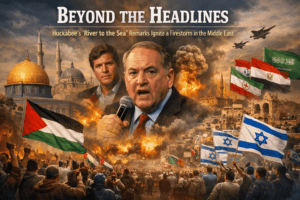
Beyond the Headlines: Huckabee’s “River to the Sea” Remarks Ignite a Firestorm in the Middle East
By [Your Name/Expert Analysis] Date: February 22, 2026
The Middle East, a region perpetually balanced on the edge of a diplomatic knife, has once again been thrust into turmoil. This time, the spark wasn’t a military incursion or a terrorist attack, but a podcast interview. The speaker? Mike Huckabee, the United States Ambassador to Israel. The result? A unified diplomatic rebuke from over a dozen Arab and Muslim nations, a chorus of condemnation that has laid bare the profound and enduring sensitivities surrounding land, religion, and sovereignty in the world’s most contested neighborhood.
At the heart of the firestorm is a concept as ancient as the scriptures and as volatile as modern geopolitics: the belief in a “Greater Israel,” a divinely ordained territory that, according to a literal interpretation of certain biblical passages, stretches from the Nile River in Egypt to the Euphrates River in Iraq and Syria.
The Quote that Lit the Fuse
The controversy erupted not from an official policy speech, but from the informal, often provocative setting of a podcast hosted by Tucker Carlson, a figure whose own recent interviews have drawn accusations of antisemitism. When Carlson pressed Huckabee on the meaning of Genesis 15:18—a verse where God promises Abraham’s descendants land “from the river of Egypt to the great river, the Euphrates”—Huckabee’s response was immediate and, for many, alarming: “It would be fine if they took it all.”
Though Huckabee quickly attempted to contextualize the remark, calling it “somewhat of a hyperbolic statement” and clarifying that Israel is “not asking to take all of that,” the damage was done. For a region scarred by decades of war, occupation, and the denial of sovereignty, a senior American diplomat casually endorsing the concept of Israeli dominion over the sovereign territory of multiple modern nation-states was not a moment of rhetorical excess. It was a confirmation of their deepest fears.
A “Dangerous and Inflammatory” Unification
The response from the Arab and Islamic world was swift, but more importantly, it was historic in its breadth and unity. By Sunday, a joint statement signed by 14 countries and three major regional organizations—the Arab League, the Organization of Islamic Cooperation (OIC), and the Gulf Cooperation Council (GCC)—was released. This was not a collection of disparate, unilateral condemnations; it was a coordinated, collective action, signaling a unified red line.
The signatories, which include powerhouses like Saudi Arabia, the UAE, Egypt, Turkey, and Indonesia, described the remarks as “dangerous and inflammatory.” Their statement went beyond mere diplomatic rebuke, framing Huckabee’s words as a direct challenge to the foundational principles of the modern international order. By stating that the comments contravene the United Nations Charter, they effectively accused a US ambassador of undermining the very concept of international law, national sovereignty, and territorial integrity that has underpinned global relations since 1945.
This unity is significant. In recent years, the Middle East has been characterized by fragmentation, civil wars, and the Abraham Accords, which saw some Arab nations normalize ties with Israel. This unified front sends a clear message to Washington and Jerusalem: while bilateral relations may evolve and even flourish, the core issue of land—and the respect for the borders of existing Arab states—remains an absolute, non-negotiable red line.
Deconstructing the Backlash: Why This Hit So Hard
To understand the visceral reaction, one must look beyond the literal words to their historical and political context.
- The Echo of Expansionism:For nations likeEgypt, Syria, Iraq, Jordan, and Lebanon, Huckabee’s words are not abstract biblical history. They are a painful echo of real-world conflicts. These are countries that have fought wars with Israel in 1948, 1956, 1967, and 1973. They have lost territory—the Golan Heights (Syria), the West Bank (Jordan), and the Sinai Peninsula (Egypt, later returned). To hear a US ambassador suggest that Israel has a “right” to land stretching from the Nile to the Euphrates is to hear a justification for past conquests and a threat of future ones. Jordan’s condemnation of the remarks as “an assault on the sovereignty of the countries of the region” captures this sentiment perfectly.
- The Poisoning of the Two-State Well:The Palestinian Authority’s response was particularly pointed, noting that Huckabee’s words “contradict US President Donald Trump’s rejection of [Israel] annexing the West Bank.” This highlights a deep-seated fear: that such maximalist rhetoric, even if dismissed as hyperbole, emboldens the most hardline elements within Israeli society and government. If a US ambassador speaks openly of divinely ordained borders that erase Palestine, Jordan, and parts of Egypt and Syria, how can the two-state solution—which envisions a Palestinian state on a fraction of that land—ever be seen as a serious, U.S.-backed goal? It validates the Palestinian narrative that the ultimate aim of the Israeli right and its American supporters is not peaceful coexistence, but territorial expansion.
- The Weaponization of Religion in Geopolitics:The Arab and Muslim world is deeply sensitive to the use of religious texts to justify modern political claims. While many Jews and Christians view the biblical land promise as a matter of faith, its invocation by a sitting diplomat is perceived as injecting an immutable, non-negotiable divine right into a conflict that requires practical, human compromise. Egypt’s reaffirmation “that Israel has no sovereignty over the occupied Palestinian territory or any other Arab lands” is a firm rejection of a theological argument in favor of the principle of international law. Iran’s foreign ministry seized on this, accusing Huckabee of revealing “American active complicity” in what it called Israel’s “expansionist wars of aggression”—a narrative Tehran consistently uses to rally regional sentiment against both the U.S. and Israel.
The Domestic Political Angle: A Tale of Two Audiences
While the international reaction was one of unified outrage, the domestic political calculus within the U.S. and Israel is more complex.
Ambassador Huckabee, a former governor of Arkansas and a two-time presidential candidate, was not appointed to his post because of his diplomatic subtlety. He was appointed because of his long, unapologetic, and deeply held Christian Zionist beliefs. For his evangelical base in the United States, his comments on the Tucker Carlson podcast were not a gaffe; they were a reaffirmation of shared faith and a validation of their worldview. They see the modern state of Israel through the lens of biblical prophecy, and Huckabee’s presence in the ambassador’s chair is a powerful symbol of that bond.
Within Israel, the reaction is predictably split. Right-wing politicians, like Knesset Speaker Amir Ohana, praised Huckabee and dismissed the interviewer’s questions as “falsehoods and manipulations.” For them, Huckabee is a true friend who articulates a historical and spiritual connection to the land that they share. He is a welcome contrast to what they see as the constant international pressure to compromise.
However, for more centrist and left-leaning Israelis, as well as for the country’s security establishment, such rhetoric is a strategic nightmare. It alienates key allies like Jordan and Egypt, with whom Israel has vital peace treaties and security cooperation. It provides propaganda fodder for enemies like Iran and militant groups. And it makes the already Herculean task of finding a political solution to the conflict with the Palestinians virtually impossible. While Huckabee’s words may warm the hearts of some in the settler movement, they coldly complicate the work of Israeli diplomats and generals who must operate in the real world.
The Deeper Question: What is the U.S. Policy?
Perhaps the most significant fallout from this incident is the confusion it sows about official U.S. policy. Is Ambassador Huckabee speaking for himself, for his faith community, or for the administration that appointed him?
While the White House has not yet officially commented on this specific incident, the ambiguity is itself damaging. The joint statement from the Arab and Muslim countries implicitly holds the U.S. government accountable for the words of its official representative. The reference to “US President Donald Trump’s rejection of annexing the West Bank” suggests they are trying to hold the administration to its more pragmatic, if still controversial, actions, while signaling that Huckabee’s rhetoric is dangerously out of step.
This incident exposes a fundamental tension at the heart of the U.S.-Israel relationship. Can a country maintain a “special relationship” based on shared values and strategic interests while its official representative publicly champions irredentist claims that undermine the sovereignty of its other allies? The answer, as the unified condemnation shows, is a resounding “no” from the region.
Conclusion: More Than Just Words
Mike Huckabee may have dismissed his initial remark as “hyperbole,” and he may not address it further in his clarifications. But in the Middle East, words are never just words. They are loaded with the weight of history, the memory of bloodshed, and the anxiety of an uncertain future.
This controversy is not an isolated incident. It is a stark reminder that the Israeli-Palestinian conflict, and the broader Arab-Israeli dynamic, cannot be reduced to a simple land dispute. It is a clash of narratives, histories, and deeply held beliefs. By invoking a biblical promise in his official capacity, Ambassador Huckabee has poured fuel on a fire that the entire region is desperately trying to extinguish.
The unified condemnation from Cairo to Jakarta is a powerful signal that while the Arab and Muslim world may be divided on many things, it remains united in its rejection of any vision for the region that is based on divine right rather than international law, and on expansion rather than mutual recognition of sovereignty. The question that now hangs in the air is whether this message will be heard in Washington and Jerusalem, or if it will be dismissed as just another round of diplomatic noise in a region known for it. The answer will help determine the prospects for peace and stability for years to come.
You must be logged in to post a comment.