
Beyond the Headlines: How India’s Suryastra Rocket Launcher Redefines Artillery Power and Strategic Self-Reliance
Under emergency procurement powers, the Indian Army has signed a ₹293 crore contract with domestic firm NIBE Limited, in collaboration with Israel’s Elbit Systems, to acquire the indigenously manufactured “Suryastra” multi-calibre rocket launcher system. Capable of precision strikes up to 300 km and launching loitering munitions, this acquisition aims to rapidly enhance deep-strike artillery firepower along contested borders. The deal underscores a pragmatic “Make in India” model that combines urgent operational needs with technology transfer, providing immediate capability while building domestic defence industrial capacity and diversifying the Army’s long-range arsenal alongside ongoing projects like the Pinaka system.
Beyond the Headlines: How India’s Suryastra Rocket Launcher Redefines Artillery Power and Strategic Self-Reliance
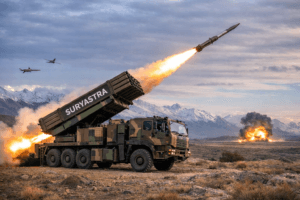
In a move that significantly reshapes the tactical calculus along its contested borders, the Indian Army has swiftly concluded a ₹293 crore contract under emergency procurement powers for the “Suryastra,” a Made-in-India, universal multi-calibre rocket launcher system with a blistering 300 km strike range. This isn’t merely another defence acquisition; it is a potent symbol of a maturing defence industrial ecosystem and a strategic leap in India’s artillery doctrine. The deal with Pune-based NIBE Limited, backed by critical Israeli technology from Elbit Systems, marks a pivotal moment where operational urgency, indigenous manufacturing, and cutting-edge capability converge.
Decoding the “Suryastra”: More Than Just Range
At first glance, the headline figures are arresting: a single rocket launcher platform capable of delivering precision strikes at 150 km and 300 km. However, the true ingenuity of the Suryastra system lies in its universality and integration. Traditionally, artillery units are equipped with specific systems for specific range brackets. The Suryastra breaks this mold. As a “multi-calibre” platform, it can integrate and fire various rocket types from a single launcher. This means that on a chaotic, fluid battlefield, commanders are not limited by which system is deployed in their sector. The same vehicle can engage a tactical target at 40 km, a strategic command post at 150 km, and a deep-storage depot or airfield at 300 km, providing unprecedented operational flexibility.
Furthermore, its claimed Circular Error Probable (CEP) of less than five meters transitions it from an area saturation weapon to a precision-strike tool. This accuracy, likely achieved through guided rocket technology and advanced fire-control systems, minimizes collateral damage and increases lethality per round—a crucial factor given the logistical challenges of supplying ammunition in high-altitude or remote areas. The added capability to launch loitering munitions (up to 100 km) transforms the launcher into a sensor-shooter node. These “kamikaze drones” can circle a target area, allowing for last-minute abort decisions, targeting of moving vehicles, or intelligence gathering before a decisive strike.
The Strategic “Why Now?”: Emergency Procurement and Border Realities
The use of Emergency Procurement (EP) powers is a critical subtext. The Defence Acquisition Council’s recent extension of these powers allows the armed forces to bypass lengthy procurement procedures for contracts under ₹300 crore, with delivery mandated within a year. The Army’s decision to invoke this clause for the Suryastra signals an immediate, identified gap in its long-range firepower. This urgency is undeniably linked to the persistent military standoffs and infrastructure build-up along India’s northern borders.
The 300 km range is a game-changer in this geography. It brings a vast array of potential targets within reach from relatively safer rear positions. This creates a complex dilemma for any adversary, forcing them to disperse logistics, command centres, and air defence systems far beyond the immediate front line, thereby complicating their offensive planning and imposing significant economic and operational costs.
The Partnership Model: A Blueprint for Aatmanirbhar Bharat
The NIBE-Elbit collaboration is a textbook case of the evolving “Make in India” defence model. This isn’t a simple off-the-shelf import. The July 2025 Technology Collaboration Agreement (TCA) signifies a transfer of technology and know-how. NIBE will manufacture the ground equipment, accessories, and ammunition in India. This approach delivers immediate capability while building domestic industrial muscle memory for maintaining, upgrading, and potentially developing future variants.
It also deepens the strategic defence tie with Israel, a relationship built on discreet reliability and technological prowess. While India’s primary indigenous system, the Pinaka (with its new 120km and 300km variants under development by DRDO), remains the cornerstone of its artillery modernization, the Suryastra introduces healthy diversification. It accelerates induction through the private sector, fosters competition, and provides the Army with a different technological solution, insulating the supply chain from over-reliance on a single developer.
The Broader Artillery Ecosystem: Pinaka and Suryastra
The DRDO Chairman’s simultaneous announcement about the impending manufacture of 120 km and 300 km Pinaka variants indicates a two-track approach to building deep-strike capacity. The Pinaka, a proven system with a strong public-sector pedigree, will form the bulk of the regiments. The Suryastra, emerging from the private sector with Israeli tech, offers a parallel, rapidly inducted capability. This is not redundancy but resilience. Different systems can employ different guidance packages, electronic signatures, and logistical pathways, making it exponentially harder for an adversary to develop effective countermeasures.
The Human and Tactical Impact: Changing the Game for Commanders
For the soldier and commander on the ground, this system translates to greater safety and decisiveness. The ability to launch devastating, precise fire from far behind the forward edge of the battle area reduces the exposure of gun crews to counter-battery fire. The long range also allows for the concentration of fire from multiple dispersed launchers onto a single target, a tactic known as “deadly symphony,” which can overwhelm enemy defences.
At the corps and command level, it provides a non-airborne means of conducting deep battle. While air power remains vital, it is vulnerable to advanced air defence systems and weather. Long-range rockets provide a persistent, all-weather, and potentially more survivable method of interdicting enemy second-echelon forces and disrupting their operational timetable.
Challenges and the Road Ahead
The procurement is just the first step. The real test lies in rapid integration. The Army must develop new targeting cycles, logistics chains for the specialized ammunition, and training regimens for crews. The “emergency” tag puts pressure on NIBE to deliver the first systems within six months, a timeline that will test the nascent production line.
Furthermore, the cost-per-round of precision-guided rockets is high. The Army will have to carefully balance its inventory between cheaper, unguided rockets for area denial and expensive guided munitions for high-value targets, ensuring sustainable ammunition stockpiles.
Conclusion: A Paradigm Shift in Indian Firepower
The Suryastra deal is more than a contract notice; it is a statement of intent. It demonstrates India’s move towards an artillery force that is longer-reaching, more precise, more flexible, and increasingly indigenous. It underscores a strategic shift from border defence to deterrence through credible denial, capable of holding adversary assets at risk far into their territory.
By successfully blending emergency operational needs with the long-term goal of self-reliance through strategic partnerships, this acquisition models a pragmatic path for India’s defence modernization. As the first Suryastra systems roll out from an Indian factory and enter service, they will not just carry warheads to distant targets; they carry the weight of a nation’s ambition to secure its frontiers on its own industrial and technological terms.
You must be logged in to post a comment.