
Beyond the Headlines: Deconstructing the ‘Win-Win’ Promise in India-US Ties
Ambassador Sergio Gor’s vision for the US-India relationship frames it as a defining 21st‑century partnership built on a “win‑win” economic synergy—where India’s infrastructure needs meet American expertise in energy, semiconductors, and digital technology, reinforced by initiatives like the COMPACT framework and India’s joining of the Pax Silica declaration—and a strategically vital security pillar anchored in deepening military interoperability, defence sales, and the Quad, all aimed at counterbalancing China’s influence. While the ambition is clear, the partnership’s success will ultimately depend on navigating persistent frictions over trade and tariffs, balancing strategic autonomy with deepening alignment, and delivering tangible benefits—from jobs to market access—that ordinary citizens in both countries can feel.
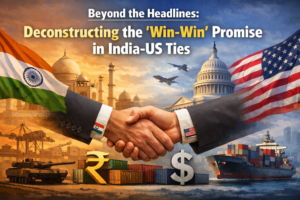
Beyond the Headlines: Deconstructing the ‘Win-Win’ Promise in India-US Ties
In the often-staid world of diplomatic communiques, the words of a US Ambassador carry a specific weight—a calibrated mix of policy, positioning, and persuasion. When US Ambassador to India, Sergio Gor, recently outlined his vision for the bilateral relationship, he did so with a striking blend of ambition and pragmatism. His remarks, reported by PTI, paint a picture of two nations not merely cooperating, but actively constructing what he terms the “defining strategic partnership of the 21st century.”
But beyond the polished phrases of “win-win” economic growth and “robust” security cooperation lies a more complex and compelling story. This isn’t just about two governments signing deals; it’s a narrative of intertwined futures, where infrastructure gaps meet technological prowess, and where shared anxieties over a rising China are reshaping the geopolitical map of the Indo-Pacific. To understand the true value of Gor’s vision, we must deconstruct its core pillars, moving from the diplomatic headline to the tangible reality on the ground.
The Economic Pillar: A Symbiosis of Need and Expertise
The most potent aspect of Gor’s argument lies in his framing of the economic relationship as a natural alignment of needs. He correctly identifies that India’s “growing economy and massive infrastructure needs” are the perfect counterpart to “American expertise in energy, advanced manufacturing and digital infrastructure.” This is not a charitable arrangement; it is a symbiotic one.
For India, the imperatives are clear. The nation is in the midst of a once-in-a-generation infrastructure overhaul. From modernizing its railway network to expanding its urban centers and building a digital backbone that can support a billion-plus users, the scale of investment required is staggering. The government’s focus on becoming a global manufacturing hub, encapsulated in initiatives like ‘Make in India’, demands not just capital but cutting-edge technology and process know-how—areas where the United States has a distinct and enduring advantage.
For the US, the appeal is equally significant. The Indian market represents one of the last great frontiers of growth for American multinationals. In a global economy facing headwinds, a rapidly expanding middle class in India offers a stable and lucrative destination for everything from aerospace (witness the recent Air India order for hundreds of Boeing jets) to high-tech semiconductors and digital services. Ambassador Gor’s emphasis on this being a “win-win” is not merely rhetoric; it is an acknowledgment that a prosperous India, with a modernized infrastructure, creates a more robust and reliable partner for American economic interests.
The New Frontier: Supply Chains and Pax Silica
What elevates this economic partnership from traditional trade to strategic alliance is the focus on future-critical sectors. Gor’s mention of the US-India COMPACT (Catalysing Opportunities for Military Partnership, Accelerated Commerce and Technology) framework is pivotal. This isn’t about just selling goods; it’s about co-creating resilient ecosystems.
The focus on “building resilient supply chains for semiconductors and critical minerals” is a direct response to the geopolitical disruptions of the last decade. The pandemic and subsequent global tensions laid bare the vulnerability of supply chains overly dependent on a single source—namely, China. By aligning on these sectors, the US and India are not just diversifying their supply chains; they are actively building a parallel, more secure architecture. India’s ambition to become a semiconductor hub, supported by its $10 billion incentive program, finds a natural partner in American chip giants like Micron, who are already setting up assembly and test facilities in the country.
This strategy is further crystallized in India’s recent decision to join the Pax Silica Declaration. As Gor explains, this initiative is about aligning “economic and national security interests” through partnerships on critical minerals and AI infrastructure. “Pax Silica” is a concept designed to secure the digital and mineral resources essential for the next generation of technology—from electric vehicles to artificial intelligence. India’s entry into this US-led initiative signals a clear choice to align its technological future with the West, a move with profound implications for the global tech landscape.
However, the path to this “win-win” is not without its friction points. The article notes that these remarks come amid “a turbulent spell triggered by the US policy on tariffs.” The ongoing negotiations for a bilateral trade deal remain complex, with issues like digital tariffs and agricultural market access still points of contention. Gor’s vision of the US as the “main facilitator” of economic growth in South and Central Asia, anchored by a trade deal with India, will ultimately be judged by its ability to navigate these thorny, practical details. A truly “powerful anchor” for regional integration requires the US to not only promote its own interests but also to create pathways that accommodate India’s developmental sensitivities.
Security Cooperation: The Unshakable Core
If the economic pillar is about shared prosperity, the security pillar is about shared survival. Gor rightly calls this the “most strategically significant” area of collaboration. The relationship has evolved dramatically over the last two decades, from a hesitant post-Cold War engagement to a deep defence partnership that now stands as a cornerstone of stability in the Indo-Pacific.
The ambassador’s emphasis on military interoperability is key. Exercises like Malabar (a naval exercise involving the US, India, Japan, and Australia), Tiger Triumph (a tri-service humanitarian assistance and disaster relief exercise), and Cope India (air force exercises) are not just symbolic gestures. They build the practical muscle memory for two large militaries to operate alongside each other. In a crisis—whether a natural disaster or a military confrontation—this ability to communicate, coordinate, and operate seamlessly is invaluable.
Gor’s logic is sound: the three aspects of diplomacy, defence exercises, and military sales create a self-reinforcing cycle of cooperation. The US has designated India a “Major Defence Partner,” a status that facilitates the transfer of critical military technology. From the sale of P-8I anti-submarine warfare aircraft to the recent agreement for MQ-9B SeaGuardian drones, the US has become one of India’s most important defence suppliers. This isn’t just about hardware; it’s about creating a long-term operational and technological interdependence.
This defence relationship finds its highest expression in the Quadrilateral Security Dialogue (Quad) . The Quad, comprising the US, India, Japan, and Australia, has transformed from a loose informal grouping into a strategic platform for ensuring a “free and open Indo-Pacific.” Gor’s mention of the Quad is a reminder that India’s partnership with the US is now embedded in a broader network of like-minded powers. This alignment is a direct response to China’s growing assertiveness in the South China Sea and the Himalayas.
The Unspoken Undercurrent
What makes this partnership truly strategic is what often remains unsaid in official statements: China. The shared perception of China as a revisionist power is the gravitational force pulling the US and India closer together. While Gor frames the cooperation in terms of shared values and security interests, the unspoken context is the need to provide a counterbalance to Beijing’s influence. The focus on securing semiconductor supply chains, the “Pax Silica” initiative to control critical minerals, and the military exercises in the Indo-Pacific are all, at their core, strategies to manage the challenges posed by China’s rise.
The Challenge of Delivery and the Vision for Citizens
Ambassador Gor’s concluding remarks are perhaps his most significant. He states a desire for the “positive outcomes of our partnership to be felt by ordinary citizens.” This is the ultimate test of any strategic partnership. For the Indian citizen, the benefits should be tangible: better jobs created by American investments in manufacturing, more reliable and affordable energy, and a digital ecosystem that is both world-class and secure. For the American farmer, it means expanded market access. For the American worker, it means jobs tied to exports and global supply chains.
The vision is grand. But history suggests that grand visions are realized through persistent, often unglamorous, negotiation. The success of this “defining partnership” will be measured not by the press releases that announce it, but by the resilience of its institutions to weather the inevitable storms. The “turbulent spell” over tariffs is a reminder that even the closest allies have competing domestic interests. The challenge for both governments will be to manage these frictions without allowing them to derail the larger strategic objective.
Furthermore, the human dimension cannot be overlooked. A partnership of this scale requires deep people-to-people ties. The 4 million-strong Indian-American diaspora serves as a living bridge between the two nations, fostering understanding and driving innovation. The exchange of students, researchers, and professionals is the lifeblood of this relationship, ensuring that the strategic alignment has deep cultural and intellectual roots.
Conclusion: A Partnership Forged in a Contested Century
As Ambassador Gor outlines it, the India-US relationship is no longer just a bilateral affair; it is a geopolitical statement. It is an attempt to shape the 21st-century global order in a way that favours democracy, open economies, and a stable balance of power.
The pillars he identifies—economic synergy through infrastructure and technology, and security cooperation through interoperability and the Quad—are solid. The vision of a “win-win” scenario is credible, given the complementary strengths of the two nations. The US brings capital, cutting-edge technology, and a vast domestic market; India brings a demographic dividend, a massive and rapidly growing market, and a strategic location at the heart of the Indo-Pacific.
However, the ultimate architecture of this partnership will be defined by how it navigates the inevitable contradictions. Can the US balance its desire for greater market access in India with the need to protect its own industrial base? Can India reconcile its long-held policy of strategic autonomy with the deepening military alignment with the US? Can both nations deliver on the promise of “tangible benefits” to their citizens while bearing the costs of building a new global order?
The answers to these questions will determine whether Ambassador Gor’s vision of a “defining strategic partnership” is realized. For now, the trajectory is clear. The US and India are not just partners; they are builders—architects of a relationship that, if successful, will not only define their own futures but will also shape the security, prosperity, and balance of power in the 21st-century world. The foundation is laid. The ambition is set. The task now is the painstaking, essential work of turning a grand vision into a lived reality for the billions of people they represent.
You must be logged in to post a comment.