
Beyond the Headlines: Decoding the Market’s Split Personality on December 9th
The trading session of December 9th presented a market of contradictions: while benchmark indices like the NIFTY50 fell over 120 points due to global trade war anxieties, a fierce rotational rally emerged beneath the surface. The NIFTY Smallcap 100 index notably surged 1.14%, led by a dramatic 14.42% rebound in Kaynes Technology—a stark recovery after a 30% correction—highlighting bargain-hunting in oversold quality stocks.
This divergence, coupled with the separate operational crisis at IndiGo prompting a 10% flight cut and governance concerns, underscored critical investor lessons: benchmark weakness can mask sector-specific opportunities, understanding context is key to interpreting sharp moves, and risks extend beyond market volatility to include operational and governance failures, demanding heightened selectivity.
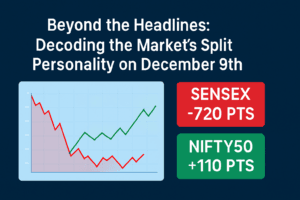
Beyond the Headlines: Decoding the Market’s Split Personality on December 9th
The trading session on Tuesday, December 9th, presented a tale of two markets. While headlines screamed about benchmark indices bleeding, a deeper dive reveals a nuanced story of selective resilience, dramatic recoveries, and sectors moving to their own rhythms. This wasn’t a blanket sell-off; it was a strategic reshuffle, offering critical insights into current investor psychology.
The Macro Shockwave: Why the Benchmarks Stumbled
The initial market weakness was undeniable. The SENSEX plummeted over 720 points intraday, and the NIFTY50 breached the 25,730 level. The primary catalyst was external: renewed trade war anxieties. Former US President Donald Trump’s threat of new tariffs, specifically targeting Indian rice and Canadian fertilizer, sent a ripple of uncertainty through global markets. For Indian indices laden with heavyweight global-facing stocks, this was a direct hit.
The giants stumbled. ICICI Bank, HDFC Bank, and Reliance Industries—the triumvirate often dictating index direction—dragged the benchmarks down. The IT pack, including Infosys, TCS, and HCL Technologies, also faced pressure, likely on concerns over global demand and currency volatility. Asian Paints led the NIFTY losers, sliding 4.6%, potentially on profit-taking after recent runs or worries about raw material costs.
However, the day’s true story wasn’t about this decline, but about the notable intraday recovery. The indices clawed back significant ground, with the NIFTY50 settling at 25,840. This resilience suggests a underlying bid in the market, where domestic investors and funds used the dip as a buying opportunity in select pockets, setting the stage for the fascinating divergence that followed.
The Smallcap Spectacle: Kaynes Technology and the Rebound Narrative
While the headline indices wore red, the NIFTY Smallcap 100 index surged 1.14%. This outperformance is the first critical insight: the day’s risk sentiment was not uniformly negative. Money rotated, rather than retreated.
The star of this show was undoubtedly Kaynes Technology. Its staggering 14.42% gain to ₹4,356 is a masterclass in market mechanics. Context is key: the stock had corrected a brutal 30% over four consecutive sessions. Tuesday’s explosion was likely a combination of bargain-hunting, short covering, and value discovery after an overheated sell-off. It underscores a classic market behavior: excessive pessimism often sows the seeds for a sharp rebound. For investors, Kaynes serves as a reminder that quality stocks undergoing severe technical corrections can offer dramatic entry points, though they require strong nerves and a clear understanding of the company’s fundamentals beyond the price chart.
The smallcap gainers’ list was instructive. PG Electroplast (4.59%), Delhivery (4.25%), and Bandhan Bank (4.07%) joined the rally. This wasn’t a random bounce; these companies represent electronics manufacturing, logistics, and niche finance—themes aligned with India’s structural growth story. Their strength amid a weak broader market indicates continued institutional faith in long-term domestic narratives.
The Midcap Medley: Steady as She Goes
The NIFTY Midcap 100 index mirrored this resilience, closing 0.32% higher. Its performance was a balanced mix. Godfrey Phillips (up 4.69%) and Vodafone Idea (up 4.57%) showcased momentum in specific, often news-driven stories. In contrast, the presence of Godrej Properties (up 3.2%) and Tube Investments (up 3.83%) pointed to sustained interest in real estate and diversified manufacturing.
However, the midcap segment also housed significant losers like Coforge (-4.13%) and BSE (-3.53%), reminding us that even within resilient segments, stock-specific risks and profit-booking prevail. This bifurcation highlights the need for razor-sharp selectivity in the midcap space.
The IndiGo Saga: A Case Study in Operational Risk
Separate from the index movements, the unfolding drama at InterGlobe Aviation (IndiGo) offers a profound lesson in non-market risk. The stock, which had been a gainer in the NIFTY on Tuesday, faced renewed selling pressure on December 10th after the aviation ministry mandated a 10% flight schedule cut.
The implications are vast:
- Governance Under the Microscope: The ICSI’s (Institute of Company Secretaries of India) pointed statement on “governance lapses” elevates this from an operational hiccup to a boardroom concern. It highlights how internal process failures—in this case, crew roster management during regulatory change—can erupt into massive financial and reputational damage.
- The Cost of Disruption: Beyond immediate refunds and penalties, the long-term cost includes brand erosion, passenger defection, and lost future revenue. For a sector with razor-thin margins, such disruptions can impact valuations for quarters.
- Investor Takeaway: It reinforces that investing is not just about analyzing financial statements and market trends. It also involves assessing operational robustness, management’s executional agility, and contingency planning. A company can be in a high-growth sector (like aviation) but remain highly vulnerable to self-inflicted wounds.
Synthesis: Key Takeaways for the Discerning Investor
- Decouple Benchmark Noise from Stock Opportunities: December 9th proved that a falling NIFTY can be an excellent backdrop to find rising stars, particularly in oversold quality smallcaps.
- Rotation is the New Normal: The market is not moving in lockstep. Money is actively shifting between large, mid, and small caps, and across sectors based on micro and macro triggers. A top-down view must be complemented with bottom-up stock analysis.
- Context is King: A 14% gain like Kaynes’ is meaningless without understanding the preceding 30% drop. Always zoom out to the larger chart and recent news flow to distinguish between a sustainable reversal and a dead-cat bounce.
- Risk Multidimensionality: The IndiGo story is a stark reminder that investment risk extends beyond market beta. Operational, regulatory, and governance risks are equally potent and can materialize abruptly.
- Domestic Resilience vs. Global Volatility: The recovery in indices and strength in smallcaps suggest domestic liquidity and confidence are providing a cushion against global trade shocks. This bifurcation may define market behavior in the coming months.
In conclusion, December 9th was far more than a “market down” day. It was a revealing session that highlighted the market’s complex layers—where fear and opportunity coexisted, where global headlines met local conviction, and where the silent rotation of capital painted a more optimistic picture than the headlines suggested. For the astute investor, such days are not for panic but for careful analysis, portfolio rebalancing, and recognizing that in a maturing market like India, stories are increasingly stock-specific, not index-dependent.
You must be logged in to post a comment.