
Beyond the Headlines: Decoding the India-US Interim Trade Deal – Who Really Wins, and at What Cost?
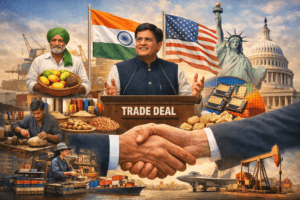
Beyond the Headlines: Decoding the India-US Interim Trade Deal – Who Really Wins, and at What Cost?
In the bustling halls of Vanijya Bhawan, Commerce Minister Piyush Goyal struck a tone of confident victory. The newly inked interim trade agreement with the United States, he asserted, was a “fair, equitable, and balanced” pact that would turbocharge India’s exports while staunchly protecting its most sensitive sectors: agriculture and MSMEs. The narrative was clear – a win for the artisan in Sambhal, the fruit grower in Karnataka, and the textile exporter in Tiruppur. But beneath the surface of this political and economic diplomacy lies a more complex story of strategic calculus, unspoken concessions, and a high-stakes balancing act that will test India’s economic resilience.
The Carrot: A Calculated Opening of the American Bazaar
The most immediate and tangible benefits of the deal lie in the realm of tariffs. For Indian exporters who have been navigating the turbulent waters of Trump-era protectionism since last August, the relief is significant. The slashing of U.S. reciprocal tariffs from a punitive 50% to zero on items like textiles, leather, plastics, and organic chemicals isn’t just a policy shift; it’s a lifeline restored. These labor-intensive sectors are the backbone of non-farm rural employment, and renewed access to the world’s largest consumer market could catalyze job creation and stabilize countless small and medium enterprises.
The more politically resonant victory, however, is in agriculture. Goyal’s emphasis on “zero duty” for a basket of tropical and niche produce—coconut, mangoes, cashews, shiitake mushrooms—is masterful optics. It paints a picture of the Indian farmer finally getting a fair shot at the American dinner table. This isn’t just about economics; it’s about dignity and global recognition. For decades, Indian agricultural exports have struggled with non-tariff barriers and high duties. This deal, in theory, cracks that door open. It incentivizes a shift towards quality, standardization, and value addition, pushing the agrarian sector to think beyond subsistence and local mandis.
Furthermore, the promise of access to critical U.S. technology, particularly semiconductors, is a forward-looking coup. In an era where AI supremacy is the new space race, securing a reliable pipeline for these foundational components is not just a trade gain; it’s a national security and strategic autonomy imperative. It aligns perfectly with India’s ambitions in electronics manufacturing and digital sovereignty.
The Shield: The Red Lines That Held
Perhaps more telling than what’s in the deal is what is conspicuously absent from it. Goyal’s explicit list of exclusions reads like a manifesto of India’s socio-economic sacred cows. Genetically modified crops, dairy, poultry, staples like wheat, rice, sugar, and millet—all remain shielded. This is no accident. It represents a hard-fought defense against the most potent sources of domestic political backlash.
The Indian farmer, particularly in the politically crucial northern belt, is not just an economic actor but a potent political symbol. The government’s refusal to yield on these items is a direct message to its rural base: their livelihoods will not be bartered for a trade deal. It acknowledges the deep-seated fears of being swamped by highly subsidized, industrially produced American agricultural commodities. By protecting the dairy sector, it safeguards the millions involved in the cooperative model, a system intertwined with rural economic and social fabric. This defensive posture is arguably the deal’s most significant achievement from a political risk perspective, demonstrating that New Delhi understood the “red lines” drawn not just by policy but by public sentiment.
The Fine Print: The Unspoken Bargains and Future Battles
However, to view this deal solely through the lens of tariffs is to miss its deeper architecture. The real story may lie in the commitments on non-tariff barriers (NTBs), standards alignment, and digital trade.
When Goyal states that India will “review acceptance of US and international standards within six months,” it signals a potential seismic shift. For sectors like medical devices, this could mean moving towards U.S. FDA-like norms, which may benefit patients with faster access to innovation but could disrupt local manufacturers accustomed to a different regulatory regime. The “alignment of standards” is often where the playing field is truly leveled—or tilted.
The digital trade component is another frontier. “Common digital trade rules” with the U.S. could have far-reaching implications for data localization, e-commerce policy, and the taxation of digital giants. While fostering smoother cross-border data flows, it may require compromises on India’s emerging data privacy framework and its desire to nurture domestic tech champions.
Furthermore, the headline-grabbing pledge for India to purchase $500 billion worth of U.S. goods over five years is a staggering commitment. While it will help balance trade, it also locks India into a massive import corridor, primarily for energy, aircraft, and possibly defense equipment. This brings us to the unspoken question lingering in the background: does this economic embrace nudge India away from other strategic partnerships, notably its continued import of Russian crude? While not explicitly mentioned, the deal is undoubtedly a tool in Washington’s broader geopolitical toolkit.
The Human Element: Between the Artisan’s Hope and the Farmer’s Fear
The commerce minister’s anecdote about the Sambhal artisan encapsulates the deal’s promise: hope for the skilled, small-scale entrepreneur who sees a world market suddenly become more accessible. For them, a tariff reduction from 50% to 18% isn’t a statistic; it’s the difference between stagnation and survival, between a handful of orders and a thriving business.
Yet, the opposition’s criticism and the “aghast” reactions Goyal mentions are not merely political noise. They stem from a lived history of trade liberalization where promises of gains often materialize for a few, while the costs are diffused and painful for many. The fear is that even with protected sectors, the inflow of competitive goods in allied areas could depress prices. The concern is whether the MSMEs celebrated in speeches have the financial muscle and export readiness to navigate complex American supply chains and compliance requirements, or if the benefits will accrue predominantly to larger corporate players.
Conclusion: A Bridge, Not a Destination
The interim India-US trade deal is neither the unalloyed victory portrayed by its architects nor the one-sided surrender decried by its detractors. It is a carefully constructed interim bridge—a provisional map of the possible.
It secures immediate, tangible export wins and protects core sensitivities, giving the government a political win. Simultaneously, it defers the hardest conversations on agriculture, digital sovereignty, and comprehensive market access to a future “full” agreement. The real test will be in the implementation: can Indian exporters, from farmers to artisans, be effectively mobilized and supported to seize these new opportunities? Can the safeguards for staples hold under future negotiating pressure?
Ultimately, this deal is a high-stakes bet on India’s economic maturity. It bets that its producers are competitive enough to win in the American market and that its economy is resilient enough to manage the new currents of competition it invites. The interim framework has set the stage; the real drama of execution, adaptation, and consequence is just beginning. The true balance sheet of this “fair and equitable” deal will be written not in joint statements, but in the ledgers of small workshops and the fortunes of farming communities in the years to come.
You must be logged in to post a comment.