
Beyond the Headlines: Decoding the India-Russia Business Forum and the Unfolding of a New Economic Corridor
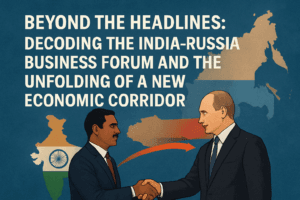
Beyond the Headlines: Decoding the India-Russia Business Forum and the Unfolding of a New Economic Corridor
The recent state visit of Russian President Vladimir Putin to India, accompanied by the Russia-India Business Forum 2025, generated predictable headlines about diplomatic ties and trade targets. Yet, to dismiss it as mere political theatre is to miss a significant, quieter narrative: the meticulous, sector-by-sector construction of a modern economic partnership designed for a fragmenting world. Led by the Roscongress Foundation, the Forum was less a celebration of past camaraderie and more a pragmatic, blueprint-laying assembly for a future both nations are urgently scripting.
Alexander Stuglev, CEO of the Roscongress Foundation, called it “one of the most opportunity-rich platforms for economic development.” His words are not mere hyperbole. They reflect a conscious pivot from a relationship historically anchored in defence and energy to a multidimensional corridor encompassing AI, pharmaceuticals, technology, and even cultural exchange. This is the story of how two civilizational powers, each navigating unique global pressures, are building a bridge for a new era.
The Strategic Backdrop: Why Now?
The renewed vigor behind India-Russia economic ties cannot be understood in a vacuum. It is a direct response to tectonic geopolitical shifts. For Russia, the imperative is clear: diversify economic partnerships and build resilient supply chains beyond the West. For India, the calculus is one of strategic autonomy—securing critical resources (like energy and defence spares), accessing niche technologies, and opening new markets for its booming tech and pharmaceutical sectors, all while maintaining a balanced global stance.
The stated goal of $100 billion in bilateral trade by 2030, reiterated during the visit, is ambitious—current trade, heavily skewed by discounted oil, is already at elevated levels. The real challenge, and the Forum’s true focus, was on quality and sustainability: moving beyond commodity-based transactions to integrated, value-added collaboration.
Deconstructing the Deals: From Vodka to APIs
The signed agreements, while diverse, reveal a deliberate strategy:
- The Pharma & Medical Tech Leap:The Agreement of Intent between BDR Pharmaceuticals, the Kaluga Region, and Pharmasyntez for an Active Pharmaceutical Ingredient (API) production facility in Kaluga is monumental. It’s not just about drug sales; it’s about Russia localizing critical pharmaceutical production and India leveraging its “Pharmacy of the World” prowess to embed itself in Russia’s healthcare supply chain. This mitigates risk for both and sets the stage for joint R&D in medical technology and hospital management, sectors explicitly highlighted in discussions.
- Industrial Symbiosis Goes Digital:The partnership between Omega Elevators and SCAD Tech, and the advanced talks between Sberbank and India’s CSIR, signal a move into industrial digitization and smart infrastructure. It’s about marrying Russian engineering prowess with Indian software and process innovation. The focus on cybersecurity, AI, and digital innovation in the dialogues underscores a shared understanding that the future of manufacturing is connected, intelligent, and must be secure.
- The Soft Power Engine: Media & Culture:The clutch of media MoUs—between TASS and PTI, Prasar Bharati and Gazprom-Media, NFDC and Gazprom-Media—is often under-analyzed. In an age of narrative warfare, creating a shared information ecosystem and facilitating content exchange (films, documentaries) builds lasting people-to-people connectivity. It fosters a mutual cultural understanding that makes business smoother and tourism, another highlighted sector, more viable.
- The SME Backbone:Perhaps the most critical long-term play is the trilateral MoU between Delovaya Rossiya, the All-India Association of Industries, and the World Trade Center Mumbai. Large state-led deals make news, but diversified, resilient economic corridors are built on thousands of small and medium enterprise (SME) connections. This framework aims to de-risk and facilitate these smaller partnerships, which are the lifeblood of innovation and employment in both nations.
The Unseen Challenges: Logistics, Trust, and the “Devil in the Details”
The Forum’s optimism is tempered by well-acknowledged, thorny issues. Logistics and Finance remain the twin pillars yet to be fully reinforced. While the Eastern Maritime Corridor and International North-South Transport Corridor were discussed, creating predictable, cost-effective, and insured shipping routes is a work in progress. Similarly, circumventing the dollar-dominated SWIFT system through rupee-rouble trade mechanisms is conceptually agreed upon but practically cumbersome. Building seamless financial pathways is as crucial as any sectoral MoU.
Furthermore, there is a cultural gap in business practices. Russian corporate hierarchies can be starkly different from the more agile, sometimes informal, Indian business style. The Forum’s structured B2B sessions are designed to bridge this, but trust is built contract by contract, delivery by delivery. The emphasis on “transparent, efficient mechanisms” by Stuglev directly addresses this need for institutionalized trust.
A Partnership for a Multipolar World
Ultimately, the Russia-India Business Forum 2025 was a masterclass in realpolitik economics. It wasn’t about creating an alliance against anyone, but about forging a self-reliant partnership for themselves. In a world where economic blocs are re-forming, India and Russia are signaling their intent to build their own pole—one based on mutual need, pragmatic complementarity, and strategic insulation from external volatility.
The follow-up actions—themed investment forums, regional dialogues, and delegation exchanges promised by Roscongress—will be the true test. The blueprint is signed. The scaffolding, from Kaluga’s API plants to joint AI research labs and SME matchmaking platforms, is now being erected. If the momentum holds, the India-Russia economic corridor could evolve into one of the defining, opportunity-rich partnerships of the coming decade, not defined by the Cold War past, but engineered for a complex, multipolar future.
For business leaders and observers, the insight is clear: look beyond the oil figures and the defence contracts. Watch the pharma JVs, the tech collaborations, and the slow, steady work of connecting SMEs. That is where the real transformation of this ancient relationship into a modern economic engine is taking place.
You must be logged in to post a comment.