
Beyond the Headlines: Decoding the Conviction Behind India’s Decade of Transformation
The Prime Minister’s address at the ET Now Global Business Summit revealed a fundamental philosophical shift in Indian governance—moving from “reform by compulsion,” where previous governments only acted during crises like the 1991 bankruptcy or the 26/11 attacks, to “reform by conviction” characterized by proactive, long-term thinking that has transformed everything from bureaucratic processes (like time-bound Cabinet note approvals and empowered local border infrastructure decisions) to massive digital inclusion through the Jan Dhan-Aadhaar-Mobile trinity, resulting in India’s emergence as a global growth engine contributing over 16% to world growth, securing trade agreements with 38 countries compared to just four under the previous administration, and fundamentally reorienting governance toward outcome-based budgeting, fiscal federalism with nearly ₹100 lakh crore devolved to states, and genuine sensitivity toward marginalized communities—all driven by the understanding that nations outlast individual generations and that building a developed India by 2047 requires sowing today what future generations will harvest.
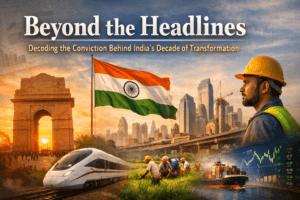
Beyond the Headlines: Decoding the Conviction Behind India’s Decade of Transformation
The Unspoken Shift That’s Reshaping India’s Economic Destiny
When the Prime Minister took the stage at the ET Now Global Business Summit on February 13, 2026, the assembled business leaders expected the usual ceremonial remarks. What they received instead was something far more revealing—a rare glimpse into the philosophical undercurrents that have quietly redirected one of the world’s largest economies.
The theme “A Decade of Disruption, A Century of Change” provided the perfect backdrop, but the substance of the address cut far deeper than any summit agenda could capture. This wasn’t merely a recitation of achievements; it was an articulation of a fundamental reimagining of how governance should function in a rapidly fragmenting world.
The Compulsion vs. Conviction Divide That Nobody Talks About
Here’s something that didn’t make it into the news summaries: the most significant transformation in Indian governance over the past decade hasn’t been any single policy or reform. It’s been the wholesale rejection of what might be called “crisis-driven decision-making.”
Consider this historical pattern that the Prime Minister alluded to—1991’s reforms came only when gold had to be physically shipped to secure loans. The NIA was formed after 26/11 exposed gaping security holes. Power sector reforms happened only when grids actually failed.
This is the unspoken truth about pre-2014 India: we waited for fires to start before buying fire extinguishers.
The shift toward “reform by conviction” rather than “reform by compulsion” sounds like political rhetoric until you examine what it actually enables. When you’re not constantly putting out fires, you can build fire-resistant structures. When you’re not scrambling to respond to crises, you can anticipate them.
The Cabinet Note That Changed Everything
buried within the speech was a seemingly mundane example that reveals more about India’s governance transformation than any macroeconomic indicator.
The humble Cabinet note.
For those outside the government bubble, this sounds impossibly boring. But ask anyone who’s navigated Delhi’s bureaucratic maze, and they’ll tell you—the Cabinet note approval process was where good ideas went to die. Months of drafting. Endless layers of review. Files gathering dust on countless desks.
The reform? Time-bound, technology-driven processing. A simple rule: a note cannot languish beyond a fixed number of hours. Approve it. Reject it. But decide.
This is the kind of reform that never makes headlines but fundamentally alters what a government can accomplish. It’s process re-engineering at scale, and it explains why infrastructure that once took a decade to approve now moves at speeds that would have seemed impossible fifteen years ago.
The Railway Overbridge That Took Years to Cross
Another seemingly trivial example deserves attention: railway overbridge approvals.
Before 2014, getting a single design approved required multiple clearances across multiple levels. Letters had to be written. Files had to travel. And this was entirely within government—we weren’t even talking about private sector involvement yet.
The reform wasn’t glamorous. It didn’t involve massive budget allocations or new legislation. It simply involved empowering people at appropriate levels to make decisions and take responsibility.
Today, the physical evidence of this mindset shift surrounds us. The pace of road and railway construction isn’t just about increased spending—it’s about a system that no longer treats every decision as something requiring clearance from people who’ve never seen the actual location.
The Border Infrastructure Blind Spot
Perhaps nowhere has the old approach caused more damage than in border infrastructure. For decades, even simple road construction in border areas required Delhi’s permission. District-level authorities had practically no decision-making power. Walls upon walls of approval requirements meant nobody could take responsibility.
The result? Border infrastructure remained perpetually inadequate, even decades after it was clearly needed.
Post-2014, local administrations gained real authority. District magistrates could make decisions without seeking blessings from half a dozen ministries. The infrastructure we’re now seeing along our borders isn’t just about concrete and asphalt—it’s about trust in local decision-making.
UPI: The Trinity That Nobody Planned
The Jan Dhan-Aadhaar-Mobile trinity deserves special attention because it represents something unprecedented in governance history: a massive systemic transformation that emerged from convergence rather than central planning.
UPI wasn’t designed in a closed room and imposed on the country. It emerged from the intersection of financial inclusion priorities (Jan Dhan), digital identity infrastructure (Aadhaar), and mobile penetration. Each piece existed independently, but their convergence created something entirely new.
This is the opposite of the old model, where government would announce a program, allocate funds, and hope something happened. Instead, government created conditions for emergence—enabling infrastructure that allowed private innovation to flourish.
The result? People who never had bank accounts are now active participants in the digital economy. Street vendors display QR codes. Rural women manage household finances through mobile apps. A decade ago, this would have seemed like science fiction.
The Budget Transformation Nobody Notices
Watch any budget coverage from before 2014, and you’ll notice something striking: the entire conversation revolved around tax rates and allocations. Did income tax increase or decrease? How many new trains were announced? What became cheaper or more expensive?
The implicit assumption was that government’s role was to allocate resources, and everything else would follow.
The shift toward outcome-centric budgeting represents a fundamental philosophical change. It’s no longer sufficient to ask how much was spent—we must now ask what was achieved. This seems obvious in retrospect, but it required dismantling decades of entrenched thinking within the bureaucracy.
When you start measuring outcomes rather than outlays, entire departments have to reconfigure how they function. Reporting requirements change. Accountability mechanisms shift. The questions asked in parliamentary committees transform.
The State Devolution Story That Deserves Attention
buried in the speech was a statistic that deserves far more attention than it’s received: between 2004 and 2014, states received approximately ₹18 lakh crore in tax devolution. Between 2014 and 2025, that figure reached ₹84 lakh crore. With this year’s budget, it will approach ₹100 lakh crore.
This isn’t just about generosity or political calculations. It reflects a genuine philosophical commitment to fiscal federalism—the recognition that states are better positioned to address many developmental challenges than the central government.
The criticism that India remains too centralized has merit in many areas, but the tax devolution trend suggests genuine movement toward empowering state governments to pursue their own developmental priorities.
The FTA Puzzle: Why Now?
Trade agreements with developed nations didn’t materialize before 2014 despite India having the same population, the same youthful energy, the same government system. What changed?
The answer is uncomfortable but necessary to acknowledge: India wasn’t taken seriously.
When you’re labeled among the “Fragile Five” economies, when your manufacturing base is weak, when policy paralysis and corruption dominate headlines—why would developed nations negotiate seriously with you? Why would they open their markets when they doubt your ability to deliver on commitments?
The transformation in India’s trade position reflects something deeper than diplomatic skill. It reflects genuine capability development. Over eleven years, India built a manufacturing ecosystem that can compete globally. It created infrastructure that can support complex supply chains. It demonstrated policy stability that makes long-term commitments credible.
This is why trade deals that seemed impossible a decade ago are now being concluded. The world’s trust had to be earned, not demanded.
The Sensitivity Dimension That Media Misses
When the Prime Minister mentioned standardizing Indian Sign Language, it probably sounded like a minor footnote. But it reveals something important about how governance thinking has evolved.
Previously, disability policy meant announcements—funds allocated, programs announced, statistics reported. But genuine sensitivity means recognizing that a differently-abled person from Tamil Nadu should be able to communicate with one from Uttar Pradesh. It means understanding that fragmented sign language creates barriers that compound physical challenges.
The transgender community’s recognition through legislation, the criminalization of triple talaq, women’s reservation in Parliament—these aren’t separate initiatives. They reflect a consistent philosophical position that governance must actively include those previously excluded.
The Free Food Grains Debate
The criticism that providing free food grains to those who’ve escaped poverty is “wasteful” reveals a fundamental misunderstanding of economic vulnerability.
When a patient is discharged from the hospital, does the doctor immediately withdraw all support? No—because the transition period is when relapse is most likely.
Similarly, people who’ve recently escaped poverty remain vulnerable to shocks. A medical emergency, a bad harvest, a job loss—any of these can push them back below the poverty line. Continued support during this transition isn’t welfare dependency; it’s insurance against backsliding.
This understanding reflects something that doesn’t show up in economic models: the human reality of poverty’s lingering effects even after official metrics show improvement.
The 2047 Question
“Why speak of 2047? Will we even be alive then?”
This question, which the Prime Minister addressed directly, reveals a deeper cultural shift that’s difficult to quantify but essential to understand.
The freedom fighters didn’t know if they’d live to see independence. They faced lathi charges, imprisonment, execution—with no guarantee that their sacrifices would bear fruit in their lifetimes. Yet they persisted because they understood something fundamental: nations outlast individuals. The work of building a country isn’t completed in any single generation.
This orientation toward the long term—toward 2047, toward a century of change—represents a departure from the electoral cycle thinking that has dominated Indian politics. When every decision is evaluated against the next election, long-term investment becomes difficult. When you’re thinking about what India should look like in 2047, different priorities emerge.
AI and the Disruption to Come
The Global AI Impact Summit, scheduled for the coming days, represents another dimension of this long-term thinking. AI will fundamentally reshape every economy, every society, every governance system. The countries that adapt successfully won’t necessarily be those with the most advanced technology—they’ll be those with the most adaptable institutions.
India’s approach to AI, like its approach to digital infrastructure, appears to be focused on creating enabling conditions rather than picking winners. The goal isn’t to replicate Silicon Valley or Shenzhen—it’s to create an environment where Indian solutions to Indian problems can emerge organically.
The Real Story Behind the Headlines
The ET Now Global Business Summit address contained plenty of material for news summaries—statistics about economic growth, announcements about infrastructure spending, comparisons between past and present governments. But the real story lies beneath these surface-level elements.
It lies in the philosophical shift from compulsion to conviction, from crisis management to anticipatory governance, from outlay-focused to outcome-focused thinking.
It lies in the recognition that process reforms—Cabinet notes, railway approvals, border infrastructure decisions—matter as much as policy announcements.
It lies in the understanding that economic transformation requires not just resources but capability, not just intentions but trust, not just promises but demonstrated delivery.
Whether these shifts will prove sufficient for the challenges ahead—the AI disruption, the climate crisis, geopolitical realignments—remains to be seen. But the direction of travel is clear, and it represents something genuinely new in India’s governance history.
The question now isn’t whether India can change—it’s whether it can change fast enough, and whether the conviction that’s driven the past decade can be sustained through the disruptions yet to come.
You must be logged in to post a comment.