
Beyond the Headlines: Decoding Rahul Gandhi’s Explosive Allegations on the India-US Trade Deal
In a fiery address at the Kisan Mahachaupal in Bhopal, Leader of Opposition Rahul Gandhi accused Prime Minister Narendra Modi of “selling the country” by hastily conceding to the India-US trade agreement under alleged American pressure linked to two sensitive issues—the unreleased Jeffrey Epstein files and an ongoing US criminal case involving the Adani Group. Gandhi claimed that negotiations had been stalled for four months over agriculture, as the government resisted opening Indian markets to American soy, cotton, maize, and pulses, but suddenly reversed course without cabinet approval due to external leverage. He suggested the US used the threat of releasing embarrassing Epstein documents and the prosecution of Adani as bargaining chips to force India into signing the deal, thereby prioritizing political and corporate interests over the livelihoods of millions of Indian farmers. The allegations raise serious questions about diplomatic sovereignty, procedural governance, and the transparency of decision-making in India’s highest office.
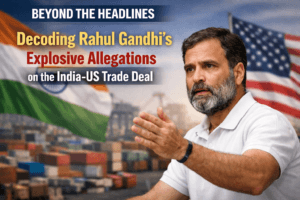
Beyond the Headlines: Decoding Rahul Gandhi’s Explosive Allegations on the India-US Trade Deal
The Political Earthquake in Bhopal
On a charged Monday morning in Bhopal’s Kisan Mahachaupal, Rahul Gandhi hurled what might be his most serious accusation yet at the Modi government. Standing before a gathering of farmers, the Leader of Opposition didn’t just critique the recently concluded India-US trade agreement—he fundamentally questioned the sovereignty of decision-making in the country’s highest office.
“When the Prime Minister sells the country’s interests, farmers are the first to pay the price,” Gandhi declared, his words carefully chosen to land with maximum impact in India’s heartland. The agricultural community gathered at the chaupal listened with rapt attention as he wove together a narrative that connected international diplomacy, unreleased court documents, and corporate criminal investigations into what he described as a “surrender” before American pressure.
But beyond the political theater of it all lies a complex web of questions that deserve genuine examination. What really transpired during those final negotiations? Why did the talks, reportedly stalled for four months on agricultural issues, suddenly accelerate? And perhaps most importantly, what does this tell us about the evolving nature of India-US relations in an increasingly polarized global order?
The Agricultural Standoff That Never Made Headlines
For those tracking trade negotiations between New Delhi and Washington, the agricultural sector had indeed emerged as the principal stumbling block. American soybean farmers have long eyed the Indian market with hungry ambition. Cotton growers from Texas to Mississippi see India’s textile industry as an untapped frontier. Maize and pulse producers similarly view India’s massive population as a potential goldmine.
The resistance from New Delhi was neither new nor surprising. Indian agriculture, despite decades of reforms, remains delicately balanced between subsistence farming and commercial viability. Nearly 86% of Indian farmers are small and marginal landowners, cultivating less than two hectares. Opening the floodgates to American agricultural imports—heavily subsidized and produced at scales that Indian farmers cannot hope to match—would be economically devastating for millions.
“What the Prime Minister has done,” Gandhi told the gathering, “is something no Indian politician would willingly do. No farmer wants this. No political party wants this. Even his own government didn’t want this for four months. Then suddenly, everything changed.”
This is where Gandhi’s narrative takes its most controversial turn—toward what he described as “two sources of pressure” from the United States.
The Epstein Files: Unsealing More Than Documents
The first pressure point Gandhi identified relates to the Jeffrey Epstein files—documents connected to the convicted sex offender whose death in a Manhattan jail cell remains shrouded in mystery and conspiracy theories. For years, Epstein’s network of influential contacts has haunted political establishments across the globe, from American hedge fund managers to British royalty.
But what possible connection could unreleased Epstein files have with Indian trade negotiations? Gandhi’s implication was unmistakable: someone in the Prime Minister’s circle, or perhaps the Prime Minister himself, had something to fear from these documents’ release.
The logic, as Gandhi presented it to the farmers, was simple enough to understand. “The Americans had leverage,” he explained. “They could release files that would embarrass powerful people, or they could hold them back. In exchange for the trade deal, they held them back.”
It’s the kind of allegation that, if proven true, would represent perhaps the most significant political scandal in independent India’s history. If proven false, it represents a level of political rhetoric that dangerously undermines the country’s diplomatic relationships and international standing.
The Epstein files, for those who’ve followed the saga, contain names, flight logs, and communications that have already implicated numerous powerful figures. Their complete unsealing has been repeatedly delayed, with various legal battles playing out in American courts. Whether Indian political figures appear in those documents remains unknown—a vacuum of information that Gandhi has now filled with his own narrative.
The Adani Prosecution: Corporate India in the Crosshairs
The second pressure point Gandhi identified cuts even closer to the heart of contemporary Indian politics. The Adani Group, one of India’s largest conglomerates with interests spanning ports, energy, media, and infrastructure, faces ongoing legal scrutiny in the United States.
The allegations against the Adani Group are serious—bribery charges related to solar energy contracts, with claims that millions of dollars were paid to secure favorable terms. The group has consistently denied these allegations, but the investigation continues to cast a shadow over its international operations.
Gandhi’s suggestion at the Kisan Mahachaupal was that the fate of this prosecution somehow became entangled with the trade negotiations. “The Americans told the Prime Minister, ‘Sign this deal, and we’ll go easy on your friends,'” he claimed, to murmurs of agreement from the gathered farmers.
The timeline, as Gandhi presented it, seemed designed to raise eyebrows. Four months of stalled negotiations, followed by a sudden breakthrough that bypassed even cabinet approval. For the average farmer struggling with input costs, erratic monsoons, and uncertain market prices, the idea that their future was traded away in some backroom deal between Washington and New Delhi resonated with deep-seated suspicions about how the powerful operate.
The Constitutional Question: Did Procedure Matter?
Beyond the sensational allegations, Gandhi raised a procedural point that deserves attention regardless of one’s political persuasion: the apparent bypassing of cabinet approval for the trade agreement.
Indian constitutional democracy operates on principles of collective responsibility. Major decisions, particularly those with far-reaching economic implications, typically require cabinet deliberation and approval. The Prime Minister’s office, while powerful, is not meant to function as a solo decision-making body on matters of national importance.
If Gandhi’s claim that the trade deal was rushed through without proper cabinet scrutiny is accurate, it raises questions about governance norms that transcend partisan politics. Why would a government with a comfortable majority feel the need to bypass established procedures? What was the urgency that couldn’t accommodate a few weeks of additional deliberation?
Government sources, speaking on condition of anonymity to The Indian Express, have offered a different explanation. The breakthrough, they suggest, came not from external pressure but from a strategic reassessment of India’s negotiating position. With global supply chains reorganizing and China’s economic dominance facing challenges, the opportunity to secure preferential access to the American market outweighed the risks to domestic agriculture.
“There were internal debates, yes,” one source acknowledged. “But ultimately, the decision was based on national interest, not external coercion.”
The Farmer’s Calculus: What This Actually Means for Agriculture
For the farmers at the Kisan Mahachaupal, the political drama in Delhi matters less than the practical implications for their livelihoods. What does an India-US trade deal actually mean for someone tilling a small plot in Madhya Pradesh?
The answer, agricultural economists suggest, is complicated. Indian agriculture has long operated within a protective bubble—tariffs, quotas, and various non-tariff barriers have insulated domestic producers from global price fluctuations. This protection has allowed millions of small farmers to survive, but it has also discouraged efficiency improvements, diversification, and value addition.
American agricultural imports would bring economies of scale that Indian farmers cannot match. A soybean farmer in Iowa operates thousands of acres with machinery that reduces labor costs to a fraction of Indian levels. The result is cheaper production costs that, if passed on to Indian consumers, would undercut domestic producers.
But the story isn’t entirely one-sided. American agricultural technology, particularly in water management, cold storage, and supply chain efficiency, could benefit Indian farmers if accompanied by knowledge transfer and investment. The trade deal, government supporters argue, isn’t just about imports—it’s about creating frameworks for collaboration that could modernize Indian agriculture.
“Nobody is abandoning Indian farmers,” a government spokesperson insisted following Gandhi’s speech. “The agreement includes safeguards, phase-wise implementation, and support mechanisms to ensure our farmers can compete and benefit from new opportunities.”
The Geopolitical Context: India Between Powers
To understand what might have really happened in those negotiations, one must step back and examine the broader geopolitical canvas against which this drama unfolded.
India-US relations have undergone a remarkable transformation over the past two decades. From冷战-era suspicion to strategic partnership, the relationship now encompasses defense cooperation, intelligence sharing, technology transfer, and increasingly, economic integration. The United States sees India as a crucial counterweight to China’s growing influence. India sees the United States as an essential partner in its own rise.
But this partnership has never been without tension. American concerns about India’s human rights record, its democratic backsliding (as perceived by some international observers), and its continued engagement with Russia have created friction. India’s concerns about American extraterritorial jurisdiction, its pressure on intellectual property issues, and its demands for market access have similarly complicated the relationship.
The trade deal, from this perspective, represents not a sudden surrender but a carefully negotiated compromise in an ongoing dance. India gains preferential access to American markets for its textiles, pharmaceuticals, and services. America gains access to Indian markets for its agricultural products and technology. Neither side gets everything it wants, but both get enough to declare victory.
The Political Theater: Why Gandhi Chose This Moment
Rahul Gandhi’s allegations didn’t emerge in a vacuum. They come at a specific political moment—with state elections approaching, with farmer discontent simmering in multiple states, and with the opposition desperately seeking narratives that can break through the BJP’s formidable political machinery.
The Congress leader has increasingly positioned himself as the defender of ordinary Indians against what he describes as a “crony capitalist” establishment. His accusations against the Prime Minister follow a pattern established over years—allegations of corruption, favoritism, and the concentration of economic power among a small group of industrialists with political connections.
Whether these allegations resonate with voters depends on factors beyond their factual basis. They must align with existing suspicions, be communicated effectively, and be seen as credible despite the government’s denials. The Kisan Mahachaupal provided an ideal setting—an audience already predisposed to view trade liberalization with suspicion, already struggling with economic pressures, and already skeptical of promises from distant Delhi.
The Unanswered Questions
For all the passion of Gandhi’s speech and the government’s denials, several questions remain unanswered:
First, what exactly changed in those final weeks of negotiation? If the government’s position was indeed that agricultural markets must remain protected, what new information or circumstances prompted the reversal?
Second, what role, if any, did the Adani prosecution play in the broader context of India-US negotiations? Corporate investigations rarely exist in complete isolation from diplomatic relationships, but establishing direct linkage requires evidence beyond temporal coincidence.
Third, why the apparent bypassing of cabinet approval? Even if the decision was sound, the process matters in a constitutional democracy.
Fourth, what safeguards, if any, exist for Indian farmers in the implemented agreement? Will there be adjustment periods, support mechanisms, or fallback options if American imports cause genuine hardship?
Beyond the Allegations: The Deeper Democratic Question
As the dust settles on Gandhi’s explosive allegations, perhaps the most important question isn’t about this specific trade deal or these specific accusations. It’s about how a healthy democracy navigates the tension between diplomatic necessity and domestic accountability.
International negotiations require confidentiality. Countries cannot negotiate effectively if every proposal, every concession, every strategic calculation becomes immediate public knowledge. But democracies also require transparency—citizens must be able to understand and evaluate decisions made in their name.
This tension has no perfect resolution. Every democratic government must strike its own balance, navigating between the demands of effective diplomacy and the requirements of public accountability. When that balance tips too far toward secrecy, citizens rightly become suspicious. When it tips too far toward transparency, diplomatic effectiveness suffers.
Rahul Gandhi’s allegations, whatever their factual basis, tap into this fundamental democratic anxiety. They suggest that secrecy served not the national interest but private interests—that decisions were made not through careful balancing of competing priorities but through external coercion and internal complicity.
The Path Forward
For Indian farmers listening to the debate unfold, the path forward remains uncertain. Will American agricultural imports flood Indian markets, depressing prices and destroying livelihoods? Or will the agreement create opportunities for Indian agriculture to modernize, diversify, and compete on a larger stage?
The truth, as is often the case, probably lies somewhere between the apocalyptic vision Gandhi painted and the optimistic picture government supporters offer. Some sectors will face genuine pressure. Others may find new opportunities. The ultimate outcome will depend on implementation details, support mechanisms, and the government’s willingness to adjust course if things go wrong.
What’s clear is that the debate over India’s economic relationship with the United States has moved beyond technical discussions of tariffs and quotas. It has become, like so much else in contemporary Indian politics, a referendum on the nature of power itself—who holds it, who influences it, and in whose interest it is exercised.
Rahul Gandhi’s speech at the Kisan Mahachaupal may or may not prove accurate in its specific allegations. But it has succeeded in forcing a conversation that extends beyond this trade deal or this government. It has asked Indians to consider what they expect from their leaders, what transparency they require, and what sovereignty means in an interconnected world.
Those are questions worth asking, regardless of what the Epstein files ultimately contain or what happens with the Adani prosecution. They are questions that will shape Indian democracy for years to come, long after this particular controversy has faded from the headlines.
You must be logged in to post a comment.