
Beyond the Headlines: Decoding Piyush Goyal’s Diplomatic Blitz – How India is Quietly Rewiring Global Supply Chains
In a strategic display of India’s multi-pronged economic diplomacy, Union Minister Piyush Goyal’s recent virtual engagements—spanning Mexico, Greece, pharmaceutical giant Eli Lilly, and homegrown quick‑commerce leader Zepto—underscore a cohesive vision to position India as a resilient, high‑value node in global supply chains. The talks with Mexico’s Marcelo Ebrard aim to deepen a trans‑Pacific manufacturing corridor that leverages Mexico’s USMCA access, while the dialogue with Greece reinforces India’s role in the India‑Middle East‑Europe Economic Corridor (IMEC) and maritime connectivity. Simultaneously, the meeting with Eli Lilly signals India’s ascent from generic pharmaceuticals to high‑tech innovation and complex drug manufacturing under the “Make in India for the world” initiative, and the conversation with Zepto’s Aadit Palicha reflects a strategic embrace of quick‑commerce platforms to modernize agricultural supply chains and boost youth skilling. Together, these interactions reveal a government that is proactively weaving together geopolitical alignment, advanced manufacturing, and digital‑first infrastructure to anchor India as an indispensable hub in the evolving global economy.
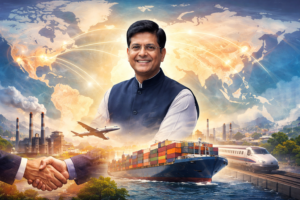
Beyond the Headlines: Decoding Piyush Goyal’s Diplomatic Blitz – How India is Quietly Rewiring Global Supply Chains
On the surface, the calendar of India’s Union Commerce and Industry Minister, Piyush Goyal, looked like a typical Saturday of back-to-back virtual meetings. A call with Mexico’s economy chief. A chat with a Greek diplomat. A conversation with a pharmaceutical giant. A sit-down with a startup founder.
But to view these interactions as mere routine is to miss the forest for the trees. In the world of global trade and economic diplomacy, there is no such thing as a random meeting. Goyal’s schedule on this particular Saturday was a masterclass in India’s current geopolitical and economic strategy—a multi-polar approach that balances traditional state-level diplomacy with aggressive private sector engagement.
As the world grapples with supply chain fragmentation, inflationary pressures, and the looming threat of protectionism, India is positioning itself as the stable, reliable alternative. Here is a deeper look at what these meetings truly signify for the Indian economy, the global south, and the future of “Make in India.”
The Mexico Moment: A Trans-Pacific Bridge
When Piyush Goyal sat down virtually with Marcelo Ebrard, Mexico’s Secretary of Economy, the conversation was framed around “deepening economic ties.” However, the subtext of this discussion is far more significant. Mexico has recently surpassed China as the United States’ largest trading partner. As the US pushes for “nearshoring” (moving supply chains closer to home), Mexico has become a manufacturing powerhouse for North America.
For India, Mexico represents a gateway. It is a strategic entry point to the US market under the USMCA (United States-Mexico-Canada Agreement). Strengthening the India-Mexico economic partnership isn’t just about bilateral trade; it’s about creating a synergistic manufacturing corridor.
Currently, bilateral trade between India and Mexico stands at roughly $12-13 billion, but the potential is exponentially higher. Indian automotive, textile, and pharmaceutical companies have already established a strong foothold in Mexico. What Goyal and Ebrard are likely negotiating is the next phase: removing non-tariff barriers and collaborating on supply chain resilience.
From India’s perspective, this partnership is a hedge against global uncertainty. By aligning with Mexico, India ensures that Indian manufacturers have a launchpad into North America, while Mexico benefits from India’s expertise in IT services, fintech, and cost-effective manufacturing. This isn’t just trade; it is strategic alignment between the world’s largest democracy and the largest Spanish-speaking nation.
Greece: The Revival of an Ancient Corridor
The virtual meeting with Harry Theoharis, Greece’s Deputy Minister of Foreign Affairs, was equally telling. While the statement mentioned “maritime connectivity,” this was likely a euphemism for one of the most ambitious infrastructure projects of the decade: the India-Middle East-Europe Economic Corridor (IMEC).
Greece, with its massive port of Piraeus, is the European terminus for this corridor. For India, the IMEC is a direct counter to the traditional Suez Canal route, offering a faster, more reliable path to Europe. By engaging Greece, India is signaling that it is not merely content with being a manufacturing hub in Asia; it wants to be the anchor of a new trade route that connects South Asia to Europe via the Arabian Peninsula.
Furthermore, the tourism angle mentioned in the discussion is critical. Greece is a tourism behemoth, and India is one of the fastest-growing outbound tourism markets in the world. Deepening cooperation here opens up cultural exchange and investment opportunities in hospitality and aviation. However, the real prize remains maritime security and port modernization—areas where India has built significant expertise and is eager to export to the Mediterranean.
Eli Lilly and the Evolution of ‘Make in India’
One of the most insightful meetings of the day was not with a foreign government, but with Patrik Jonsson, the head of Lilly International. The discussion about Eli Lilly and Company’s “expanding operations” touches upon a sensitive yet vital sector: healthcare security.
The COVID-19 pandemic exposed the fragility of global pharmaceutical supply chains. India, known as the “pharmacy of the world,” has traditionally dominated generics. However, the conversation with Eli Lilly signals a shift toward innovation and complex drug manufacturing.
When Goyal discusses “strengthening ‘Make in India for the world’” with a global innovator like Eli Lilly, it indicates that India is moving up the value chain. The government is no longer satisfied with simply manufacturing generic drugs; it wants to attract R&D centers and high-tech biotech manufacturing for novel drugs and insulin.
This is a massive win for Indian patients and the economy. For Eli Lilly, establishing deeper roots in India allows them to tap into a massive talent pool of scientists and engineers while utilizing India’s cost advantages for global export. For India, it solidifies its position not just as a pharmacy, but as a global hub for medical innovation. It is a signal to other multinational pharma companies that India is ready for high-value, complex manufacturing partnerships.
Zepto: The Politics of Quick Commerce and Farmers
Perhaps the most unexpected meeting on the list was with Aadit Palicha, the young co-founder of Zepto, a quick-commerce giant. At first glance, the Commerce Minister meeting a startup founder might seem like a photo op. But the discussion points—”skilling,” “integrating farmers into modern supply chains,” and “innovation-led entrepreneurship”—reveal a deep understanding of where India’s economic growth is actually happening.
Quick commerce (q-comm) is revolutionizing Indian retail. Companies like Zepto, Blinkit, and Instamart are building infrastructure that delivers groceries and essentials in under 10 minutes. While critics worry about market disruption, Goyal’s engagement suggests the government sees these platforms as a solution to one of India’s oldest problems: agricultural value loss.
In India, a significant portion of agricultural produce is wasted due to inefficient cold storage and fragmented supply chains. Quick-commerce platforms are essentially building hyper-local dark stores and logistics networks. By integrating farmers directly into these modern supply chains—as Goyal mentioned—the government hopes to eliminate middlemen, reduce wastage, and ensure that farmers get better prices while consumers get fresh produce.
Moreover, the focus on “skilling” is crucial. The startup ecosystem has created millions of jobs in logistics, delivery, and warehousing. Formalizing this sector, upskilling the workforce, and ensuring that this rapid growth translates into sustainable employment is a priority for the administration. Goyal’s meeting with Palicha is a signal that the government views startups not as disruptors to be regulated out of existence, but as critical infrastructure partners in the journey toward a $5 trillion economy.
The Big Picture: A Minister Acting as a ‘Startup Nation’
What ties these disparate meetings together—from Mexico to Greece, from Big Pharma to Quick Commerce—is a cohesive vision of India as an indispensable node in the global economy.
For decades, Indian economic diplomacy was largely reactive. Today, under the current administration, it is proactive and multi-stakeholder. Minister Goyal’s interactions demonstrate a government that understands that modern trade deals are not just signed in conference rooms; they are built in boardrooms, on farms, and through digital infrastructure.
- With Mexico and Greece, India is building geopolitical resilience, ensuring that its trade routes and market access are diversified and secure.
- With Eli Lilly, India is signaling to the world that it is moving beyond its comfort zone of services and generics into high-tech innovation and complex manufacturing.
- With Zepto, India is showing that it understands the pulse of its domestic economy—that growth must be inclusive, connecting the farmer in rural India to the consumer in urban India through technology.
As the world watches the shifting sands of global trade, with protectionism rising in the West and supply chains still reeling from past shocks, India is quietly laying the groundwork for a different kind of globalization—one where it is the central hub, connecting East and West, tradition and innovation.
For the average Indian, these meetings may seem distant and bureaucratic. But the outcome—better market access for exports, cheaper drugs, fresher groceries, and more jobs—is as real as it gets. The Saturday diplomacy of Piyush Goyal was not just about talking; it was about scripting the next chapter of India’s economic story.
You must be logged in to post a comment.