
Beyond the Headlines: Decoding Modi’s ‘Techade’ Vision and India’s Semiconductor Gambit
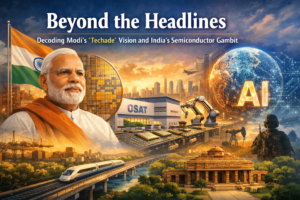
Beyond the Headlines: Decoding Modi’s ‘Techade’ Vision and India’s Semiconductor Gambit
When Prime Minister Narendra Modi declared this decade as “India’s Techade” during the inauguration of the Kaynes Semiconductors OSAT (Outsourced Semiconductor Assembly and Test) plant in Sanand, Gujarat, it was more than just a political slogan. It was a statement of intent that seeks to position India not merely as a consumer of technology, but as a critical node in the global supply chain. While the headlines captured the inauguration of the plant and the launch of development projects worth approximately ₹20,000 crore, the underlying narrative is one of strategic recalibration—economic, geopolitical, and societal.
In a world grappling with supply chain disruptions, a chip war between the United States and China, and a volatile geopolitical landscape in West Asia, Modi’s dual focus on semiconductor self-reliance and regional stability offers a window into the Indian government’s current playbook. To understand the significance of this “Techade,” one must look beyond the ribbon-cutting ceremonies and examine the convergence of industrial policy, geopolitical maneuvering, and domestic governance.
The Silicon Shift: Why the OSAT Plant Matters
The inauguration of the Kaynes Semiconductors plant in Sanand is a milestone that warrants closer scrutiny. Sanand is already a burgeoning industrial hub, hosting major automobile and manufacturing units. Adding a semiconductor facility transforms it into a cradle of high-tech manufacturing.
For the uninitiated, semiconductors—or chips—are the bedrock of the modern economy. They power everything from smartphones and cars to AI supercomputers and military defense systems. The global shortage of chips in recent years exposed the fragility of a supply chain that was overly reliant on a handful of East Asian nations. India’s entry into this arena, starting with OSAT facilities, is significant.
OSAT is the backend of chip manufacturing—the assembly, packaging, and testing phase. While it isn’t the most complex stage (like fabrication), it is the most labor-intensive and crucial for ensuring chip reliability. By focusing here first, India is playing to its strengths: a massive, skilled technical workforce and a push for cost competitiveness. Modi’s assertion that India is “emerging as a leading partner in the field of semiconductors” reflects a strategy of incremental vertical integration. The hope is that by building a robust backend ecosystem, India can eventually attract the more complex front-end fabrication units (Fabs) that require billions in investment and advanced water management systems.
For the global investor community, this sends a clear signal: India is serious about moving up the value chain. It is no longer just a market for finished electronics; it aims to be a manufacturing base for the components that power the AI revolution.
AI and the Promise of Global Benefit
Modi’s statement that India’s initiatives in Artificial Intelligence (AI) will “benefit the entire planet” touches upon a critical debate currently unfolding globally: the democratization of AI. For the past few years, the discourse around AI has been dominated by Western tech giants and the narrative of a “winner-takes-all” scenario. India’s pitch is different.
India’s approach to AI, as seen through initiatives like the IndiaAI Mission, is predicated on scale and inclusion. While the Western world focuses on generative AI and large language models (LLMs) for productivity, India is focusing on AI for development—agriculture, healthcare, language translation, and governance.
The “benefit to the planet” claim hinges on the idea that solutions developed in India to tackle massive, complex problems (such as delivering healthcare to a billion people or streamlining welfare payments) can serve as scalable templates for other developing nations in the Global South. If India can successfully build an AI stack that is interoperable, affordable, and secure, it could export not just software, but a governance model. This is the soft power dimension of “Techade”—moving beyond the image of India as a back-office of the world to that of a front-line architect of digital public infrastructure.
The West Asia Conflict: A Test of Governance
Interwoven with the technological optimism was a stark reminder of the volatile world we live in. Modi’s remarks regarding the West Asia conflict were particularly telling. He stated that despite the turmoil, his government had “not allowed the impact of the West Asia conflict to affect the citizens.”
This is a significant domestic political claim. The conflict in West Asia has historically had a direct impact on India—primarily through oil prices, inflation, and the welfare of the nearly 9 million Indian diaspora working in the Gulf region. For the government, maintaining “control” during such a conflict involves a delicate balancing act: diplomatic engagement with all stakeholders, strategic petroleum management to curb inflation, and ensuring the safe repatriation or protection of Indian nationals in conflict zones.
By highlighting this during a development-focused event, the Prime Minister was reinforcing a narrative of “crisis management competency.” In the context of “Techade,” stability is a prerequisite. No amount of semiconductor investment will pay dividends if the macroeconomic environment is rocked by external shocks. The message to investors was implicit: even when the world is on fire, India remains an island of stability.
Beyond Semiconductors: The Infrastructure Push
The event also saw the inauguration and foundation laying of projects worth ₹20,000 crore in Vav-Tharad. This dual focus—high-tech semiconductors and rural infrastructure—is characteristic of the government’s strategy to broaden its electoral and economic appeal.
While the techade captures the imagination of the urban youth and the investor class, the infrastructure projects in the districts speak to the grassroots. These projects typically include water supply schemes, road connectivity, and power grid stabilization—the basic enablers of economic life. By juxtaposing a futuristic semiconductor plant with rural development, the government is attempting to project a vision of holistic development: one foot in the future, one foot firmly planted in the present needs of the agrarian economy.
The Samrat Samprati Museum: Reclaiming Historical Narratives
Adding a cultural layer to the visit was the inauguration of the Samrat Samprati Museum in Koba, Gandhinagar. For those unfamiliar with Indian history, Samrat Samprati was a grandson of the great Mauryan Emperor Ashoka. While Ashoka is globally renowned for spreading Buddhism, Samprati is celebrated in Jain traditions for his patronage of Jainism and his efforts to spread non-violence and peace.
The establishment of a museum dedicated to a relatively lesser-known emperor is a continuation of the government’s ongoing effort to rediscover and celebrate historical figures who may have been overshadowed in mainstream historical narratives. It reflects an attempt to weave a more comprehensive tapestry of India’s ancient heritage—one that connects modern governance philosophies of peace and non-violence to ancient Indian principles. In the context of a “Techade,” it serves as a reminder that India’s identity in the global arena is built not just on its economic heft or technological prowess, but on its deep civilizational roots.
The Road Ahead: Challenges and Opportunities
As India marches forward with its “Techade” vision, the road is not without obstacles. The semiconductor industry is notoriously cyclical, capital-intensive, and subject to fierce global competition. India will have to compete with entrenched ecosystems in Taiwan, South Korea, and the United States, which are offering massive subsidies to bring chip manufacturing home.
Furthermore, the success of the OSAT plant depends on the efficiency of “Make in India” incentives. Bureaucratic red tape, land acquisition issues, and the need for a consistent supply of ultra-pure water and stable electricity are perennial challenges that the government must overcome to ensure these high-tech plants don’t become white elephants.
On the AI front, the challenge lies in regulation. How does India foster innovation while ensuring data privacy and ethical use of AI? The Digital India Act and future AI regulations will determine whether India’s techade is characterized by open innovation or cautious restraint.
Conclusion
Prime Minister Modi’s visit to Gujarat was a masterclass in political messaging, weaving together threads of high-tech ambition, geopolitical stability, and cultural heritage into a single narrative. By calling this decade India’s “Techade,” he is setting a benchmark for the country’s aspirations.
The inauguration of the semiconductor plant is not just about chips; it is about signaling to the world that India is ready to take on complex manufacturing. The comments on West Asia were about signaling to the domestic population and global investors that the government is a reliable steward of stability. The infrastructure projects were about signaling to the rural electorate that development is inclusive.
Whether India can fully capitalize on this moment depends on execution. If the semiconductor plants come online on schedule, if the AI mission yields tangible results in public welfare, and if the geopolitical juggling act continues to pay dividends, the “Techade” could indeed transform India from a follower to a leader on the global stage. For now, the foundations are being laid—literally and figuratively—for a decade that promises to redefine India’s role in the 21st century.
You must be logged in to post a comment.