
Beyond the Headlines: Decoding Japan’s Strategic Diplomatic Foray into the Middle East and Asia
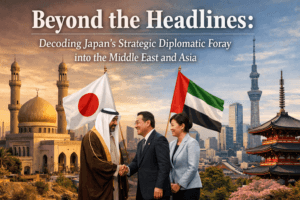
Beyond the Headlines: Decoding Japan’s Strategic Diplomatic Foray into the Middle East and Asia
Introduction: A Nine-Day Journey at a Crossroads of Crises
As Japanese Foreign Minister Toshimitsu Motegi embarked on his nine-day, five-nation tour on January 10th, he was not merely logging frequent flyer miles. His itinerary—spanning Israel, Palestine, Qatar, the Philippines, and India—maps a precise trajectory through some of the world’s most volatile geopolitical flashpoints. This is not routine diplomacy; it is a calculated maneuver by Tokyo at a moment of profound global uncertainty. The tour reveals Japan’s ambition to carve out a unique, activist role, leveraging its historical posture as a non-confrontational power to address both the smoldering embers of the Middle East and the escalating tensions of the Indo-Pacific. In an era often defined by loud rhetoric and rigid alliances, Japan is betting on the power of quiet, consistent dialogue.
Part 1: The Middle East Tightrope: Peacemaker in a Landscape of Mistrust
Minister Motegi’s first leg places him on the delicate soil of the Israeli-Palestinian conflict. Japan’s stance here is underpinned by a rare and valuable asset: it maintains cordial, stable relations with both Israel and the Palestinian Authority, free from the heavy historical baggage that often complicates the diplomacy of Western powers. His mission, as outlined, is to “call for maintaining the ceasefire” and urge “concrete action” to implement peace plans in Gaza.
However, the real insight lies beneath these official statements. Japan’s role is less about imposing a grand solution and more about fostering the preconditions for one. By stressing the need to “dispel mutual distrust,” Motegi is engaging in a form of diplomatic therapy. Japan can act as a credible messenger, conveying concerns and potential concessions between parties that often refuse to speak directly. This involves nuanced advocacy: ensuring humanitarian aid reaches Gaza without bolstering Hamas, supporting Palestinian state-building while acknowledging Israeli security fears, and promoting economic projects that tangibly benefit both peoples.
Furthermore, the stop in Qatar is strategically astute. As a key mediator with influence over Hamas and a major energy supplier, Qatar represents another node where Japan’s energy security interests (as a resource-poor nation) and its peace diplomacy intersect. Motegi’s conversations there likely reinforce a shared interest in regional stability, which is paramount for the uninterrupted flow of goods and energy upon which Japan’s economy depends.
Part 2: The Asian Pivot: Navigating the Hegemon’s Shadow
The second act of Motegi’s journey shifts dramatically east, to Manila and New Delhi. The subtext is unmistakably clear: “China’s increasing hegemonic actions.” In the Philippines, the talks with Foreign Secretary Lazaro will center on maritime security in the South China Sea, where Chinese assertiveness directly challenges the sovereignty of Manila and the principles of a rules-based order. Japan has been a steadfast partner to the Philippines, providing coast guard vessels, conducting joint exercises, and strengthening security ties. This visit is about consolidating that partnership, ensuring that the Philippines feels supported in its legal and diplomatic stands, and deepening economic cooperation to build resilient supply chains less dependent on any single power.
The culmination in India, however, is the tour’s strategic linchpin. The relationship with External Affairs Minister Jaishankar is one of Tokyo’s most vital. In the face of shared concerns over China, Japan and India have cultivated a “Special Strategic and Global Partnership,” which forms the bedrock of the Quadrilateral Security Dialogue (Quad) alongside the US and Australia. Coordination with India, however, requires deft handling. New Delhi maintains its strategic autonomy and a complex relationship with Moscow, which differs from Japan’s staunch alliance with the G7 position on Ukraine.
Motegi’s task is to synchronize strategies—not just on military posture, but on critical areas like infrastructure development in third countries (as an alternative to China’s Belt and Road Initiative), semiconductor cooperation, and securing undersea cable networks. The goal is to step beyond mere dialogue and into tangible, coordinated action that reinforces a multipolar Asia where no single country can dominate through coercion.
Part 3: The “Motegi Doctrine”: Consistency in a Chaotic World
Beneath the specific agendas lies a coherent philosophy that could be termed a “Motegi Doctrine” of Japanese foreign policy. It is characterized by three pillars:
- Proactive Contribution to Peace: Moving beyond Cold War-era pacifism, Japan now seeks to actively shape its security environment. This doesn’t mean becoming a traditional military power, but using its diplomatic capital, economic strength, and developmental aid to prevent conflicts and build institutional resilience among partners.
- Universal Value Entrepreneurship: Japan quietly champions the rules-based international order, freedom of navigation, and democratic governance. It does so not through ideological lecturing, but by demonstrating how adherence to these principles leads to stability and prosperity, as seen in its own post-war history.
- Multi-Alignment with a Core Alliance: Japan’s security alliance with the United States remains sacrosanct. Yet, Tokyo is skillfully building a latticework of complementary relationships—with ASEAN, India, Australia, Europe, and even cautious engagement with China—to create a robust safety net. This tour is a live demonstration of this multi-alignment in practice.
Conclusion: The Quiet Diplomat’s Moment
Foreign Minister Motegi’s journey is a microcosm of Japan’s contemporary global role. In the Middle East, it is a trusted listener and a patient facilitator. In Asia, it is a security partner and a builder of strategic economic alternatives. The common thread is a diplomacy of reassurance and concrete partnership, offered without the bombast that defines much of today’s statecraft.
As the world grapples with interconnected crises, the value of a nation that can talk to all sides, invest in long-term stability, and reliably uphold its commitments should not be underestimated. This nine-day tour is more than a series of meetings; it is a statement. Japan, often perceived as a reactive power, is proactively stitching together a fraying global order, one quiet conversation at a time. Whether in the ancient streets of Jerusalem or the bustling capital of New Delhi, Motegi is not just representing Japan—he is testing a model of diplomacy for an age of disruption. The success of his mission will be measured not in dramatic breakthroughs, but in the subtle strengthening of trust and the slow, hard work of building a more stable peace.
You must be logged in to post a comment.