
Beyond the Headlines: Decoding India’s Strategic Climate Pivot and the 2035 NDC
India’s updated Nationally Determined Contribution (NDC), shifting the target year to 2035, raises ambition with 60% non‑fossil power capacity, a 47% emissions intensity reduction, and an expanded carbon sink—but the real story lies in the strategic signals beneath the numbers. Having already surpassed its earlier 2030 renewable targets ahead of schedule, India is using the new NDC to align with global post‑2030 climate timelines while preserving its developmental space through an emissions‑intensity approach. The power sector is approaching a critical inflection point, with clean energy additions set to match demand growth as early as 2026, yet deep contradictions remain: massive planned expansions in coal, petrochemicals, and coal‑based steel threaten to offset renewable gains, and inadequate grid infrastructure and forest‑cover gaps undermine carbon sink goals. Ultimately, the updated NDC reflects India’s intention to lead on its own terms—but its success will depend not on headline targets, but on whether the nation can resolve the tension between fossil‑fuel dependency and a genuine, sustained clean‑energy transition.
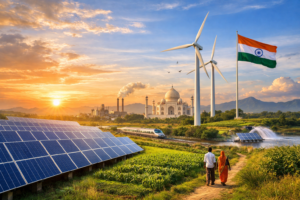
Beyond the Headlines: Decoding India’s Strategic Climate Pivot and the 2035 NDC
In the high-stakes arena of global climate diplomacy, the release of a Nationally Determined Contribution (NDC) is rarely just a bureaucratic submission. It is a carefully calibrated signal—a declaration of intent that balances domestic compulsions with international expectations. On March 29, 2026, India sent a powerful signal. The approval of its updated NDC, which shifts the target year to 2035 and raises ambition across the board, is more than a mere update; it is a strategic pivot.
While the headlines focus on the numbers—60% non-fossil power capacity, a 47% reduction in emissions intensity, and a larger carbon sink—the real story lies beneath the surface. It is a story of a nation that has outrun its own targets, is navigating the treacherous waters of a fossil-fuel dependent economy, and is attempting to define what “climate leadership” looks like for the Global South.
The Art of the Ambition: Why 2035 Matters
The most significant, yet understated, change in India’s new NDC is the timeline. By shifting the target year from 2030 to 2035, India is not pushing the goalposts further away; it is aligning itself with the new global rhythm. At COP28 in Dubai, the global community agreed to transition away from fossil fuels, but the subsequent years have been marked by a scramble for nations to define their post-2030 pathways. By announcing its 2035 targets now, India is closing a critical gap, joining the ranks of G20 nations that have already laid out their mid-term climate strategies.
This temporal shift also demonstrates a quiet confidence. The government is effectively saying that the old 2030 targets were not the finish line, but merely a waypoint. Having already achieved approximately 52% non-fossil capacity by early 2026—exceeding the original 2030 target of 50%—India has earned the right to set a higher bar for the next decade. This isn’t ambition born of external pressure; it is ambition born of demonstrated execution.
The Emissions Intensity Conundrum: A Clever Compromise
To understand the nuance of India’s strategy, one must look at the emissions intensity target. A 47% reduction in emissions intensity of GDP (from 2005 levels) is a steep climb, but it is a metric that allows for a crucial distinction: emissions versus development.
For developing economies, the absolute reduction of emissions is often a red line. India’s per-capita emissions remain a fraction of those in the developed world, and its historical contribution to the atmospheric stock of carbon is negligible. By focusing on intensity, India is asserting its right to grow its economy—its total emissions may rise—while ensuring that the carbon cost of that growth shrinks.
This approach is a masterclass in equitable climate logic. It puts the onus on efficiency. It demands that every rupee of GDP generated from here on out must be cleaner than before. However, it also exposes a fault line. As the analysis of India’s recent emissions trends shows, while the power sector is greening, heavy industries like steel and cement are proving stubborn. An 8% rise in steel emissions and a 10% rise in cement emissions indicate that the “intensity” battle is far from won. The real challenge for India will be whether it can decarbonize its industrial base with the same velocity as it has decarbonized its power grid.
The Inflection Point: A Power Sector in Transition
The most hopeful data point underpinning India’s new NDC is the structural shift occurring in its electricity grid. The 2025 analysis revealing a 3.8% drop in power sector emissions and a decline in coal generation (outside of the COVID anomaly) for the first time since 1973 is nothing short of historic.
We are witnessing the dawn of what analysts call the “inflection point.” By 2026, India is projected to reach a stage where the annual addition of clean energy capacity (solar, wind, hydro, nuclear) matches the annual growth in electricity demand. If sustained, this is the holy grail of energy transition: growth without a commensurate rise in fossil fuel consumption.
The record-breaking additions of 47 GW of solar and 6.3 GW of wind in 2025 are not accidents of policy. They are the result of a decade-long industrial policy focused on manufacturing scale and cost reduction. India’s climate story is increasingly not being written in the conference halls of Bonn or Sharm El Sheikh, but in the auction rooms of the Solar Energy Corporation of India (SECI) and the transmission lines crisscrossing its deserts.
However, the caveat is crucial. Experts warn that the 2025 slowdown was aided by a confluence of favorable conditions: a mild summer and a temporary industrial lull. To truly celebrate a “peak coal,” India needs to see these trends hold through a brutal heatwave and a period of high industrial growth. Furthermore, the issue of stranded renewable capacity—37 GW of clean energy that cannot be transmitted due to inadequate grid infrastructure—is a bottleneck that could throttle this progress.
The Contradictions of Growth: Coal, Petrochemicals, and the Forest Question
Any honest analysis of India’s climate path must confront its inherent contradictions. While the NDC speaks of a clean future, the Ministry of Power and the Ministry of Steel are planning for a massive expansion of fossil fuel infrastructure.
The proposal for 100 GW of new coal capacity, a $1 trillion investment in petrochemicals by 2040, and a 50% increase in coal-based steel capacity represent a parallel, fossil-heavy development strategy. This is not necessarily hypocrisy; it is a reflection of the sheer scale of India’s developmental needs. A nation of 1.4 billion people, still in the process of urbanization and industrialization, cannot simply switch off coal overnight without risking energy security and economic stability.
The success of India’s new NDC will ultimately hinge on whether this “twin-track” approach is a genuine transition strategy or a permanent divergence. For the NDC to be credible, the renewable energy track must not only grow but must eventually replace the fossil track, rather than merely running parallel to it. The recent decline in coal-based emissions suggests that replacement is possible, but the planned investments suggest that the political economy of coal remains deeply entrenched.
Similarly, the carbon sink target of 3.5–4 billion tonnes of CO₂ equivalent relies heavily on forest expansion. Yet, India’s forest and tree cover stagnates around 24%, well short of the national goal of 33%. While the government often touts increases in “tree cover,” which includes plantations and trees outside forests, conservationists argue that these are not substitutes for dense, old-growth forests that offer genuine biodiversity and carbon sequestration. The quality of the sink matters as much as the quantity.
Human Insight: What This Means for the Citizen and the Planet
For the average Indian, the new NDC will manifest not as a diplomatic document, but as a series of tangible shifts. It will mean a grid that is increasingly powered by the sun, potentially leading to cheaper electricity during the day but also requiring behavioral shifts in when we consume power. It will mean a push for rooftop solar that turns citizens from consumers into “prosumers.” It will mean a job market that is quietly shifting from coal mining to solar installation and grid management—a transition that must be managed with justice for affected communities.
For the global community, India’s updated NDC is a challenge. For years, developed nations have argued that developing countries must do more. India’s response is now a pointed question: We have set our targets; where is the promised climate finance?
The gaps in the NDC framework—particularly the absence of clear fossil fuel phase-down plans and the reliance on inadequate international finance—are not just India’s problems; they are global systemic failures. By submitting a more ambitious NDC while simultaneously expanding its fossil fuel capacity, India is signaling that it will pursue its green transition on its own terms, using its own resources, but it will not de-industrialize to satisfy Western climate purists.
Conclusion: A Document of Intention, A Test of Implementation
India’s new NDC is a robust document of intention. It raises the bar, aligns with global timelines, and leverages the nation’s proven strengths in renewable energy deployment. It reflects a realistic understanding that the path to net-zero is not a straight line but a complex negotiation between ecological imperatives and economic necessities.
The coming years will separate signal from noise. Will the grid infrastructure catch up to the renewable capacity? Will the coal expansion plans be scaled back as renewable costs continue to fall? Will the industrial sector—steel, cement, petrochemicals—find a viable path to decarbonization? And crucially, will the international community step up with the finance and technology transfer that was promised in Paris and reiterated in Glasgow and Dubai?
For now, the updated NDC serves its purpose: it confirms that India is moving in the right direction, faster than many anticipated. But in the fight against climate change, intentions are fleeting; only measurable, sustained decarbonization of the real economy will matter. India has written a bold new chapter; the hard work of ensuring it is not just ambitious, but also authentic and implementable, has only just begun.
You must be logged in to post a comment.