
Beyond the Headlines: Decoding India’s Strategic Fuel Duty Cut Amid the Strait of Hormuz Crisis
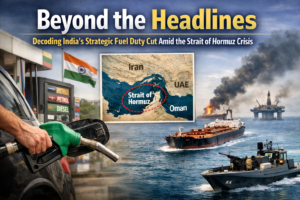
Beyond the Headlines: Decoding India’s Strategic Fuel Duty Cut Amid the Strait of Hormuz Crisis
In the high-stakes world of global energy, few events send as immediate a shockwave through the Indian economy as a disruption in the Strait of Hormuz. On Thursday, the Indian government made a decisive move to cushion its citizens from the latest geopolitical tremors, slashing the Special Additional Excise Duty on petrol to Rs 3 per litre (from Rs 13) and eliminating it entirely on diesel.
At first glance, this appears to be a simple, if significant, tax cut aimed at preventing a spike at the fuel pumps. But beneath the surface of this government order lies a complex narrative of geopolitical maneuvering, fiscal tightrope walking, and a stark reality check about India’s vulnerability in a multipolar world. While the headlines focus on the price drop, the true story is about how a nation of 1.4 billion people navigates a labyrinth of global conflict, corporate strategy, and electoral economics.
The Domino Effect: Why Hormuz Matters to Your Commute
To understand the urgency of the duty cut, one must look not at the streets of Delhi or Mumbai, but at the chokepoint of the Strait of Hormuz. The ongoing conflict involving Israel, Iran, and the United States has turned this narrow waterway—through which approximately 20% of the world’s petroleum passes—into a geopolitical powder keg.
When Iran tightens its grip on the strait, it isn’t just an abstract political crisis; it is a direct threat to India’s energy security. India is the world’s third-largest oil importer, relying on imports to meet over 85% of its crude needs. Any ripple in Hormuz becomes a tidal wave in India. The article notes that Brent crude had climbed as high as $108 per barrel, a psychological threshold that triggers alarm bells in finance ministries across Asia.
The timing of the Indian government’s duty revision is particularly telling. It came just as the United States signaled a potential de-escalation, stating that negotiations with Iran were “going very well” and extending a deadline by ten days. This diplomatic pause caused crude prices to cool by roughly 2% in early trade. By slashing duties now, the government is essentially banking on this price softening to maximize the benefit to consumers, while also pre-emptively neutralizing the inflation spike that would have occurred if crude had remained at $108.
The Political Calculus: Timing, Tactics, and Pakistan’s Shadow
One cannot analyze a fuel duty cut in India without acknowledging the political subtext. The article’s sidebar, “Watch Modi Govt Slashes Excise Duty On Fuel Even As Global Oil Crisis Hits Neighbours Like Pakistan,” is not just a throwaway headline—it is a framing device.
The comparison with Pakistan is deliberate and potent. While Pakistan is grappling with a balance of payments crisis and soaring energy costs that have crippled its economy, the Indian government is showcasing its ability to absorb shocks. By cutting duties, New Delhi is projecting an image of fiscal resilience. It sends a message: “While our neighbors are crumbling under the weight of global instability, we are providing relief.”
This is a classic move of strategic economic management wrapped in political messaging. However, the decision also comes with a hefty price tag. The revenue foregone by cutting excise duty from Rs 13 to Rs 3 on petrol is immense. The government is essentially subsidizing the consumer out of its own tax coffer. It is a calculated risk, betting that the political capital gained from stable fuel prices outweighs the short-term fiscal deficit.
The Corporate Conundrum: Nayara’s Preemptive Strike
Perhaps the most fascinating subplot in this saga is the role of private fuel retailers, specifically Nayara Energy. Just a day before the government’s duty cut announcement, Nayara—India’s largest private fuel retailer, backed by Russian oil giant Rosneft—raised petrol prices by Rs 5 per litre and diesel by Rs 3 per litre.
This move by Nayara reveals the stark divide in India’s fuel retail landscape. Public Sector Undertakings (PSUs) like Indian Oil, Bharat Petroleum, and Hindustan Petroleum often absorb price volatility to maintain stability, acting as a buffer for the government’s social welfare policies. Private players, however, operate on pure market dynamics.
Nayara’s price hike was a direct consequence of rising input costs due to the Middle East situation. They were passing on the pain of the $108-per-barrel crude oil to the consumer. This created a dangerous scenario: a fragmented market where public pumps kept prices low (subsidized by the government’s duty structure) while private pumps raised them, creating arbitrage opportunities and potential supply shortages.
The government’s duty cut effectively erased the need for that hike. By reducing the excise duty, the government lowered the baseline cost for everyone, including Nayara. This move stabilized the market, ensuring that private retailers wouldn’t have to hike prices further, and in fact, might have to roll back their increases to remain competitive. It was a masterstroke in market intervention, ensuring that the burden of international volatility is shared between the state (through reduced revenue) and the corporate sector (through compressed margins), rather than falling solely on the consumer.
The Crude Oil Paradox: Why $70 Seems Like a Dream
While the duty cut offers immediate relief, it’s important to contextualize where we stand. The article notes that crude prices remain “well above the roughly $70 levels recorded before the conflict began.” For Indian consumers, this is the underlying anxiety.
The current cooling of prices to around $105 per barrel (Brent) is a welcome respite from the $108 high, but it is hardly a return to normalcy. The global energy market is fundamentally altered. The conflict in the Middle East has introduced a persistent “war premium” into oil prices. Every diplomatic stalemate, every blast reported near an embassy, and every statement from the CIA or the White House now triggers price swings of 4-5% in a single session.
For the Indian household, this means that fuel prices are no longer just a function of supply and demand, but of geopolitics. The duty cut is a temporary shield. If tensions escalate again—if Israel launches “fresh waves of strikes” or the US-Iran negotiations collapse—crude prices will surge back toward $108 or higher, putting the government back on the defensive.
Impact on the Ground: Inflation, Consumption, and the Economy
For the average Indian, the immediate benefit is tangible. A reduction in excise duty directly lowers the retail price of petrol and diesel. This is critical because fuel is not just a transportation cost; it is an input cost for everything from vegetables (which travel by truck) to manufacturing.
By slashing duties, the government is attempting to break the inflationary spiral. When fuel prices rise, they trigger “second-round effects”—where transporters raise freight charges, manufacturers hike product prices, and ultimately, the cost of living skyrockets. By cutting duties, the government is hoping to arrest this cycle.
However, there is a second-order effect: disposable income. When families spend less on fuel, they have more money to spend on consumer goods, housing, and services. In a consumption-driven economy like India, this liquidity injection—effectively a tax cut for the middle class—can stimulate economic activity. The government is essentially sacrificing its excise revenue in the short term to prop up consumer sentiment and aggregate demand, which might be flagging under the weight of global economic uncertainty.
Looking Forward: The Ten-Day Window
The article mentions a critical detail: the United States extended its deadline with Iran by 10 days. This creates a short but crucial window of relative stability. The Indian government’s duty cut is timed to maximize relief within this window.
If negotiations succeed and the Strait of Hormuz opens fully, crude prices could slide further toward $90-$95, turning this duty cut into a massive windfall for consumers (as prices would fall even more dramatically). If negotiations fail and conflict resumes, the government has bought itself some time to find alternative supply routes or prepare for further interventions.
Moreover, the government’s decision to raise ATF (Aviation Turbine Fuel) duty simultaneously, as mentioned in the related stories, shows a surgical approach. The government is protecting the common man (who uses petrol and diesel) while asking the aviation sector—a recovering industry—to bear a slightly higher burden. This targeted fiscal management indicates a sophisticated understanding of sectoral sensitivities.
Conclusion: A Policy of Resilience
The revision of the fuel duty structure is more than a bureaucratic footnote; it is a reflection of India’s current economic philosophy. In a world characterized by the “Israel Iran War” headlines, the “US-Israel-Iran War News Live Updates,” and the constant threat of supply chain fractures, India is trying to maintain a steady ship.
By absorbing the fiscal hit of reducing excise duties, the government has drawn a line in the sand: the volatility of the Strait of Hormuz will not be allowed to destabilize domestic consumption patterns. It is a costly policy, but one that underscores a commitment to shielding the citizenry from the harsh winds of geopolitics.
As global markets continue to react to every diplomatic whisper—from Trump extending the “Iran Strike Pause” to Rubio blasting NATO over Hormuz—India’s maneuver offers a lesson in agile governance. It acknowledges that in the 21st century, economic security is national security. While the global oil crisis hits neighbors, India has chosen to use its fiscal space as a buffer. Whether this buffer holds depends not just on the government’s treasury, but on the sanity of the global stage.
For now, as drivers queue up at petrol pumps, the immediate crisis is averted. But the underlying reality remains: until peace returns to the Middle East, the price of mobility in India will remain inextricably linked to the geopolitical chess game playing out thousands of miles away.
You must be logged in to post a comment.