
Beyond the Headlines: Decoding India’s Strategic Pivot in the Modi Government’s Landmark Israel Visit
The Indian Prime Minister’s February 2026 visit to Israel marked a significant escalation in bilateral ties, upgrading the relationship to a “Special Strategic Partnership for Peace, Innovation & Prosperity” and establishing a high-level framework on Critical and Emerging Technologies (CET) to drive cooperation in AI, cybersecurity, semiconductors, and space. Beyond strategic and defence alignment, the visit yielded concrete outcomes including a labour mobility agreement for 50,000 Indian workers, a multi-year cybersecurity roadmap, and expanded collaboration in agriculture and water management through innovation centres and research fellowships. The partnership is increasingly viewed through a geopolitical lens, with both nations leveraging frameworks like I2U2 and the India-Middle East-Europe Economic Corridor (IMEC) to enhance regional connectivity, all while India carefully balances its deepening ties with Israel against its historical support for the Palestinian cause.
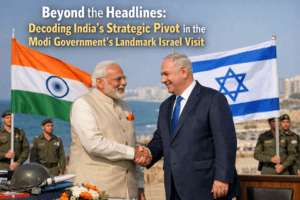
Beyond the Headlines: Decoding India’s Strategic Pivot in the Modi Government’s Landmark Israel Visit
The Evolution of a Partnership: From Cautious Diplomacy to Strategic Convergence
When the Indian Prime Minister’s aircraft touched down in Tel Aviv on February 26, 2026, it marked more than just another diplomatic stopover on a busy international calendar. The visit represented the culmination of a remarkable transformation in one of India’s most strategically significant—and historically complex—bilateral relationships.
For decades, India and Israel maintained their connection at arm’s length, constrained by Cold War geopolitics, domestic political sensitivities, and India’s steadfast support for the Palestinian cause. The transformation from those tentative beginnings to what both nations now formally term a “Special Strategic Partnership for Peace, Innovation & Prosperity” tells a deeper story about how India views its global role in an increasingly multipolar world.
The Architecture of a New Partnership
The upgrade in nomenclature matters, but what gives it weight are the institutional mechanisms now being put in place. The establishment of a bilateral framework on Critical and Emerging Technologies (CET), to be steered by the National Security Advisors of both countries, signals something profound: these two nations are now thinking together about the future.
The CET initiative spans artificial intelligence, cybersecurity, semiconductors, quantum computing, biotechnology, and space—areas that will define economic competitiveness and national security for the next generation. For India, which has positioned itself as a technology powerhouse, access to Israeli innovation in these fields offers a shortcut to capabilities that would otherwise take years to develop indigenously. For Israel, partnership with India opens doors to one of the world’s largest markets and a manufacturing ecosystem that can scale its innovations.
The Memorandum of Understanding on Artificial Intelligence deserves particular attention. Unlike routine cooperation agreements that simply express good intentions, this one includes a “Horizon Scanning/Strategic Foresight Mechanism”—essentially, a joint early-warning system to identify where technology is heading and what challenges and opportunities lie ahead. This is the diplomatic equivalent of two friends deciding to navigate an unfamiliar city together, watching each other’s backs rather than simply exchanging pleasantries.
The Human Dimension: Labour Mobility and People-to-People Connections
Tucked away in the joint statements was an announcement that will transform lives in tangible ways: a quota of up to 50,000 Indian workers over the next five years. This isn’t about software engineers or tech professionals—it’s about construction workers, caregivers, agricultural laborers, and skilled tradespeople who will find opportunities in Israel’s dynamic economy.
For the families who will receive remittances from relatives working in Tel Aviv, Haifa, and Jerusalem, this agreement represents economic lifelines. For Israel, facing labour shortages in key sectors, it provides a reliable workforce. But beneath the economics lies something more fundamental: the creation of human bridges between societies.
Every Indian worker who spends years in Israel returns home with stories, perspectives, and connections. Every Israeli employer who comes to rely on Indian workers develops an appreciation for Indian culture and work ethic. These human ties, accumulated over decades, create bonds that no government agreement can replicate.
Cybersecurity: Building Defences Together
The announcement of a multi-year cybersecurity roadmap and an India–Israel Centre of Excellence in Cybersecurity in India reflects a shared vulnerability. Both nations operate in challenging neighbourhoods. Both face persistent cyber threats from state and non-state actors. Both have developed sophisticated capabilities to defend their digital frontiers.
But the partnership goes beyond defensive measures. By establishing a centre of excellence in India, the two countries are betting on joint development of cybersecurity solutions that can be commercialized globally. This is the defence industry model—where strategic cooperation spawns commercial ventures—applied to the digital domain.
What makes this particularly significant is the trust it implies. Cybersecurity cooperation requires sharing information about threats, vulnerabilities, and capabilities—the kind of transparency nations reserve for their closest allies. That India and Israel have reached this level of comfort speaks volumes about how the relationship has matured.
Agriculture and Water: Addressing India’s Core Challenges
The India–Israel Innovation Centre for Agriculture (IINCA) and the 20 Joint Fellowships in Agricultural Research might sound like routine academic cooperation, but they address existential challenges for India.
Consider this: India supports 18% of the world’s population with just 4% of the world’s freshwater resources. Agriculture consumes more than 80% of that water, much of it used inefficiently through flood irrigation. Israeli agricultural technology—developed in a country that is 60% desert—offers solutions that can dramatically reduce water consumption while increasing crop yields.
Drip irrigation, precision agriculture, desalination, and wastewater recycling are not abstract concepts for Indian farmers. They represent the difference between viable livelihoods and distress migration to cities. The IINCA, by adapting Israeli technologies to Indian conditions, could transform agricultural productivity across the country.
The timing is propitious. As climate change makes rainfall patterns increasingly unpredictable, India’s food security depends on squeezing more from every drop of water. Israel’s experience in turning desert into farmland offers lessons that no amount of theoretical research can replicate.
The Geopolitical Chessboard: I2U2 and IMEC
The joint statement’s reference to cooperation under I2U2 (India, Israel, UAE, USA) and the India-Middle East-Europe Economic Corridor (IMEC) reveals the true strategic weight of this relationship. Neither India nor Israel sees their partnership in bilateral terms alone—both view it as part of a larger realignment reshaping the Middle East and South Asia.
IMEC, announced during the 2023 G20 Summit in New Delhi, proposes to connect India with Europe through a network of railways and ports crossing the UAE, Saudi Arabia, Jordan, and Israel. For India, this offers an alternative to trade routes that depend on the Malacca Strait and the Suez Canal. For Israel, it positions the country as a critical transit hub linking Asia to Europe.
The vision is audacious: container ships from Mumbai docking at UAE ports, transferring cargo to trains that cross Saudi Arabia and Jordan, then reloading onto ships at Haifa port for the final leg to Europe. Such a route would slash transit times and bypass potential chokepoints. But it requires political stability, infrastructure investment, and—most critically—the normalization of relations between Israel and its Arab neighbours.
This is where I2U2 becomes significant. The grouping brings together India, Israel, the UAE, and the United States—a unique combination that bridges the Gulf and the Levant. By working within this framework, India can support regional integration without being seen as taking sides in the Israeli-Palestinian conflict.
The Palestinian Question: India’s Delicate Balance
No discussion of India-Israel relations can ignore the Palestinian dimension. India’s support for the Palestinian cause is deeply embedded in its foreign policy DNA, rooted in anti-colonial solidarity and the Congress party’s historical positioning. Successive Indian governments have maintained this stance while gradually expanding ties with Israel.
The current government’s approach has been to separate issues: deepening strategic and economic cooperation with Israel while maintaining rhetorical support for Palestinian statehood. The “Peace” component of the newly christened “Special Strategic Partnership for Peace, Innovation & Prosperity” is not incidental—it signals that India continues to see a two-state solution as essential for regional stability.
This balancing act grows increasingly difficult as the ground situation in the West Bank deteriorates and as India’s relationships with Gulf Arab states deepen. Saudi Arabia and the UAE, India’s major energy suppliers and hosts to millions of Indian workers, have their own complex relationships with Israel. The Abraham Accords normalized relations between Israel and several Arab states, but public opinion across the Arab world remains staunchly pro-Palestinian.
India navigates these waters by emphasizing its consistent support for Palestinian rights while arguing that engagement with Israel serves Palestinian interests by positioning India as a potential mediator. Whether this argument convinces Palestinian leadership or Arab publics remains an open question.
Economic Foundations: Beyond Defence
For decades, the India-Israel relationship was defined by defence procurement. Israel emerged as a critical supplier during and after the 1999 Kargil conflict, providing ammunition, unmanned aerial vehicles, and precision-guided munitions when other suppliers hesitated. The relationship deepened through successive governments, with Israel becoming one of India’s top three defence suppliers.
But the current trajectory suggests a diversification that reduces dependence on the defence pillar. Bilateral trade reached $3.75 billion in FY 2024-2025, driven by diamonds, chemicals, and technology products. The proposed UPI-Israel payment linkage would integrate India’s digital public infrastructure with Israeli payment systems, facilitating trade and tourism.
The diamonds story is particularly illustrative. India processes roughly 90% of the world’s rough diamonds, while Israel is a major trading hub. The two countries essentially dominate different segments of the same global value chain. Deeper cooperation in this sector benefits both economies while creating business constituencies with stakes in the bilateral relationship.
The Innovation Bridge: I4F and Beyond
The India-Israel Industrial R&D and Innovation Fund (I4F), established with $40 million in joint funding, has quietly become one of the most successful bilateral technology funds. By supporting joint research and commercialization efforts, it has created a pipeline of innovations that combine Israeli technological depth with Indian scale and manufacturing capability.
This model—government seed funding catalyzing private sector collaboration—offers lessons for other bilateral relationships. Rather than simply buying Israeli technology, India is co-developing solutions tailored to its needs. Rather than viewing India as merely a market, Israeli companies are finding partners who can help them scale globally.
The CET initiative announced during this visit takes this model to the next level. By focusing on critical and emerging technologies, it positions the partnership at the frontier of innovation. The National Security Advisor-led structure ensures that cooperation aligns with strategic priorities while maintaining the flexibility to adapt as technologies evolve.
Academic and Parliamentary Bridges
The launch of the India-Israel Academic Cooperation Forum and the India-Israel Parliamentary Friendship Group may receive less attention than trade agreements or technology MoUs, but their long-term impact could be equally significant.
Academic exchanges create cohorts of Indian and Israeli students who study in each other’s countries, developing personal connections and professional networks that last lifetimes. Parliamentary exchanges build understanding between legislators who shape policy in both capitals. These institutional relationships ensure continuity even as governments change and individual leaders move on.
For Israel, which faces persistent challenges to its legitimacy in international forums, India’s parliamentary support carries particular weight. As the world’s largest democracy, India’s voice matters. When Indian parliamentarians speak knowledgeably about Israel’s security concerns and technological achievements, it shapes global perceptions.
Looking Forward: The Next Decade
As the Prime Minister’s aircraft departed Tel Aviv, the joint statements signed and agreements concluded, the question inevitably arises: where does this relationship go from here?
The foundations are solid: defence cooperation that has weathered political transitions, economic ties that benefit both countries, technological collaboration that addresses future challenges, and people-to-people connections that create lasting bonds. The institutional architecture—from the CET framework to I4F to the parliamentary forum—provides mechanisms to manage differences and seize opportunities.
But challenges remain. India’s relations with Iran, which Israel views as an existential threat, require careful management. India’s continued support for the Palestinian cause, however qualified, creates periodic friction. Domestic political sensitivities in both countries limit how openly the relationship can be discussed.
Yet the trajectory is unmistakable. Two decades ago, an Indian Prime Minister’s visit to Israel would have been unthinkable. A decade ago, it would have been controversial. Today, it is routine—and the agenda has shifted from establishing diplomatic presence to shaping the technological and strategic landscape of the twenty-first century.
The “Special Strategic Partnership for Peace, Innovation & Prosperity” announced during this visit is not merely a rhetorical flourish. It captures a relationship that has moved beyond transactional exchanges to shared vision. In a world of shifting alliances and emerging challenges, that vision may prove to be the most valuable outcome of all.
You must be logged in to post a comment.