
Beyond the Headlines: Decoding India’s Claim of Downing Pakistani Jets
India’s air force chief publicly claimed for the first time that Indian forces, primarily using advanced S-400 missiles, shot down five Pakistani fighter jets and a surveillance aircraft during intense May 2025 clashes, calling it a record long-range kill. This assertion, made months after the conflict and met with domestic applause, directly challenges Pakistan’s consistent denial of any aircraft losses. Crucially, Pakistan maintains it downed six Indian jets, including a sophisticated French-made Rafale – a claim seemingly validated by France’s air chief who acknowledged seeing evidence of a Rafale loss, contradicting India’s minimal admission of damage.
The starkly opposing narratives, combined with a lack of independently verifiable evidence from either nuclear-armed rival, highlight the deep fog of war and the strategic use of propaganda. India’s emphasis on the S-400’s success serves as a potent demonstration of its military capability, while the unresolved dispute over the Rafale’s fate strikes at the heart of India’s air power credibility. Ultimately, the conflicting official stories underscore how perceived victories and concealed losses remain critical tools in this volatile regional dynamic.
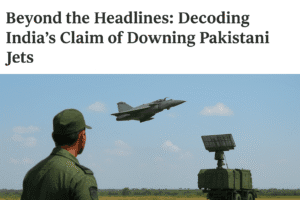
Beyond the Headlines: Decoding India’s Claim of Downing Pakistani Jets
The simmering tensions between India and Pakistan flared dramatically in May 2025, leaving a trail of contested narratives. Three months later, India’s Air Force Chief, Air Chief Marshal A.P. Singh, made a significant and provocative assertion: India shot down five Pakistani fighter jets and one large military aircraft during those clashes. This claim, delivered to an audience including military personnel and officials, demands deeper scrutiny beyond the headline-grabbing announcement.
The Core of India’s Claim:
- The Tally: Singh stated India downed “at least five fighters confirmed killed, and one large aircraft,” likely a surveillance plane, shot down at an impressive 300 km range. He termed this “the largest ever recorded surface-to-air kill,” met with applause.
- The Weapon: Crucially, Singh attributed most kills to India’s Russian-made S-400 Triumf air defense systems. This is a key strategic point, validating India’s significant investment in this advanced platform and showcasing its long-range capability.
- Additional Strikes: Singh also mentioned airstrikes damaging an additional surveillance plane and “a few F-16” fighters parked in hangars at Pakistani air bases, implying successful offensive operations deep into Pakistani territory.
- Basis: He cited “electronic tracking data” as confirmation, though no specific evidence (like radar logs or wreckage imagery) was publicly presented.
Pakistan’s Counter-Narrative & Lingering Questions:
- Flat Denial: Pakistan has consistently denied losing any aircraft during the May clashes. Its military did not immediately respond to Singh’s latest claim, but its position remains unchanged.
- Pakistan’s Own Claims: Islamabad asserts it shot down six Indian jets, including the highly advanced French-made Rafale – a cornerstone of India’s modern air power.
- The French Corroboration: Adding complexity, France’s Air Chief, General Jerome Bellanger, stated he had seen evidence confirming the loss of three Indian fighters, including a Rafale. India has not officially commented on Bellanger’s statement, creating a significant discrepancy with Pakistan’s claim and raising questions about India’s own transparency regarding losses.
- The Evidence Gap: The absence of independently verifiable proof for either side’s major claims (downed jets, deep strikes) leaves a crucial vacuum. Military conflicts between these rivals are historically fraught with propaganda and minimized admissions of loss.
The Human Insight: Why This Matters Beyond the Numbers
- Testing the S-400’s Mettle: Singh’s emphasis on the S-400 isn’t just about the kills; it’s a strategic message. Deploying the system effectively against modern fighters validates India’s defense choices and signals its potent air defense capability to the region and potential adversaries like China. The claimed 300-km kill is a powerful demonstration of reach.
- The Rafale Factor: Pakistan’s claim, seemingly partially supported by France, of downing a Rafale strikes at the heart of India’s air superiority narrative. If true, it would be a major operational and symbolic blow, forcing a reassessment of the aircraft’s survivability in high-intensity conflict and India’s tactics. India’s silence on Bellanger’s comment speaks volumes.
- The Fog of War & Propaganda: The starkly contradictory claims from both nations, amplified by the delayed nature of Singh’s announcement, underscore the persistent “fog of war” and the role of strategic messaging. Each side aims to project strength, deter future aggression, and manage domestic morale. The applause in Bengaluru highlights the domestic audience for such pronouncements.
- Escalation Risks: Public claims of inflicting significant losses and striking deep into enemy territory, while denying one’s own, can fuel nationalist fervor and create pressure for further escalation in future crises. The nuclear dimension makes accurate communication and restraint paramount.
The Unresolved Reality:
While Air Chief Marshal Singh’s statement provides India’s official version of events, it does not settle the debate. Pakistan’s counter-claims and the French corroboration regarding Indian losses, particularly the Rafale, remain significant counterpoints. The lack of transparent evidence from either side means the true cost and outcome of the May 2025 air clashes remain obscured by strategic interests and national narratives.
The enduring lesson is clear: in the high-stakes arena of India-Pakistan conflict, claims of victory and denial of loss are as much weapons of perception and deterrence as the missiles and jets themselves. The full truth likely lies somewhere in the contested airspace between the two official stories, a reminder of the perilous dynamics between these nuclear-armed neighbors.
You must be logged in to post a comment.