
Beyond the Headlines: Decoding India’s Calculated Gamble in an Age of AI and Geopolitics
India’s recent Union Budget and a newly announced trade deal with the US represent a high-stakes geopolitical gambit, where New Delhi is trading fiscal concessions and market access to secure stronger American alliance and strategic support against China, a calculated move overshadowed by domestic shortcomings. While the global AI sell-off following Anthropic’s announcement is likely an overreaction that could ultimately force India’s IT sector to accelerate its climb up the value chain, the government’s true strategic vulnerability lies at home: in the persistent underinvestment in indigenous R&D and hard-tech innovation, and in the corrosive neglect of social cohesion, which together undermine the long-term sovereignty and resilient growth that the external deals are meant to secure.
Beyond the Headlines: Decoding India’s Calculated Gamble in an Age of AI and Geopolitics
The past week felt like a whirlwind for observers of India’s economy and its place in the world. Three seismic events—a cautious Union Budget, a landmark (and controversial) trade deal announcement with the US, and a global AI-induced market panic—converged to paint a complex picture of a nation navigating treacherous waters. This isn’t just a story of policy shifts; it’s a narrative about India’s high-stakes bet on its future, where external alliances are being prioritized, often at the visible expense of domestic fortification. To understand this bet is to look beyond the panic and the political outcry, to the sobering calculations and the quieter, more dangerous neglect.
The AI Panic: A Wake-Up Call, Not a Death Knell
The trigger was Anthropic’s Claude Cowork. The announcement of AI transitioning from selling “intelligence” to selling “work” through specialized plugins sent shockwaves through global tech stocks, dragging Indian IT majors down in a tide of fear. The narrative was seductive and terrifying: if AI can handle legal vetting, data processing, and customer relations, what becomes of the vast armies of coders and service professionals?
This reaction, while understandable, is likely a profound overreaction—a classic case of the market confusing disruption for obliteration. The critical insight here is one of integration over replacement. AI tools, however sophisticated, do not deploy themselves. They require seamless integration into complex, legacy-laden business workflows. They need rigorous testing for “hallucinations” and bias. They demand human oversight for context, ethics, and exceptional cases. The notion that a plugin could single-handedly implement a new ERP system for a multinational or guide a digital transformation strategy is a fantasy.
For India’s IT sector, this panic should serve as a potent accelerant, not a funeral dirge. The savvier firms have already been climbing the value chain, evident in their rising revenue-per-employee metrics. This AI shock is, in essence, a forceful kick for the dawdlers. It underscores an urgent truth: the future lies in higher-order skills—in AI governance, in complex systems integration, in strategic consulting, and in the very R&D that builds these tools. The real threat isn’t AI taking jobs; it’s Indian companies failing to evolve fast enough to create the new ones. For long-term investors, the sell-off may present a buying opportunity in firms demonstrating this agile evolution.
The Budget & The Trade Deal: Reading Between the Lines of Concession
While the market grappled with AI anxieties, the government delivered a Budget marked by fiscal conservatism. Lowering the expenditure-to-GDP ratio and projecting a reduced deficit signals a shift towards restraint, reducing the economic stimulus from public spending. This prudence, however, was juxtaposed with a puzzling concession: a proposed 20-year tax holiday for foreign hyperscalers building massive data centres.
Given that tech giants like Amazon, Microsoft, and Google have already committed $65 billion to this sector without such incentives, this move raises urgent questions. Anonymous official hints that the break may apply to global income only deepen the mystery. It appears less an economic necessity and more a strategic sweetener, a gesture within a larger geopolitical bargain.
That bargain was unveiled, in characteristic fashion, by Donald Trump on Truth Social. The announced Indo-US trade deal—with its promises of slashed tariffs, an end to Russian oil imports, and astronomical $500 billion purchase targets—immediately ignited cries of a “sellout.” The opposition’s charge of surrendered sovereignty is politically potent but analytically premature.
A more nuanced reading is essential. First, such announcements are opening positions, not final texts. Subsequent clarifications about phased goals and protected sectors (like agriculture) are crucial. Second, zero tariffs on specific imports—say, advanced NVIDIA chips, LNG, or modular nuclear reactor equipment—are not a surrender; they are a strategic necessity for India’s own energy and tech transition. It makes little sense to tax critical inputs that your economy and security apparatus desperately need.
The core of the deal lies not in the headline numbers but in the unspoken geopolitical calculus. India finds itself in a precarious strategic bind, facing an increasingly assertive China that uses Pakistan as a proxy. The US remains a critical, if sometimes unreliable, counterweight. The trade deal, therefore, is a lever to ensure continued American engagement and strategic support. It is a calculated compromise, trading market access for diplomatic and strategic space, all while attempting to guard “strategic autonomy” on core issues.
The Real Betrayal: Neglecting the Home Front
This is where the analysis must turn inwards, for India’s true high-stakes bet isn’t merely external. The government’s fault line lies not in negotiating with Washington, but in what it is choosing to deprioritize at home.
- The Innovation Deficit:While offering tax holidays to foreign tech giants, the Budget and broader policy landscape continue to underinvest in cultivating a vibrant, indigenous R&D ecosystem. Where is the “Moonshot” funding for hard-tech startups in semiconductors, advanced materials, or aerospace? The contrast is stark: we are eager to host the factories and data centres of global leaders but hesitant to spawn and nurture our own champions. A trade deal can secure technology transfer, but it cannot build a nation’s innate capacity for innovation. That requires relentless focus, generous public funding for fundamental research, and a cultural shift that celebrates deep-tech entrepreneurship over quick-commerce ventures.
- The Social Fabric Erosion:Perhaps the most damaging compromise to India’s long-term strategic interests is the continued assault on its own social cohesion. Incidents of hate speech and majoritarian aggression, from Assam to Uttarakhand, are not mere law-and-order issues. They are direct threats to national stability and economic potential. A nation divided by internal fracture cannot stand firm on the world stage, no matter how clever its trade deals. Social unity is the bedrock upon which economic ambition and geopolitical credibility are built. Its erosion represents a profound betrayal of the national interest, undermining the very strength India seeks to project.
Conclusion: A Tightrope Walk Over Two Chasms
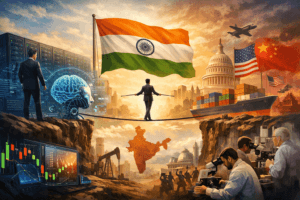
India’s current path is a dramatic tightrope walk. On one side lies the chasm of geopolitical isolation and technological dependency; on the other, the chasm of domestic under-preparation and social discord. The government’s moves—the fiscal restraint, the trade concessions, the hyperscaler incentives—are maneuvers to navigate the first chasm. They are a bet that aligning closer with US economic and strategic interests will provide the time, technology, and security to propel India forward.
Yet, this bet risks being a catastrophic folly if the second chasm is ignored. No amount of American goodwill can substitute for a weak innovation base. No trade deal can protect a society at war with itself. The “high-stakes bet” is, therefore, a dual one: that external alliances will yield enough dividends to compensate for internal neglect.
The weeks ahead will demand rigorous scrutiny of the trade deal’s fine print and a clear-eyed assessment of the AI disruption. But the most vital task for observers and policymakers alike is to shift the spotlight inward. India’s ultimate sovereignty and its place in the AI-driven future will not be secured in negotiation rooms with foreign powers alone. It will be forged in its research labs, in its startup incubators focused on hard problems, and most fundamentally, in the preservation of its pluralistic, cohesive society. That is the insight that must guide the nation beyond the panic and the politics.
You must be logged in to post a comment.