
Beyond the Headlines: Decoding India’s Tightrope Walk in the West Asia Crisis
In a significant parliamentary address during the March 2026 Budget Session, Prime Minister Modi outlined India’s calibrated response to the escalating West Asia conflict, emphasizing that the choice of Parliament itself signaled the crisis’s direct impact on Indian citizens—from energy prices to the safety of the 10‑million‑strong diaspora in the Gulf. His statement balanced strategic autonomy with pragmatic action: highlighting energy security through expanded import sources and strategic petroleum reserves, detailing the evacuation of over 375,000 Indians and the plight of stranded seafarers, and reaffirming “dialogue and diplomacy” as the only solution. Notably, his deliberate omissions—no condemnation of US or Israeli actions, no condolences to Iran—reflected India’s careful balancing act, preserving ties with all regional players while protecting national interests. The speech underscored that India’s West Asia policy is no longer just foreign policy, but a deeply domestic concern tied to livelihoods, remittances, and economic stability.
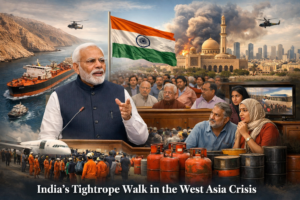
Beyond the Headlines: Decoding India’s Tightrope Walk in the West Asia Crisis
When Prime Minister Narendra Modi rose to address the Lok Sabha during the Budget Session of March 2026, the chamber held its breath. For four weeks, the West Asia conflict had been escalating, sending shockwaves through global oil markets, disrupting maritime trade, and threatening the livelihoods of millions. But what made this parliamentary intervention significant wasn’t just the content—it was the choice of platform itself.
In a departure from routine foreign policy statements delivered through press releases or diplomatic channels, Modi chose Parliament. This wasn’t merely protocol. It was a deliberate signal that the crisis unfolding thousands of kilometers away had landed on Indian doorsteps, affecting everything from the price of cooking gas in a Mumbai kitchen to the safety of a fisherman’s son stranded on a cargo ship in the Strait of Hormuz.
The Weight of Words: Why Parliament Became the Podium
There is something profoundly democratic about a prime minister explaining foreign policy to elected representatives. Modi’s decision to address Parliament on West Asia—rather than issuing a standard Ministry of External Affairs statement—acknowledged something fundamental: foreign policy is no longer the exclusive domain of diplomats in South Block. When conflict erupts in the Gulf, it resonates in the bylanes of Malappuram, the sugarcane fields of western Uttar Pradesh, and the tea gardens of Bengal.
The timing was equally telling. Four weeks into the conflict, as diplomatic channels buzzed with activity and global powers scrambled to calibrate their responses, India chose to articulate its position through its highest democratic institution. This was India telling the world—and its own citizens—that this crisis mattered at the most granular level of governance.
The Economic Architecture at Risk
Modi’s statement peeled back layers of complexity to reveal the raw economic calculus beneath India’s diplomatic maneuvering. When he spoke of “supply chain disruptions affecting everyday goods,” he was translating geopolitical tension into the language of household budgets.
Consider the Strait of Hormuz, a 21-mile-wide passage through which approximately 20 percent of the world’s petroleum passes. Modi didn’t mince words: any closure of this waterway would be “unacceptable.” For a nation that imports over 80 percent of its crude oil requirements, the strait isn’t just a geographical feature—it’s the aorta of the Indian economy. The 22 Indian ships and 700 seafarers stuck in these waters represent not just commercial vessels but the fragile threads connecting India’s energy security to global geopolitics.
What’s particularly striking is how India has been preparing for precisely this moment without drawing attention to its preparations. Over the past eleven years, the country has quietly expanded its energy import sources from 27 to 41 nations. This diversification strategy—once dismissed by critics as diplomatic tourism—has now proven its worth. When one region becomes unstable, India can lean on others without appearing desperate or forced into uncomfortable alliances.
The numbers tell a compelling story. India’s Strategic Petroleum Reserve currently stands at over 5.3 million metric tonnes, with plans to expand to 6.5 million. But these aren’t just statistics to be cited in policy papers. Behind each tonne is a calculation about inflation, about the rupee’s stability, about whether the auto-rickshaw driver in Delhi will pay ₹15 or ₹18 for a kilogram of LPG.
The Human Equation: 10 Million Reasons to Care
Any discussion of India’s West Asia policy that focuses solely on oil barrels and shipping routes misses the point entirely. The human dimension—what Modi’s statement referred to indirectly but powerfully—is where India’s stake in this conflict becomes visceral.
Approximately 10 million Indians live and work across the Gulf countries. They are not expatriates in the traditional sense; they are the economic backbone of entire districts in Kerala, Uttar Pradesh, Bihar, and West Bengal. A prolonged conflict doesn’t just threaten their safety—it threatens the remittance flows that sustain countless Indian families. When the Gulf sneezes, large parts of India catch a cold.
Modi’s mention of the 1,000 evacuated Indians from Iran, including over 700 medical students, puts a human face on the crisis. These aren’t abstract numbers on a government dashboard; they are young men and women whose educational futures hung in the balance, whose families back home spent sleepless nights watching news channels. The CBSE’s decision to cancel board exams in Gulf countries wasn’t administrative convenience—it was recognition that children caught in conflict zones shouldn’t have to worry about trigonometric equations while air raid sirens sound in the distance.
The evacuation of over 375,000 Indians since the conflict began represents one of the largest civilian evacuation operations in recent history. But what Modi’s statement doesn’t fully capture is the sheer logistical complexity of such an operation—coordinating with multiple countries, securing safe passage, arranging transportation, and ensuring that each evacuee’s documentation, health, and basic needs are addressed. This isn’t just crisis management; it’s crisis management at scale, and it reveals India’s evolving capacity to protect its citizens abroad.
The Art of Strategic Silence
Perhaps the most sophisticated aspect of Modi’s parliamentary address was what he chose not to say. In a world that demands clear alignments and moral certitude, India offered something more nuanced: deliberate ambiguity.
No condemnation of US or Israeli actions. No condolences for the Iranian leadership. To the casual observer, these omissions might seem like diplomatic oversights. But in the hyper-articulate world of international relations, silence speaks volumes.
This is strategic autonomy in practice—not the lofty concept debated in academic journals, but the messy reality of a nation with interests spanning the entire geopolitical spectrum. India needs American technology and investment. It needs Iranian oil and the strategic depth of the Chabahar port. It needs Israeli defense technology and agricultural expertise. It needs Gulf Arab petrodollars and the goodwill of their governments to protect 10 million Indian workers. Choosing sides in West Asia isn’t just impractical—it would be self-destructive.
Modi’s statement that he has spoken “twice to all major leaders in the region” reveals India’s diplomatic method: maintain lines of communication with everyone, position oneself as a neutral voice for peace, and ensure that no party feels alienated. This approach earned India credibility during the Russia-Ukraine war, and it’s being deployed again with West Asia.
The Diplomatic Architecture of Engagement
Behind Modi’s parliamentary speech lies a complex machinery of diplomatic engagement that rarely makes headlines but shapes outcomes. The activation of consular mechanisms, the establishment of 24/7 control rooms, the regular issuance of advisories—these aren’t bureaucratic formalities. They represent India’s capacity to project soft power when it matters most.
What’s particularly noteworthy is the regional approach India has adopted. Rather than dealing with the crisis as a bilateral issue with individual countries, India has consistently engaged with the Gulf region as an interconnected system. This reflects an understanding that in West Asia, nothing happens in isolation. The security of Indians in the UAE affects those in Qatar; the stability of shipping routes through the Strait of Hormuz determines safety for seafarers in Oman.
Modi’s personal diplomacy—calling leaders across the Gulf, from Iran to Saudi Arabia—serves multiple purposes. It reassures Indian citizens that their concerns are being addressed at the highest level. It signals to regional powers that India sees itself as a stakeholder in West Asian stability. And it creates diplomatic space for quiet negotiations when backchannel communications become necessary.
Beyond the Headlines: Reading Between the Lines
For those accustomed to India’s traditional foreign policy pronouncements, Modi’s statement contained subtle shifts worth noting. The emphasis on domestic LPG production alongside energy security signals a recalibration toward self-reliance even as global integration deepens. The mention of “dialogue and diplomacy as the only solutions” echoes India’s consistent position, but the context matters: in a conflict where military escalation seems increasingly likely, India’s voice for peace carries weight precisely because it isn’t aligned with any military coalition.
The parliamentary setting itself adds another layer of meaning. By choosing to address the crisis in the Lok Sabha rather than through diplomatic channels, Modi signaled that West Asia is no longer a foreign policy issue to be managed by specialists—it’s a national issue that concerns every Indian. This framing allows the government to justify difficult decisions, build public consensus, and prepare citizens for potential economic disruptions.
The Road Ahead: What India’s Position Means for the Future
As the conflict enters its second month, India’s carefully calibrated position faces tests on multiple fronts. Domestically, the government must manage potential inflation, ensure energy supplies, and maintain confidence among the diaspora. Regionally, India must continue engaging all parties without compromising its credibility as an honest broker. Globally, India must navigate pressure from major powers to take clearer sides while preserving its strategic autonomy.
What Modi’s statement reveals is that India has moved beyond the reactive crisis management of the past. The expansion of energy sources, the building of strategic reserves, the strengthening of consular capabilities—these aren’t responses to the current crisis. They represent a decade-long effort to build resilience against exactly this kind of geopolitical shock.
The 10 million Indians in the Gulf remain the ultimate barometer of India’s West Asia policy. Their safety, their livelihoods, their ability to send remittances home—these aren’t just metrics to be monitored; they are the human reality that gives India’s strategic calculations their moral weight. When Modi speaks of “dialogue and diplomacy,” he is speaking for families in Kozhikode waiting for news of their sons, for wives in Patna checking flight schedules, for parents in Kolkata wondering if their daughter’s medical education in Iran will continue.
In the end, India’s position on the West Asia conflict isn’t merely a foreign policy stance. It’s a reflection of who India has become—a nation with global ambitions but local concerns, strategic patience but operational readiness, diplomatic nuance but clear red lines. Modi’s parliamentary address captured this complexity not by simplifying it, but by presenting it plainly to the Indian people, trusting them to understand that in a dangerous world, the path of wisdom is rarely the path of simplicity.
As the crisis continues to unfold, India’s approach will be tested in ways no one can fully predict. But the framework laid out in that Lok Sabha speech—protecting citizens, ensuring energy security, maintaining strategic autonomy, pursuing dialogue—provides a compass for navigating whatever comes next. In a region defined by volatility, India has chosen the steady course. Whether that course holds will depend on events beyond its control, but the foundation has been laid for the long journey ahead.
You must be logged in to post a comment.