
Beyond the Headline: Why the Rupee’s ‘Vulnerability’ Signals a Structural Shift, Not Just a War Shock
A recent MUFG Bank analysis reveals that the Indian rupee’s decline is no longer just a temporary reaction to geopolitical tensions but a structural vulnerability, projecting depreciation in every scenario—from 93.5 to as high as 97.5 per dollar by late 2026—regardless of whether the Middle East conflict de-escalates or intensifies. India’s acute dependence on Middle Eastern energy, especially LPG and natural gas, combined with second-order shocks like fertilizer costs, reduced remittances, and widening current account deficits, points toward a stagflationary environment of higher inflation and weaker growth. Even in the best case, the rupee settles at a permanently weaker level, challenging official narratives and signaling that the currency’s “vulnerability” is now a structural feature of the Indian economy rather than a transient shock.
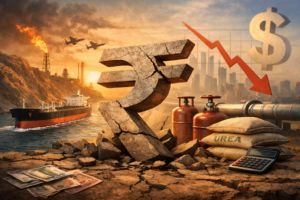
Beyond the Headline: Why the Rupee’s ‘Vulnerability’ Signals a Structural Shift, Not Just a War Shock
For months, the narrative coming from New Delhi has been one of reassurance. As the Indian rupee repeatedly sank to “historic lows,” the official refrain was consistent: this is a dollar problem, not a rupee problem. The finance minister spoke of global uncertainty and assured the public that the currency would eventually “find its own level.” The economic survey, released with great fanfare, insisted the rupee was merely “punching below its weight,” a phenomenon that did not reflect the true health of India’s “stellar economic fundamentals.”
But on March 30, 2026, a sobering analysis from Japan’s MUFG Bank cut through this political spin. The report offered a stark verdict: the Indian rupee is fundamentally “vulnerable,” and the ongoing crisis in the Middle East is merely an accelerator for a decline that now appears structural, not cyclical.
The headline grabbing attention is the forecast that the rupee could rise above 95 against the US dollar. Yet, buried within the fine print of the MUFG analysis is a far more troubling conclusion for Indian policymakers and citizens alike. The rupee is going to fall this year no matter what. The only variable is how far.
The Three Scenarios of a ‘No-Win’ Situation
To understand the gravity of the situation, one must look at the MUFG’s scenario planning. Unlike the government’s optimistic framing, the Japanese bank presents a grim trifecta of outcomes, none of which result in a strengthening of the Indian currency.
- The Best-Case (Permanent Scar): In this scenario, the conflict de-escalates, the Strait of Hormuz reopens, and oil prices crash back to pre-war levels of $80 per barrel. Even here, the rupee does not recover to its previous strength. It is projected to drift from 92 to the dollar in March 2026 to 93.5 by December 2026. This is a “best case” that still represents a steady erosion of purchasing power.
- The Base-Case (Stagnation): If oil prices stabilize at their current elevated levels—around $100 per barrel—the rupee is expected to close the year at 95.5 to the dollar. This scenario assumes a managed, ongoing conflict that keeps markets tense but doesn’t trigger a full-blown regional war.
- The Worst-Case (Stagflation): If the conflict intensifies, oil spikes to $120 per barrel, and the Strait of Hormuz remains closed for an extended period, the rupee is forecast to plummet to 97.5 by the end of the year.
The takeaway here is critical. In every single scenario, the rupee depreciates. There is no projection for a rebound to the 80s or even the low 90s. This challenges the government’s assertion that India’s fundamentals are so strong that the currency’s value is merely a temporary anomaly.
The Strait of Hormuz: A Geographic Curse
Why is India uniquely vulnerable? The MUFG report pinpoints geography. The closure of the Strait of Hormuz—the world’s most critical oil chokepoint—is not a global equal-opportunity destroyer. It is a laser-focused threat to the Indian subcontinent.
While Europe has weaned itself off Middle Eastern energy in recent years, India remains deeply tethered to the region. The report highlights a specific dependency that often flies under the radar: Liquified Petroleum Gas (LPG). India imports virtually all of its LPG from the Middle East. This is not just about industrial fuel; it is about the cooking gas that powers millions of Indian households. Furthermore, 60% of India’s natural gas imports—crucial for fertilizer production and electricity—come from the region, particularly Qatar.
This is not merely a supply chain issue; it is a matter of national subsistence. When Foreign Minister S. Jaishankar admits there is no “blanket deal” for Indian vessels to pass through the strait, it underscores the precariousness of the situation. Every ship that is delayed, every insurance premium that rises, every barrel that becomes harder to secure—these costs are immediately transferred to the Indian consumer and the Indian fiscal deficit.
The ‘Second Order’ Threat: Stagflation in Disguise
The most valuable insight from the MUFG analysis, however, lies in its discussion of “second-order consequences.” The immediate impact of a weak rupee is expensive oil. But the downstream effects create a perfect storm that the report chillingly compares to “something akin to COVID lockdowns.”
First, there is the fertilizer crisis. India relies heavily on natural gas to produce urea. If gas imports from the Middle East are disrupted or become expensive, the cost of food production skyrockets. This leads directly to food inflation, which hits the poorest citizens the hardest. The government, facing an election cycle, would be forced to increase subsidy bills, further straining the fiscal deficit.
Second, there is the remittance trap. For decades, India has benefited from the massive flow of remittances from its diaspora working in the Gulf. A prolonged conflict threatens the stability of those jobs. If construction halts in Dubai, if Saudi Arabia’s Vision 2030 projects face delays, or if Gulf economies contract, the flow of money back to Kerala, Uttar Pradesh, and Bihar could slow dramatically. This reduces the disposable income of millions of Indian families and removes a crucial cushion that often props up the rupee.
The report explicitly warns of a “stagflationary environment”—the dreaded combination of higher inflation and weaker growth. For an economy aspiring to become the world’s third-largest, stagflation is the silent killer. It erodes corporate margins, discourages foreign investment, and traps the middle class between shrinking salaries and expanding costs.
The Cost of Oil: A Mathematical Squeeze
To quantify the damage, MUFG offers a simple but devastating formula. For every $10 increase in the price of a barrel of oil, India’s current account deficit (CAD) widens by 0.4% to 0.5% of GDP. Simultaneously, GDP growth is cut by 0.1% to 0.2%, while inflation rises by 0.2%.
If oil averages $100 per barrel, MUFG warns that India’s projected 7% growth for FY2026/27 could slip below 6.5%. While 6.5% is still enviable by global standards, in India, where demographic pressures demand double-digit growth to generate sufficient jobs, a dip below 7% is politically and socially significant.
This mathematical squeeze is further exacerbated by the Reserve Bank of India’s (RBI) dilemma. The central bank has been burning through foreign exchange reserves to defend the rupee. But as economist Prabhat Patnaik noted, speculation continues to mount. The RBI is caught in a classic “impossible trinity”: it cannot simultaneously maintain a stable currency, free capital movement, and an independent monetary policy. Every dollar sold from the reserves to prop up the rupee is a dollar that cannot be used to cushion a future shock.
Structural Flaws Exposed
Ultimately, the MUFG report forces a reckoning with the fact that the rupee’s vulnerability is not merely a byproduct of war. A healthy, structurally strong currency can absorb external shocks and bounce back. The fact that the rupee is projected to stay at elevated levels (93.5+) even in the best-case scenario suggests that the conflict has merely exposed underlying weaknesses.
These include a persistent reliance on capital inflows that can reverse at the first sign of trouble, an export sector that has struggled to gain competitiveness despite the weak rupee, and a domestic economy that remains highly sensitive to energy price shocks. The government’s insistence that the rupee is only falling against the dollar—and not the euro or yen—ignores the reality that global trade is still largely dollar-denominated. When oil is priced in dollars and debt is serviced in dollars, the dollar rate is the only rate that matters.
Conclusion: Facing the New Normal
As the headline figure of 95 per dollar looms, the rhetoric of “the rupee will find its own level” begins to sound less like economic wisdom and more like a surrender to gravity.
The MUFG analysis strips away the political spin to reveal a sobering reality: India is facing a period of expensive energy, reduced growth, and a currency that is structurally weaker than its “fundamentals” would suggest. The war in the Middle East is the immediate trigger, but the vulnerability is homegrown.
For the average Indian, this means the cost of fuel, cooking gas, and essential imports will not come down soon. For policymakers, it signals the end of the era where the RBI could easily manage the rupee’s decline. For investors, it is a red flag that India’s risk profile is changing.
The war may end, and the Strait of Hormuz may eventually reopen. But if the MUFG report is accurate, the rupee will not return to its former strength. The new floor is higher, the margins are tighter, and the Indian economy must now learn to navigate a world where its currency is no longer just “punching below its weight,” but is permanently heavier with risk.
You must be logged in to post a comment.