
Beyond the Headline: Why Boeing’s Bet on India is a Test of Resilience and Strategy
Boeing’s anticipation of increased Dreamliner orders in India represents a strategic bet on the nation’s soaring aviation demand, but it is tempered by significant challenges, including the need to rebuild trust following the tragic AI171 crash investigation, navigate US-imposed tariff uncertainties, and outmaneuver fierce competition from Airbus. The company’s confidence is rooted in the 787’s fuel efficiency and long-range capabilities, which align with Indian airlines’ expansion goals, and its broader commitment to industrializing India’s aerospace sector through local partnerships and supply chain investments. Ultimately, Boeing’s success hinges on its ability to demonstrate unwavering safety stewardship, mitigate geopolitical trade hurdles, and prove that the Dreamliner is the optimal tool for unlocking India’s next phase of international air connectivity.
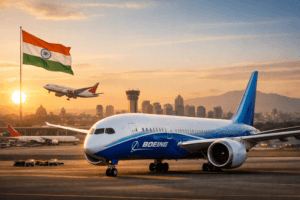
Beyond the Headline: Why Boeing’s Bet on India is a Test of Resilience and Strategy
The announcement from Boeing seems, on the surface, like standard corporate optimism. A senior executive, Salil Gupte, President of Boeing India and South Asia, tells the press that the company anticipates more orders for its 787 Dreamliner in the Indian market. He speaks of a “bright future,” of overcoming “short-term hurdles,” and of robust global demand. It’s the kind of forward-looking statement that fills news cycles. But to view this solely through the lens of a sales forecast is to miss the profound, multi-layered story beneath—a narrative about geopolitical maneuvering, aviation’s painful evolution after tragedy, and a high-stakes duel for the soul of the world’s fastest-growing major aviation market.
The Indian Sky: A Canvas of Unprecedented Demand
To understand Boeing’s confidence, one must first grasp the tectonic shifts in Indian aviation. India is no longer merely an emerging market; it is an aviation superpower in the making. It is projected to become the world’s third-largest air passenger market by the end of this decade. A burgeoning middle class, economic liberalization, and government initiatives like the UDAN scheme to connect regional airports have democratized air travel. Airlines are in a relentless expansion mode, not just to ferry passengers between megacities like Delhi and Mumbai, but to weave a dense network connecting tier-2 and tier-3 cities.
In this landscape, the Boeing 787 Dreamliner isn’t just another aircraft; it’s a strategic tool. Its efficiency lies in its composite airframe and advanced engines, offering roughly 20-25% better fuel efficiency than the older generation it replaces. For Indian carriers operating on notoriously thin margins and facing volatile fuel prices, this isn’t a luxury—it’s a necessity for profitability. Furthermore, the Dreamliner’s long-range capabilities allow airlines like Air India to dream big: connecting Indian metros directly to secondary cities in Europe, North America, and Australia without the need for the massive capacity of a Boeing 777. This enables “point-to-point” routes that bypass congested hubs, a model increasingly popular with travelers.
The Shadow of AI171: Navigating Trust and Transparency
However, Gupte’s statement cannot be divorced from its most somber context: the crash of Air India flight AI171 in June 2025. The incident, which resulted in the tragic loss of 260 lives and marked the Dreamliner’s first fatal accident, casts a long shadow. When Gupte says the victims are “foremost in our minds,” it is more than a perfunctory tribute. It underscores the monumental task of maintaining and rebuilding trust—with airlines, regulators, and, most importantly, the flying public.
The ongoing investigation by India’s Aircraft Accident Investigation Bureau (AAIB) is a crucible for Boeing’s reputation. The company’s stated position—to support the investigation fully and await the official report—is the only tenable one. Yet, behind the scenes, this event has undoubtedly intensified scrutiny on every Dreamliner in Indian skies, from maintenance protocols to pilot training. For Boeing, securing future orders in India is contingent not just on the plane’s economics, but on demonstrating an unwavering commitment to safety, transparency, and partnership in the investigation’s aftermath. The future of the Dreamliner in India hinges as much on the AAIB’s final report and Boeing’s response to it as it does on fuel burn metrics.
The Tariff Tangle: A Geopolitical Hurdle
The “short-term hurdles” Gupte alludes to prominently include US-imposed tariffs. This is where corporate strategy collides with geopolitics. Trade tensions between the US and India, while easing in some areas, can manifest in tariffs that directly impact the cost of importing multi-million-dollar aircraft. For an airline calculating the NPV (Net Present Value) of a fleet order, even a marginal increase in acquisition cost can sway a decision.
Boeing’s century-long history, as Gupte notes, is meant to project stability and resilience. The implied argument is that while tariffs pose a challenge, the fundamental demand for air connectivity and advanced aircraft is immutable. However, this stance is subtly strategic. It places the onus on governments to resolve trade disputes, positioning Boeing as a patient partner caught in the crossfire. It also serves as a quiet reminder of Boeing’s deep local investments—over 325 suppliers and $1.25 billion in annual sourcing—arguing that its success is intertwined with India’s industrial and aerospace ambitions.
The Airbus in the Room: A Battle of Philosophy
No analysis of Boeing’s prospects is complete without addressing the elephant—or rather, the Airbus—in the room. Airbus’s A350 and A330neo families are direct competitors to the Dreamliner. The competition is fierce and goes beyond mere specifications. It is a battle of commercial philosophy and fleet strategy.
Airbus has secured massive orders from Indian carriers like IndiGo for its smaller A320/321neo family, embedding its ecosystem deeply. Gupte’s comment that “airplanes are tools for our customers” is a deliberate reframing. It’s an attempt to move the conversation away from a simplistic Boeing-vs-Airbus duel and toward a mission-specific discussion. Boeing is betting that as Indian airlines like Air India, and potentially others, mature their international networks, the unique capabilities of the 787—particularly its ability to profitably serve long, thin routes—will be irresistible. They are selling a key to unlock new network possibilities, not just an aircraft.
The Road Ahead: Integration and Industrialization
Boeing’s vision for India extends beyond being a seller. Gupte’s mention of the “shared goal of industrialising India’s aerospace industry” is critical. This speaks to partnerships in manufacturing, maintenance, repair, and overhaul (MRO), and skill development. The Tata Group’s ownership of Air India and its ambitious transformation plan creates a natural anchor for such deeper collaboration. The dream for Boeing is an Indian aviation sector where its planes are not just flown, but increasingly supported, maintained, and even manufactured through local partnerships.
This long-game perspective is what allows Boeing to ostensibly brush off short-term tariff concerns. They are investing in an integrated aerospace ecosystem. More Dreamliner orders would solidify this partnership, creating a virtuous cycle: more planes necessitate more local MRO support, which builds industrial capacity, which in turn makes future orders more efficient to service.
Conclusion: A Calculated Optimism
In conclusion, Boeing’s expectation of more Dreamliner orders in India is far more than a sales target. It is a statement of calculated optimism amidst a perfect storm of opportunity and challenge. It is a bet on India’s economic destiny, a test of its own ability to steward safety and trust post-tragedy, and a strategic move in a global chess game against Airbus.
The orders will ultimately come not from corporate confidence alone, but from a confluence of factors: the AAIB’s conclusive findings, the easing of trade frictions, the financial health of Indian carriers, and the continuous proof of the Dreamliner’s operational value. Boeing has laid out its thesis: that India’s skyward trajectory is inevitable, and that the 787 is the ideal vessel for this journey. The coming years will reveal if the market concurs, making the Indian aviation story one of the most compelling to watch in global business.
You must be logged in to post a comment.