
Beyond the Headline: The Untold Story of Three Men Detained by Israeli Forces in al-Mughayyir
Based on the original news report and the subsequent feature article, the incident involved the detention of three young Palestinian men—Yousef Rajeh, Yaseen Bilal, and Mohammad Hossam from the village of Qaryut—by Israeli forces during a raid on the village of al-Mughayyir. The men were pulled from their ladders and taken into custody while peacefully working to install solar panels on a local shop, an act symbolizing economic resilience and self-sufficiency. The event, which witnesses reported involved mistreatment, stripped away their honest labor to reveal the harsh, unpredictable reality of life under military occupation, leaving their families in anguish and serving as a stark reminder of how even the most innocent pursuits of progress can be violently disrupted.
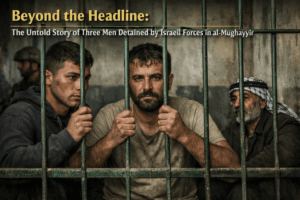
Beyond the Headline: The Untold Story of Three Men Detained by Israeli Forces in al-Mughayyir
The sun over the village of al-Mughayyir, northeast of Ramallah, is a stubborn and generous entity. It beats down on the rugged hills, on the ancient olive trees whose gnarled roots grip the rocky soil, and on the new, shimmering blue solar panels that have begun to appear on rooftops and shopfronts. For many Palestinians, this sun is more than a source of light; it is a symbol of quiet resilience, a small step toward self-sufficiency in a land where resources are often controlled and restricted. On a seemingly ordinary Thursday afternoon, however, even that modest ambition was met with the stark, unyielding reality of military occupation.
At approximately 2:30 PM on February 19, 2026, the daily hum of life in al-Mughayyir was shattered. The now-familiar, chilling sound of military vehicles rumbled through the narrow streets. Israeli occupation forces had entered the village. What followed was a swift and decisive show of force that would, by the end of the day, leave three families in a nearby village mourning the absence of their sons and a community once again reminded of its fragility.
The official report from the WAFA news agency is concise: three young men were detained while installing solar panels. Their names are Yousef Rajeh, Yaseen Bilal, and Mohammad Hossam, all residents of Qaryut, a village south of Nablus. But behind those names and the sparse details lies a far more intricate and human story—one of enterprise, community, and the unpredictable, often violent, interruptions of life under occupation.
The Village of Thorns and the Promise of the Sun
To understand this incident, one must first understand the land. Al-Mughayyir, whose name fittingly translates to “the place of thorns,” is a village that has known hardship for decades. Located in an area of the West Bank known as “Area B,” it falls under Palestinian civil control and Israeli military control, a schizophrenic reality that makes daily life a calculated risk. Its residents are farmers, laborers, and increasingly, small business owners trying to carve out a living in an economy stifled by checkpoints, movement restrictions, and the ever-present expansion of Israeli settlements on its borders.
It was this economic pressure that brought the three young men from Qaryut to al-Mughayyir. Qaryut, a village with its own long history of friction with nearby settlements, is home to Yousef, Yaseen, and Mohammad. Like so many young Palestinian men, they are not just farmers or laborers; they are pragmatists and innovators. They represent a growing, informal green-tech movement sweeping through the West Bank.
Facing high electricity costs and an unreliable grid, many Palestinians are turning to solar power. It’s an act of environmentalism, yes, but more importantly, it’s an act of defiance and economic liberation. By installing solar panels, a shopkeeper can keep his cold drinks cold, his lights on after dark, and his business running without being beholden to the Israeli-controlled distribution network.
For Yousef, Yaseen, and Mohammad, installing solar panels was their trade. They were the technicians, the modern-day handymen who brought the future to these ancient villages. On that Thursday, they were working for a local shop owner in the heart of al-Mughayyir. They were not engaged in politics. They were not throwing stones. They were on ladders, tools in hand, connecting wires and fastening mounts, working under the very sun they were harnessing for power. It was honest, skilled labor—a testament to their hope for a better, more sustainable future.
The Storm Descends
Witnesses, who spoke on condition of anonymity for fear of reprisal, described the scene with a mixture of anger and sorrow. The village had been quiet. Children were returning from school. Shopkeepers were beginning their afternoon lull. Then, without warning, a convoy of military jeeps screeched to a halt at the village’s entrance. Soldiers, clad in full tactical gear, poured out, fanning out across the main street.
“It was a ‘storming,'” one local elder told me, using the word commonly employed to describe such incursions. “They came with force, not looking for anything specific, but to show us that they can enter whenever they want. To remind us who is in charge.”
The soldiers moved methodically through the streets, their presence a violent intrusion into the pastoral calm. Their focus quickly settled on the commercial shop in the center of the village. There, unaware of the commotion until it was upon them, were Yousef, Yaseen, and Mohammad, still working on the installation.
According to local sources who witnessed the event, the confrontation began immediately. The soldiers shouted orders in Hebrew, which the young men likely did not understand. Before any meaningful communication could occur, the young men were pulled down from their ladders. The work they had been doing with such precision was now being used as a pretext for their detention.
The witnesses described scenes of “mistreatment,” a word that in the context of occupation can mean anything from harsh shoves and verbal abuse to more severe physical force. The young men were reportedly forced to the ground, their hands bound with plastic zip ties. The tools of their trade—wrenches, screwdrivers, and solar panels—became irrelevant, replaced by the cold, impersonal tools of military control. Passersby were ordered away. Shops were ordered to close. For a few terrifying moments, the main street of al-Mughayyir was not a place of commerce, but a military staging ground.
The Accusation: Connecting Wires or Connecting Cells?
The Israeli military often justifies such detentions with claims of preventing terrorism or apprehending wanted individuals. But in the vast majority of cases in villages like al-Mughayyir, the reality is far more mundane and oppressive. The men were likely detained for the crime of being young Palestinian men in the “wrong place at the wrong time.”
However, a more chilling possibility exists, one whispered among the residents. In an environment of extreme suspicion, even an act as innocent as installing solar panels can be twisted. Was the act of connecting wires misinterpreted as something more sinister? Could a soldier have mistaken the electrical work for an attempt to set up surveillance or communication devices? While this seems far-fetched, it speaks to the paranoid reality of the occupation, where every action by a Palestinian is viewed through a security lens.
More likely, this was a collective punishment or a simple act of harassment. By detaining laborers from another village (Qaryut), the army may have been sending a message: there is no safe space, even for work. Or, perhaps it was a random identity check that escalated into detention when the men couldn’t produce the correct permits for being in al-Mughayyir, despite the fact that traveling between Palestinian villages for work is a normal, everyday occurrence.
Three Names, Three Families, One Nightmare
Back in Qaryut, the news traveled faster than the wind. The families of Yousef Rajeh, Yaseen Bilal, and Mohammad Hossam were plunged into a familiar, agonizing routine.
For the mother of Yaseen Bilal, the phone call brought the world to a standstill. “He called me in the morning to tell me he was going to work, that he loved me,” she might have said, her voice thick with tears. “He was so happy. They were getting paid well for this job. He said it was a beautiful sunny day.” Now, her son’s fate was unknown. Was he being interrogated? Was he being beaten? Would he be released in a few hours, or transferred to a detention center for months or even years without charge—a practice known as administrative detention?
The Rajeh family, the Bilals, and the Hossams represent the backbone of Palestinian society. They are families whose lives are built on work, tradition, and community. Now, they are united by a shared nightmare, spending sleepless nights glued to the phone, waiting for any news from the Red Cross or prisoner rights groups like the Prisoners’ Club. The simple act of going to work—of doing a job to provide for their families—has been criminalized.
A Community’s Collective Memory
The raid on al-Mughayyir and the detention of the three young men from Qaryut did not happen in a vacuum. It is a chapter in a long, painful book.
Al-Mughayyir has seen its own children injured and killed during protests against settlement expansion. The nearby settlement of Shilo and its outposts are a constant source of tension, with settlers often attacking Palestinian farmers and their land. The village’s roads are frequently blocked. Its access to its own agricultural land is often restricted.
Qaryut, too, has a history of conflict. It is situated in an area where the friction between Palestinians and settlers is most acute. The young men from Qaryut grew up watching their parents confront land confiscations and settler violence. They learned that resilience is not just about enduring, but about continuing to live, to work, to build. Their decision to work as solar panel installers was a modern expression of that ancient resilience.
The detention of Yousef, Yaseen, and Mohammad is now part of that collective memory. It will be recounted in the men’s diwans (guesthouses) for years to come. It will be a story that starts with, “Remember when they were taken down from the ladders…” It will serve as a lesson for the next generation about the capricious nature of the power that governs their lives.
The Broader Picture: A System of Control
This incident, while specific, is far from isolated. It is a microcosm of the daily friction points that define the Israeli-Palestinian conflict. According to United Nations figures, Israel detains hundreds of Palestinians every month, many for minor infractions or no clear reason at all. The military court system that prosecutes them has a conviction rate of over 99%, leading human rights groups to decry it as a tool of control rather than a system of justice.
The raid on a sporting event near Ramallah and the incursions into Salfit, mentioned in the same news bulletin, are not separate events but pieces of the same mosaic. The occupation is not just about checkpoints and walls; it is about the ability to disrupt life at any moment—to stop a football match, to storm a city center, to pull men off ladders.
As the sun set over al-Mughayyir on Thursday evening, the solar panels on that commercial shop stood half-installed. The wires dangled, useless. The shop owner was left not only without his new power source but also traumatized by the violence he witnessed. The families in Qaryut were left in anguish. And the three young men, Yousef, Yaseen, and Mohammad, were left somewhere in the dark, inside a military jeep or an interrogation room, their only crime being the audacity to try and build a future.
The sun will rise again over the hills of the West Bank. It will shine on the olive trees and on the idle solar panels. But for three families, the light has gone out, extinguished not by a cloud, but by the iron fist of an occupation that sees a man with a solar panel not as a worker, but as a threat. Their story is a stark reminder that in this land, even the most innocent pursuit of progress can be violently interrupted, leaving a community to pick up the pieces and wait for the next storm.
You must be logged in to post a comment.