
Beyond the Headline: The Killing of Nasrallah Abu Siyam and the Unfolding Reality in the West Bank
The article delves into the killing of 19-year-old Palestinian-American Nasrallah Abu Siyam by Israeli settlers in the West Bank village of Mukhmas, using his death as a lens to expose the systemic violence, legal impunity, and accelerating displacement of Palestinians under Israeli military occupation. It highlights how settler attacks, often carried out with the tacit protection of the Israeli army, are not isolated incidents but part of a broader strategy of demographic engineering, which the UN now warns may constitute ethnic cleansing. The report connects this tragedy to the wider context of the war in Gaza, the mass detention and torture of Palestinian journalists, and the international community’s failure to hold perpetrators accountable, concluding that such killings are symptomatic of a deliberate and escalating effort to reshape the occupied territories by force.
Beyond the Headline: The Killing of Nasrallah Abu Siyam and the Unfolding Reality in the West Bank
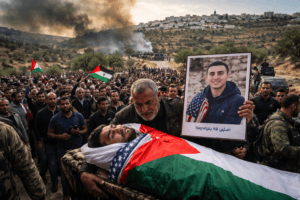
The olive groves that have stood for centuries on the limestone hills east of Ramallah were supposed to be entering their dormant winter phase. Instead, on a chilly Wednesday afternoon, they became the scene of a modern tragedy that encapsulates the slow-motion crisis of the occupied West Bank. Nasrallah Abu Siyam, a 19-year-old with a dual identity as a Palestinian and an American citizen, went to look after his land. He never came back.
The initial dispatches, like the one from the Associated Press carried by Arab News, are stark and factual: a settler attack, a confrontation, the arrival of the army, and a young man shot dead. But to understand the weight of those facts—to grasp why the United Nations is once again raising the specter of “ethnic cleansing” and why this particular death reverberates far beyond the dusty streets of Mukhmas—we must look deeper. We must look beyond the headline and into the human and political landscape that made this killing not an anomaly, but a brutal symptom of a much larger, accelerating reality.
The Day the Hills Ran Red: A Witness’s Account
To the residents of Mukhmas, the hills are not just a view; they are a lifeline. For generations, families have tended to their olive trees and grazing lands in Area C—the vast swath of the West Bank that remains under full Israeli military and civil control. It is here, in these legally ambiguous and physically vulnerable spaces, that the daily friction of the occupation is most acutely felt.
Raed Abu Ali, a resident who witnessed the events of that Wednesday, described a chillingly familiar sequence that escalated into unprecedented violence. It began, as it often does, with the appearance of a group of Israeli settlers. They were not from Mukhmas, but from one of the nearby settlements or unauthorized outposts that dot the hilltops, communities that much of the international community considers illegal under international law.
“They came to the village and attacked a farmer,” Abu Ali recounted, his voice still heavy with the shock of the previous day. “It wasn’t a random act of vandalism; it was targeted intimidation.” When the farmer cried out, other villagers rushed to his aid, a reflexive act of communal solidarity. What started as a confrontation between a farmer and a group of intruders quickly morphed into a wider clash.
Then came the Israeli military. For Palestinians in the West Bank, the army rarely arrives as a neutral peacekeeping force. It is there to protect the settlers and maintain security for the settlements. “When the settlers saw the army, they were encouraged,” Abu Ali said, describing a dynamic that human rights groups have documented for years: the presence of soldiers emboldens settlers, who feel shielded from consequences.
The army’s response, according to witnesses, was swift and overwhelming: tear gas canisters hissed through the air, stun grenades exploded with deafening cracks, and soon, live ammunition was added to the mix. The Israeli military’s official statement acknowledges using “riot dispersal methods” in response to Palestinian stone-throwing, but vehemently denies that its forces fired live rounds. For the people of Mukhmas, this distinction is meaningless. In the fog of war—and for those on the ground, this was a war-like scenario—bullets were flying. And one of them, they say fired by an armed settler emboldened by the army’s presence, found its mark.
Nasrallah Abu Siyam was struck. As he lay wounded, the brutality didn’t cease. Abu Ali described a horrifying scene: “They clubbed those injured with sticks after they had fallen to the ground.” It was a double-layered violence—first the gunshot, then the desecration of the fallen. By the time medics could reach him, it was too late. The Palestinian Ministry of Health confirmed his death from critical wounds, making him, according to the Palestinian Authority’s Wall and Settlement Resistance Commission, the first Palestinian killed by settlers in the year 2026.
A Dual Passport, a Shared Grief
In the grief-stricken home of the Abu Siyam family, another layer of complexity emerged. Speaking to the Associated Press, Nasrallah’s mother revealed a detail that elevates this case from a local tragedy to an international incident with diplomatic implications: her son was an American citizen.
This makes him the second Palestinian-American to be killed by Israeli settlers in less than a year. The revelation instantly changes the calculus. While the Biden administration has often struggled to find effective leverage in the Israeli-Palestinian conflict, the killing of a U.S. citizen creates a direct line of accountability. A U.S. embassy spokesperson issued a carefully worded condemnation: “We condemn this violence.” But the question hanging in the air is whether words will translate into action. Will there be a demand for a full FBI investigation? Will it lead to visa bans on individuals involved in settler violence, a tool the U.S. has begun to use but sparingly?
For the Abu Siyam family, their son’s American passport was a part of his identity, not a shield. In the end, it offered no protection against bullets that do not discriminate by nationality. His death underscores a grim reality: for Palestinians living under occupation, a second passport can be a lifeline for travel or education, but it is often useless in the face of systemic violence on the ground.
The Systemic Context: More Than a “Clash”
To frame Nasrallah’s death as a tragic outcome of a “clash” is to ignore the ecosystem that makes such clashes a near-daily occurrence. Mukhmas is not an isolated flashpoint; it is a microcosm of a deliberate strategy. The area surrounding it is a patchwork of Palestinian villages, Israeli settlements, and wildcat outposts, all under the jurisdiction of the Israeli military. This fragmentation, a direct result of the Oslo Accords’ division of the West Bank into Areas A, B, and C, has created a reality where Palestinians are subject to military law while Israeli settlers living next door are citizens under civilian law.
This legal disparity is the engine of impunity. The report rightly notes that Palestinians and rights groups say authorities routinely fail to prosecute settlers. An assailant in a settlement knows that the chances of an indictment, let alone a conviction, are infinitesimally small. This sense of impunity fuels the kind of behavior witnessed in Mukhmas. When settlers arrive in a Palestinian village, armed and aggressive, they do so with the unspoken understanding that they are acting with the state’s backing. When the army arrives, they are not there to arrest the aggressors, but to “restore order”—an order that is fundamentally defined by the security of the settlers, not the safety of the Palestinians.
This is the context for the staggering statistic cited in the report: Israeli forces and settlers killed 240 Palestinians last year. The figure is not just a number; it represents 240 families shattered, 240 futures erased. In contrast, 17 Israelis were killed over the same period, six of them soldiers. This disparity highlights the asymmetrical nature of the violence. One side is armed with military-grade weaponry and protected by a state, the other with stones and desperation.
The UN’s Dire Warning: “Concerns Over Ethnic Cleansing”
It is within this context that the statement from the UN Human Rights Office lands with the force of a thunderclap. Their report, based on findings from late 2024 to 2025, does not mince words. It accuses Israel of acts that constitute war crimes and describes practices that displace Palestinians and alter the demographic makeup of the West Bank as actions that “raise concerns over ethnic cleansing.”
This is not a term used lightly. Ethnic cleansing is the systematic forced removal of ethnic or religious groups from a territory. The UN report points to the “concerted and accelerating effort to consolidate annexation” while maintaining a system “to maintain oppression and domination of Palestinians.” This is the legal and political architecture that allows settler violence to flourish.
The report’s findings are devastatingly specific. It notes that Israeli military operations in the northern West Bank “employed means and methods designed for warfare,” including lethal airstrikes in densely populated refugee camps. These operations, which Israel frames as counter-terrorism, have resulted in the forcible transfer of tens of thousands of civilians from their homes. The UN says Israel “forbade” residents from returning to homes in camps like Jenin and Tulkarm, effectively creating new, permanent refugees.
Simultaneously, the expansion of settlements and outposts continues unabated. The Israeli rights group B’Tselem estimates that since the start of the Gaza war, about 45 Palestinian communities have been completely emptied, their residents fleeing a combination of official demolition orders and relentless settler attacks. This is the slow-motion ethnic cleansing the UN warns of—not a single dramatic expulsion, but a death by a thousand cuts, where life is made so unbearable, dangerous, and impossible that people leave.
Gaza and the West Bank: Two Fronts of One Reality
The report on West Bank displacement comes just months after the same UN body warned of “an unfolding genocide in Gaza,” describing “conditions of life increasingly incompatible with (Palestinians’) continued existence.” The two are inextricably linked. The devastating war in Gaza, which has reduced entire neighborhoods to rubble, has provided both a cover and a catalyst for accelerated action in the West Bank.
The statistics from Gaza are mind-numbing in their scale. Alexander De Croo, the former Belgian prime minister and head of the UN Development Program, recently returned from the strip with a grim assessment: “the worst living conditions that I have ever seen.” He noted that 90 percent of Gaza’s 2.2 million people are living in “very, very rudimentary tents” amidst mountains of rubble. The UNDP estimates it will take at least seven years *just to remove the debris*, which is laced with unexploded ordnance and human remains. The need for housing is estimated at 200,000 to 300,000 units, while only 500 improved units have been built.
While the world’s eyes have been fixed on the catastrophic humanitarian crisis in Gaza, the ground has been shifting in the West Bank. Settler violence has surged, land confiscations have increased, and the military has conducted its most extensive operations in two decades. The two territories, though geographically separate, are part of a single Israeli military and political ecosystem. The far-right ministers in the Israeli government who call for the “encouragement” of emigration from Gaza are the same ones who champion settlement expansion in the West Bank.
The Silencing of the Story: Torture of Journalists
In any conflict, the first casualty is truth. The report from the Committee to Protect Journalists (CPJ) reveals a chilling effort to control the narrative by targeting those who document it. The CPJ documented the detention of at least 94 Palestinian journalists during the Gaza war, describing conditions that amount to torture: physical assaults, forced stress positions, sensory deprivation, sexual violence, and medical neglect.
Half of these journalists were held without charge under Israel’s administrative detention system—a practice widely criticized by human rights organizations that allows for indefinite detention based on secret evidence. This is not just an assault on individual rights; it is an assault on the world’s ability to witness what is happening. If journalists are imprisoned and tortured, if their cameras are smashed and their notes seized, then the only versions of events that emerge are official ones. The story of a teenager shot in his village olive grove becomes harder to tell, and harder to believe.
Conclusion: A Reckoning Foretold
Nasrallah Abu Siyam was 19 years old. He was a farmer, a son, and an American citizen. He was also a statistic in a conflict that has claimed far too many young lives. But his death is more than a number. It is a snapshot of a system.
It is the system where settlers armed with ideology and guns can attack a village with impunity. It is the system where the army arrives to protect the attackers, not the attacked. It is the system where a U.S. passport is no defense against a bullet, and where a formal condemnation from an embassy feels hollow in the face of a mother’s grief. It is the system that the UN now warns is veering into the dark territory of ethnic cleansing, a system where Palestinian communities are systematically erased from the map, one outpost, one military order, one killing at a time.
As the sun sets over Mukhmas, the olive trees remain. They are resilient, their roots plunging deep into the rocky soil. But the people who tend them are growing ever more fearful. The killing of Nasrallah Abu Siyam is not an end. It is a warning of what lies ahead if the world continues to treat these incidents as isolated clashes rather than the bloody symptoms of a systemic and accelerating drive to reshape the land, by force, once and for all.
You must be logged in to post a comment.