
Beyond the Headline: The Human Catastrophe Behind Gaza’s 70,000 Death Toll
In late November 2025, Gaza’s fragile ceasefire failed to prevent continued bloodshed, as illustrated by the killing of two young brothers by an Israeli drone strike near a school sheltering displaced civilians. Despite the truce that began in October 2025, Israel committed hundreds of violations, resulting in hundreds of Palestinian deaths, including children, and leaving thousands injured.
With over 70,000 deaths—many of them civilians, including more than 20,000 children—the conflict has caused widespread trauma, displacement, and a collapsing health system. Humanitarian access remains severely restricted, markets are unaffordable, and reconstruction costs are estimated at $70 billion. International responses, including a UN-backed stabilization force, face challenges amid ongoing violence, Hamas’s survival strategy, and calls for accountability, underscoring the urgent need for enforceable ceasefires, full aid delivery, and a political solution to prevent further loss of life.
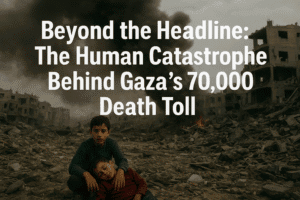
Beyond the Headline: The Human Catastrophe Behind Gaza’s 70,000 Death Toll
A Ceasefire in Name Only: The Killings Continue
On a Saturday in late November 2025, as the world was told a ceasefire was holding in Gaza, two more names were added to a grim ledger. Eight-year-old and eleven-year-old brothers were killed by an Israeli drone strike near a school sheltering displaced people in Beni Suheila . Their deaths were not an anomaly in a time of peace but a stark illustration of a devastating reality: even during a negotiated pause in hostilities, violence and death continue unabated. This incident, reported by the Associated Press, underscores the tragic paradox of the Gaza war—a conflict where formal truces have failed to stop the bleeding.
The reported killing of these children brings into sharp focus the fragility of the ceasefire that took effect on October 10, 2025. According to UN experts, Israel has committed at least 393 violations of the ceasefire, resulting in the deaths of 339 Palestinians, including more than 70 children, and injuring over 871 others since the truce began . UNICEF reports that an average of two children have been killed every day during this so-called “pause” in hostilities . These are not mere statistics but represent a fundamental breakdown of the agreement intended to protect civilians.
The Mounting Toll: Understanding 70,000 Deaths
The Gaza Health Ministry’s announcement that the Palestinian death toll has surpassed 70,100 marks a horrific milestone in a war now stretching into its third year. This figure, however, only tells part of the story. To comprehend its full weight, we must understand what it represents in human and demographic terms.
According to scholarly analysis, approximately 80% of Palestinians killed are believed to be civilians . The demographic breakdown is particularly harrowing: children have consistently represented a devastatingly high proportion of fatalities. At various points in the conflict, estimates showed children comprising between 30% to 44% of those killed . As of November 2025, the Palestinian Ministry of Health in Gaza reported that the confirmed killed included at least 20,179 children . This means one in every four people killed has been a child.
The Lancet published a peer-reviewed analysis in January 2025 estimating that traumatic injury deaths likely exceeded 70,000 by October 2024, with 59.1% being women, children, and the elderly . Perhaps most alarmingly, the study concluded that the Gaza Health Ministry’s counts likely undercounted trauma-related deaths by 41%, not accounting for “non-trauma-related deaths resulting from health service disruption, food insecurity, and inadequate water and sanitation” .
The social devastation extends beyond immediate fatalities. As of September 2025, 2,596 children had lost both parents, while 53,724 children had lost one parent . An entire generation is being shaped by unimaginable loss.
The Mechanics of a Fragile Truce: Why the Ceasefire Fails to Protect
The persistent violence during the ceasefire period reveals fundamental flaws in both the agreement’s design and implementation. The Al Jazeera analysis indicates that Israel has attacked Gaza on 41 out of 52 days since the ceasefire began, meaning there were only 11 days without reported violent attacks, deaths, or injuries . This pattern of near-daily violations suggests the ceasefire exists more on paper than in practice.
Several key issues undermine the truce:
- Contested Violations and Reciprocal Strikes:Both sides accuse each other of violating the agreement. The Israel Defense Forces (IDF) claims Palestinian terror groups have violated the ceasefire at least18 times through attacks, hostage return issues, and crossing established boundaries . Israel positions its strikes as responses to these violations. However, as UNICEF spokesperson Ricardo Pires noted, “There’s only one party to the conflict in Gaza with the firepower to do airstrikes” . This power asymmetry means violations by one side result in disproportionately deadly consequences.
- The “Yellow Line” and Continuous Control:The ceasefire agreement stipulated an Israeli withdrawal to a “yellow line,” yet reports indicate thatover 58% of Gaza remains under Israeli military control, with 40 active Israeli sites still operating beyond the agreed withdrawal line . This continued presence creates constant friction points and opportunities for violent incidents, particularly when Palestinians approach or cross these boundaries, often while searching for food or returning to damaged homes.
- Humanitarian Access Remains Strangled:Despite ceasefire terms calling for “full aid” to be sent into Gaza, the reality remains bleak. The World Food Programme reports onlyhalf the required food aid is reaching Gaza, while Palestinian relief agencies say total deliveries amount to just one-quarter of what was agreed . From October 10 to November 29, only 6,102 aid trucks reached their intended destinations inside Gaza—far below both needs and commitments . This forced scarcity drives civilians into dangerous movements that often end in violence.
The Broader Context: Genocide Findings and International Response
The ongoing violence occurs against the backdrop of damning international legal assessments. In September 2025, the UN Independent International Commission of Inquiry concluded that Israel has committed genocide against Palestinians in the Gaza Strip . The Commission found Israeli authorities responsible for four of the five genocidal acts defined by the 1948 Genocide Convention: killing, causing serious bodily or mental harm, deliberately inflicting conditions of life calculated to bring about destruction, and imposing measures intended to prevent births .
Commission Chair Navi Pillay stated, “It is clear that there is an intent to destroy the Palestinians in Gaza through acts that meet the criteria set forth in the Genocide Convention” . The report specifically identified Israeli President Isaac Herzog, Prime Minister Benjamin Netanyahu, and then Defence Minister Yoav Gallant as having “incited the commission of genocide” .
The international response has been fragmented. In November 2025, the UN Security Council adopted Resolution 2803, authorizing an International Stabilization Force in Gaza as part of a U.S.-backed comprehensive plan . The resolution passed with 13 votes in favor, none against, and 2 abstentions (China and Russia) . However, the plan has faced criticism for ambiguity, particularly regarding the political future of Palestinians. China’s representative noted the text was “vague and unclear” and that “Palestine is barely visible in the draft” . Several nations expressed concern over the “absence of explicit reference to the two-State solution” .
The Human Cost Beyond the Death Toll
The 70,000+ death count represents only direct fatalities. The war’s full human impact is exponentially greater:
The Injury Crisis: More than 170,985 people have been injured according to November 2025 figures . Many suffer life-altering wounds. By late-June 2024, a Palestinian NGO reported that as many as 10,000 Palestinians had been disabled by war-related injuries . Gaza now has the most amputated children per capita in the world .
The Health System Collapse: Gaza’s healthcare infrastructure has been systematically devastated. Major hospitals are only partially functional, with urgent need for restoration, equipment, and supplies . UNICEF reports around 4,000 children waiting for medical evacuation, including those with severe burns, shrapnel wounds, spinal and brain injuries, cancer, and congenital conditions requiring surgery unavailable in Gaza .
The Psychological Trauma: A survey by the Palestinian Center for Policy and Survey Research (PCPSR) showed over 60% of Gazans have lost family members since the war began . The psychological impact on an entire population, particularly children, will resonate for generations.
The Famine Conditions: Despite some market activity, food insecurity remains catastrophic. World Food Programme staff report that while markets have returned, prices are “out of reach for most people”—with a chicken costing $25 and a kilo of meat $20 . One mother told aid workers she doesn’t take her children to market “so that they won’t see all the food that’s available” .
Looking Forward: Between Stabilization Forces and Unfinished War
The U.S. blueprint for Gaza’s future, including the international stabilization force, represents an attempt to create a pathway out of the violence. The force is authorized to “deploy under a unified command to secure Gaza’s streets, oversee demilitarization, protect civilians and escort aid through safe corridors” while Israel phases out its presence .
However, significant challenges loom:
Hamas’s Survival Strategy: Despite military pummeling, Hamas maintains a strategy focused on survival and ending the war on terms that preserve its existence . Analysts note Hamas believes time plays to its benefit as Israeli military exhaustion grows and international pressure mounts over humanitarian conditions .
The Reconstruction Challenge: With tens of thousands of buildings destroyed and basic infrastructure devastated, rebuilding Gaza represents a monumental task estimated to cost at least $70 billion . This reconstruction must occur amidst ongoing insecurity and political uncertainty about who will govern Gaza.
Accountability and Justice: UN experts warn that “there can be no lasting peace without accountability for the crimes committed since 7 October 2023” . They express concern that justice is absent from current arrangements, stating that after “two years of genocidal assault, this ‘peace plan’ risks adding insult to injury” .
Conclusion: The Weight of Numbers and the Urgency of Action
The figure “70,000” is more than a headline—it represents a catastrophic failure of the international community to protect civilians. Each number corresponds to a life with aspirations, relationships, and inherent dignity. The continued killing of children during a supposed ceasefire reveals the hollow nature of diplomatic achievements that don’t translate to protection on the ground.
As winter approaches in 2025, with tens of thousands homeless, a health system in collapse, and famine conditions persisting, the people of Gaza face multiple converging crises. The international stabilization force authorized by the UN represents one mechanism for change, but its success depends on genuine political will, adequate resources, and most importantly, an immediate end to the violence that continues to claim lives daily.
The death of two brothers on a Saturday in November should serve as a urgent reminder: until ceasefire agreements are respected and enforced, until humanitarian access is fully realized, and until a political solution addressing root causes is genuinely pursued, the toll will continue to rise, and the world’s collective conscience will bear the stain of each preventable death.
You must be logged in to post a comment.