
Beyond the Headline: The Arrest of an Air India Pilot and the Unseen Safeguards of Modern Aviation
The late-December arrest of an Air India pilot at Vancouver International Airport, following a breach of the strict 12-hour “bottle-to-throttle” rule, serves not as an indictment of aviation safety but as a powerful demonstration of its robust, multi-layered defense system. While the incident highlights the ever-present human factor and the intense pressures of the profession, the subsequent chain of action—from the initial colleague’s “report of concern” that triggered the arrest, to the flight delay for a replacement crew, and finally to Transport Canada’s forceful warning threatening the airline’s operating authorizations—reveals the effective interplay of peer vigilance, corporate procedure, and stringent national oversight. This proactive interception of risk before departure underscores that modern air travel is secured not by the infallibility of individuals, but by a resilient culture of enforcement and transparency designed to ensure that such breaches are caught on the ground, thereby validating the very protocols that keep passengers safe.
Beyond the Headline: The Arrest of an Air India Pilot and the Unseen Safeguards of Modern Aviation
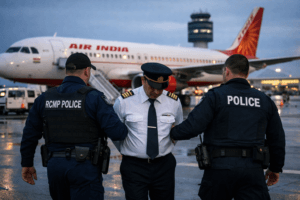
The news is stark and unsettling: a pilot, entrusted with hundreds of lives, arrested at Vancouver International Airport just hours before a trans-Pacific flight. The immediate details from December 23, 2025, are sparse—a “report of concern,” an arrest by Richmond RCMP, a delayed but ultimately safe departure of Air India Flight 188 to Delhi. Yet, Transport Canada’s subsequent warning to Air India, threatening the suspension of its flight authorizations, signals this is more than an isolated personnel issue. It is a profound window into the multilayered, often invisible, safety architecture that protects air travel, and a stark reminder of the human vulnerability at its core.
The Incident and The Immediate Ripple Effect
While police investigations remain ongoing, the alleged violation centers on Canada’s strict, non-negotiable aviation regulation: a mandatory 12-hour “bottle-to-throttle” rule, prohibiting pilots and crew from consuming alcohol or being under its influence while on duty. This zero-tolerance policy is a global standard, the bedrock of pre-flight fitness. The arrest at the gate suggests the breach was detected not in the air, but on the ground—likely through the crew member’s behavior, a report from vigilant colleagues, or routine pre-flight checks. This is the system working as a first line of defense, however alarmingly.
The immediate operational response was a several-hour delay. For passengers, this was an inconvenience; for aviation safety managers, it was a textbook procedure. The aircraft did not depart until a new, fully vetted flight crew was secured. This swift, costly substitution underscores a critical principle: no schedule, no financial pressure, ever trumps a confirmed safety concern. The aircraft, a complex machine worth hundreds of millions, was rendered immobile by the single variable of human readiness.
Transport Canada’s Warning: A Matter of Sovereign Oversight
Transport Canada’s statement is where the incident escalates from personnel discipline to diplomatic and regulatory gravity. By publicly warning Air India that non-compliance could lead to suspended authorizations, Canada is exercising its authority as a host nation. While the Directorate General of Civil Aviation (DGCA) of India holds primary regulatory oversight over Air India, every country grants the right to operate within its airspace as a privilege, contingent on adhering to local laws and safety standards.
This dynamic creates a fascinating dual-layered accountability. The DGCA will conduct its own investigation, potentially revoking the pilot’s license and mandating airline-wide reforms. Concurrently, Transport Canada’s scrutiny ensures that the airline’s operations on Canadian soil meet its specific, stringent benchmarks. The threat of losing flight authorizations is the nuclear option—a move that would sever a key air link between Canada and India, with massive economic and political repercussions. Its mere mention is a calibrated tool to ensure immediate and serious corrective action from the airline’s highest levels.
The Human Factor: Stress, Culture, and the Pressure of the Pinstripes
To view this incident solely through a lens of individual failing is to miss a crucial dimension. Piloting, especially long-haul routes across multiple time zones, is a profession of extreme pressure, erratic sleep patterns, and isolation. The psychological burden of perpetual responsibility, coupled with layovers in foreign cities, can create a perfect storm for poor judgment.
This is not to excuse a breach of the most fundamental rule, but to understand it within the ecosystem of modern aviation. Airlines have a profound responsibility not just to enforce rules, but to foster a culture where seeking help for stress, fatigue, or personal issues is not stigmatized, but encouraged. The “report of concern” that preceded the arrest is a positive indicator of such a culture—a colleague or crew member felt empowered to speak up, potentially averting a catastrophe. This “see something, say something” ethos within crew ranks is as vital as any mechanical check.
A Historical Context: Lessons from the “Swiss Cheese Model”
Aviation safety is built on the bones of past tragedies. The industry operates on the “Swiss Cheese Model” of accident prevention, where multiple layers of defense (training, regulations, technology, crew resource management) aim to cover the holes that might appear in any single layer. Historically, accidents have rarely been caused by one failure, but by a sequential alignment of holes in several slices.
In this case, the layers worked. The potential hole—an impaired crew member—was blocked by other layers: peer reporting (corporate culture), pre-flight oversight (airport/airline procedures), and regulatory enforcement (RCMP, Transport Canada). The incident is a real-world stress test of the model, demonstrating that while the human element can be unpredictable, the system surrounding it is designed to be robust.
What This Means for the Traveling Public: Trust, Not Fear
For passengers, news of this nature can instinctively erode trust. Yet, the informed takeaway should be the opposite. This event is a powerful demonstration of the system’s self-policing rigor. The breaches that make headlines are almost always prevented breaches. They are caught by the very safeguards the public rarely sees.
The true danger lies not in the reported incidents, but in the cultures where reporting is suppressed, where schedules override safety, and where regulators are complacent. Transport Canada’s forceful response and the public transparency are hallmarks of a healthy aviation safety culture. It signals that the oversight is active, aggressive, and unafraid to confront a foreign flag carrier.
The Path Forward: Beyond Punishment to Systemic Resilience
The follow-up will be critical. For Air India, which is undergoing a massive transformation under new ownership, this is a public test of its renewed commitment to safety. Its response must go beyond punishing the individual. It should involve a top-down review of its layover protocols, crew wellness programs, and the robustness of its pre-flight reporting systems. It must reaffirm to its entire staff that the company’s shield is the employee who speaks up about a concern.
For the global aviation community, it’s a reminder that the war on human error is never won, only managed. Continuous investment in predictive analytics for crew fatigue, destigmatized mental health support, and reinforced international regulatory cooperation are the next frontiers.
Conclusion: The Unseen Vigilance
The image of a pilot being led away from his aircraft is jarring because it contradicts the archetype of infallible control. But modern aviation safety is not founded on infallible humans; it is built on the premise that humans are fallible, and systems must be designed accordingly. The arrest in Vancouver is not a story of a system breaking down, but of multiple systems—corporate, peer-to-peer, national, and international—snapping into place to intercept a risk before it left the ground.
It reaffirms that every flight we board is protected not just by the skill of two people in the cockpit, but by an intricate, global web of rules, watchdogs, and a culture of vigilance that, even at 35,000 feet, keeps its feet firmly on the ground. The real story isn’t that a pilot was arrested; it’s that because he was, 300 passengers arrived in Delhi safely, unaware of the silent guardians that ensured their journey.
You must be logged in to post a comment.