
Beyond the Headline: South Africa’s Gaza Visa Move—A Deep Dive into Geopolitics, Principle, and Human Desperation
In a significant gesture of solidarity, South Africa granted a 90-day visa exemption to over 150 Palestinians from Gaza who arrived without required documents or departure stamps, prompting Palestine to express formal gratitude for the sovereign decision. While commending the humanitarian act, the Palestinian Foreign Ministry simultaneously issued a stark warning against entities exploiting the dire situation through human trafficking and deceptive relocation schemes, vowing legal consequences for such practices.
This move reinforces South Africa’s consistent political stance, following its ICJ case accusing Israel of genocide, and highlights the tragic dilemma faced by Gazans desperate to escape the ongoing conflict, balancing immediate humanitarian relief against the broader political imperative of preserving their homeland and preventing a permanent, disorderly exodus.
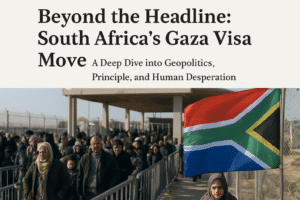
Beyond the Headline: South Africa’s Gaza Visa Move—A Deep Dive into Geopolitics, Principle, and Human Desperation
The image of 153 weary travelers, their passports lacking the official stamps that dictate modern mobility, stepping onto South African soil is more than a heartwarming humanitarian gesture. It is a potent geopolitical symbol, a narrative of defiance, and a stark window into the fragmented reality of Palestinian life. When the Palestinian Foreign Ministry issued its formal gratitude to South Africa, it was acknowledging an act that transcends border policy, touching upon raw nerves of international law, solidarity, and the relentless search for safety.
This event is not an isolated incident but a critical data point in the evolving story of the Palestinian struggle and the nations willing to stake their reputation on it. Let’s unpack the layers of this decision and its far-reaching implications.
The Act of Defiance: Sovereignty in the Service of Solidarity
South Africa’s decision to grant a 90-day visa exemption was notably assertive. The passengers arrived from Kenya, having originated from Israel’s Ramon Airport, a key detail that hints at a complex and likely arduous journey. They lacked customary departure stamps—a common reality for Palestinians exiting through Israeli-controlled crossings, where formal entry and exit stamps are often withheld, rendering their travel documents a chronicle of bureaucratic ambiguity.
Initially denied entry for failing required interviews, their fate seemed sealed. Yet, in a dramatic reversal, the South African government exercised its sovereign right to bypass its own regulations. The Palestinian statement carefully “respects” this “sovereign decision,” highlighting that it was made “without any prior notification or coordination.” This phrasing is diplomatic, but it underscores a critical truth: this was a political choice, made at a high level, to prioritize human need over procedural rigidity.
In a world where border walls are rising and asylum pathways are narrowing, South Africa’s move is a radical act of what some might call “compassionate sovereignty.” It stands in direct contrast to the policies of many Western nations, which, despite their vocal concerns, have been slow to create tangible, large-scale evacuation or asylum routes for Gazans.
The Shadow of “Human Trafficking”: A Ministry’s Grave Warning
Perhaps the most revealing part of the Palestinian Foreign Ministry’s statement is its stark warning against companies and entities that “deceive Palestinians and incite them to relocate or migrate,” accusing them of being involved in “human trafficking and exploiting dire humanitarian conditions.”
This is not mere rhetoric. It points to a grim underground economy that thrives in war zones. For Palestinians in Gaza, where over two years of devastating conflict have left over 69,000 dead, 170,000 injured, and the infrastructure in ruins, the temptation to seek any way out is overwhelming. Unscrupulous agents can exploit this desperation, charging exorbitant fees for fraudulent promises of safe passage, visas, or jobs abroad. Victims can find themselves stranded in third countries, indebted, and with even less legal protection than before.
By vowing that these entities “will bear the legal consequences,” the Palestinian authority is performing a crucial dual function:
- Protecting its Citizens: It is acting as a responsible government, trying to shield a vulnerable population from predatory networks.
- Asserting its Agency: In the face of a narrative of displacement, the Ministry is forcefully stating that the future of Palestinians should not be decided by traffickers or chaotic, uncoordinated exoduses. It is a fight for an orderly, dignified political future over a fragmented, desperate one.
The Consistent Thread: South Africa’s Longstanding Stance
To view this visa decision in a vacuum is to miss its true significance. It is the latest, most tangible manifestation of South Africa’s foreign policy, which is deeply informed by its own history of apartheid.
The African National Congress (ANC)-led government has long drawn parallels between the Palestinian struggle and its own fight against white minority rule. This is not a recent, opportunistic position. It is a cornerstone of its identity in the Global South.
The landmark event that crystallized this stance was South Africa’s case at the International Court of Justice (ICJ) in December 2023, where it accused Israel of failing to uphold its commitments under the 1948 Genocide Convention. That move was a legal and diplomatic cannonball; this visa exemption is a humanitarian and political follow-through. It aligns principle with practice. By accepting these 153 Gazans, South Africa is effectively saying: “We not only argue your case in the world’s highest court, we will also open our doors to your people in their hour of need.”
This consistency builds immense moral credibility, particularly in the developing world, and positions South Africa as a leading, alternative voice in a global order often dominated by the U.S. and its allies.
The Bigger Picture: Displacement, Dignity, and a Disappearing Homeland
Beneath the political and legal analyses lies the profound human tragedy of displacement. The people of Gaza are not just suffering a military onslaught; they are facing the erosion of their homeland. For many, the choice is between staying in a shattered, besieged territory with an uncertain future or risking everything on a perilous journey to an unknown one.
The Palestinian Ministry’s instruction to its embassy in South Africa “to preserve the dignity and humanity of the Palestinian citizens” is a poignant and telling phrase. It speaks to a core fear: that in the process of becoming refugees, Palestinians lose their identity, their history, and their agency. The fight for a political solution is, at its heart, a fight for the right to a dignified life in one’s own land.
South Africa’s action, while compassionate, also forces us to confront an uncomfortable question: in the absence of a viable political process, are ad-hoc humanitarian visas the best the international community can offer? It is a lifesaving measure for 153 people, but it does not address the root cause that creates the need for such measures for millions more.
Conclusion: A Gesture with Global Reverberations
South Africa’s acceptance of these Gazan citizens is a story with multiple, intertwined endings.
- For the 153 individuals, it is a story of respite and a 90-day chance to rebuild.
- For South Africa, it is a story of solidified principle, enhancing its leadership role in the Global South and drawing a clear line in the sand on its foreign policy.
- For the Palestinian Authority, it is a story of managing a crisis, protecting its people from exploitation, and navigating the treacherous waters between gratitude for aid and the imperative to resist permanent displacement.
- For the world, it is a challenge. It highlights the failure of a collective international response to both end the violence and create legal, safe pathways for those fleeing it. It places the issue of Palestinian asylum squarely on the table, a topic many governments have been reluctant to address formally.
In the end, this event is a microcosm of the entire conflict—a blend of high politics and profound human suffering. South Africa has offered a chapter of hope for 153 souls, but the larger book on the future of Palestine remains tragically unwritten. The world is watching, and the pressure is now on other nations to answer: where do you stand, and what are you willing to do?
You must be logged in to post a comment.